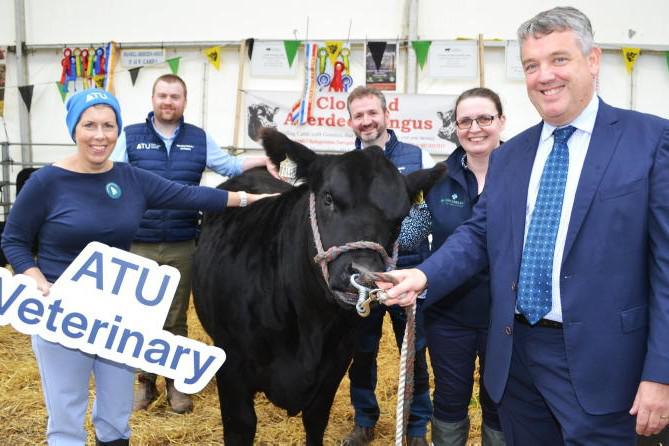
Veterinary education in Ireland is taking a major step forward as plans to expand the country’s capacity to train vets come to fruition. For decades, aspiring Irish vets only had one option to study veterinary medicine in Ireland, which was the long-established programme at University College Dublin.
Finally, the landscape is changing with the Government’s Veterinary Activation Programme (VPAP), first announced in September 2024. This set in motion the creation of two new veterinary medicine schools at South East Technological University (SETU) and Atlantic Technological University (ATU).
After months of planning, approvals, infrastructure and faculty development, both colleges will begin to welcome their first cohort of students in September 2026. With 80 additional veterinary places annually to come on stream as a result.
Studying abroad
The development of new courses acknowledges and addresses the long-standing shortages of veterinary places in the country, forcing hundreds of Irish students to go abroad to pursue degrees, simply because there were too few places at home.
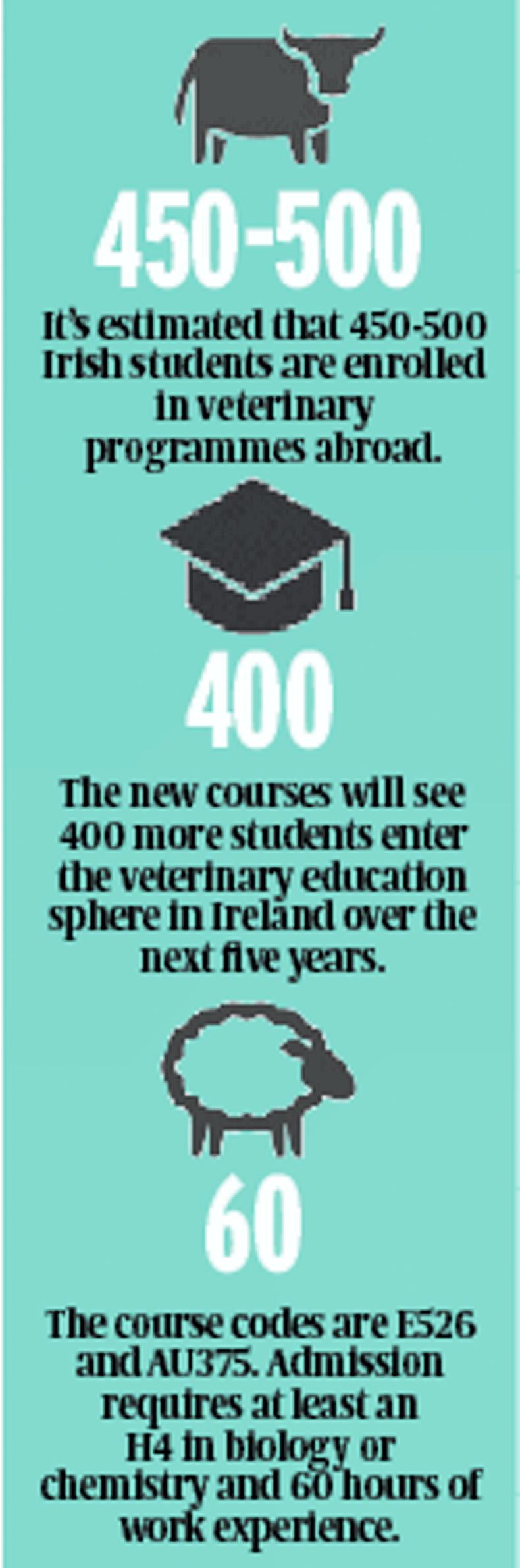
In recent years, it’s estimated that between 450-500 Irish students have been enrolled in veterinary programmes in Poland, Hungary and Slovakia, with the Warsaw University of Life Sciences and the University of Veterinary Medicine in Budapest among the favourites.
Over the next five years, the new courses will see 400 more students enter the veterinary education sphere in Ireland. This will hopefully have a knock-on effect on the number of vets practising in rural areas.
SETU programme
Dr Mary-Kate Burke started at SETU in April 2024 as the veterinary medicine programme development lead before being appointed as head of veterinary medicine in 2025.
“We needed to develop the curriculum and tease out the logistics of the distributed clinical network, which is a new model for Ireland. It made sense for there to be a veterinary programme here as we already had a diverse range of expertise across pharmaceutical science, animal science, biology and microbiology,” says Mary-Kate.
The programme is a five-year course divided into a foundation phase (first two years), a clinical phase (third and fourth year), and a professional phase (fifth year). It emphasises hands-on learning, with students spending significant time on campus and at Teagasc, Kildalton.
“Something we want to concentrate on is making sure students understand the ‘why’ – not learning anatomy for the sake of it, but giving them clinically relevant examples. This will start from day one.”
In the first two years, students will spend three to three and a half days a week on the SETU campus in purpose-built and clinical skills labs. The rest of the time will be spent in Kildalton, with free buses running between campuses.
“In third and fourth year, students will take all the underpinning knowledge and start learning about how vets treat and diagnose animals, perform surgery, anaesthesia, etc. There will be a big focus on on health, how animal health, human health and environmental health all connect, because vets play a very important role in that,” says Mary-Kate.
The scaffolded active learning model means students apply what they learn immediately. In their final year, students will move on to rotations in SETU’s clinical network.
“Over 29 partner practices have been inspected so far to make sure that they reach not only a clinical standard, but that the facilities and everything reach the accreditation standards. They’re going to be trained educators, resulting in a more structured experience than seeing practice, which is a very valuable experience,” explains Mary-Kate.
Entry requirements
The course code on the CAO is SE526, and admission requires at least an H4 in biology or chemistry and 60 hours of work experience. There is no third language required, and SETU have allocated 15% of places to mature students, along with DARE and HEAR applicants.“Students need to complete 60 hours of work experience and provide evidence of that. With 30 hours of that focused on the large animal and 30 hours focused on small animals. That placement could be done on a vet practice, a stud farm or a normal farm. Cutting silage doesn’t count, and it can’t be a family relative’s farm,” explains Mary-Kate.
Students need to have their work experience completed and documents uploaded through the CAO before the Change of Mind facility closes.
ATU programme
Prof Patrick Pollock, head of veterinary medicine and surgery at ATU, has 25 years’ experience working in veterinary education, surgery and remote and rural medicine.
“There was no question that there was a job of work to do, and as veterinary educators, we needed to go at it from a new angle. The shortage of vets in rural areas is only going to get worse unless we address it,” says Patrick.
Across the five-year programme, a large component of what the ATU course will deliver is set out by the accreditors. This includes pathology, anatomy, diseases, public health component and food safety.
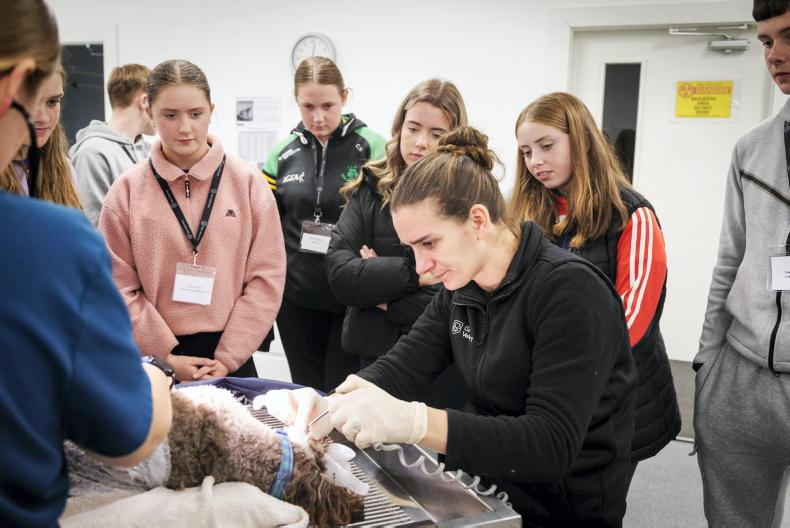
“What we’ve tried to do is break the silos down and create a very hands-on, practical component with clinical involvement from the very beginning. A cornerstone of that was the decision that anybody who was teaching a clinical aspect would be an active clinician. We also have a component of interprofessional education,” explains Patrick.
The programme is a systems-based spiral curriculum taught system by system instead of species by species.
“In the first two years, we visit those systems in health and then in the third and fourth years, we visit those systems in disease. In final year, there is a professional phase of the programme where students go into clinical practice,” he explains.
There will also be a lot of simulation-based education to allow students to become proficient in a very safe space before having to practise on a live animal.
“We have also embedded a lot of stuff on professional skills, human factors and emotional intelligence. To try and produce resilient, broad-thinking individuals, we have modules around emergencies like animal rescue with the fire service,” says Patrick.
The collaboration with Mountbellew Agricultural College will see students spend the second semester of their second year there.
“There will be accommodation for them, and they will be immersed in animal handling in Ireland’s agricultural heartland. In the clinical part of the course, we will revisit Mountbellew to explore specific aspects. In final year, we will have some student rotations there as well,” explains Patrick.

Requirements
The difference in SETU and ATU entry requirements is that in addition to work experience requirements, ATU also has a situational judgement test, called the CASPER test.
“The test looks for empathy, ability to work on a team and communication skills. They are asked to record or write down free-text answers as a test of emotional intelligence,” explains Patrick.
The college is hoping this will moderate the points score.
“Someone with more points but lower emotional intelligence will get their points reduced. Someone with lower points but more emotional intelligence will get more points. This is a direct response to our profession, who say you’re recruiting the wrong people,” he explains. The course code for anyone interested in applying is AU375.
See setu.ie and atu.ie