



Women and girls in Ireland continue to be under-represented across STEM (Science, Technology, Engineering and Mathematics) fields.
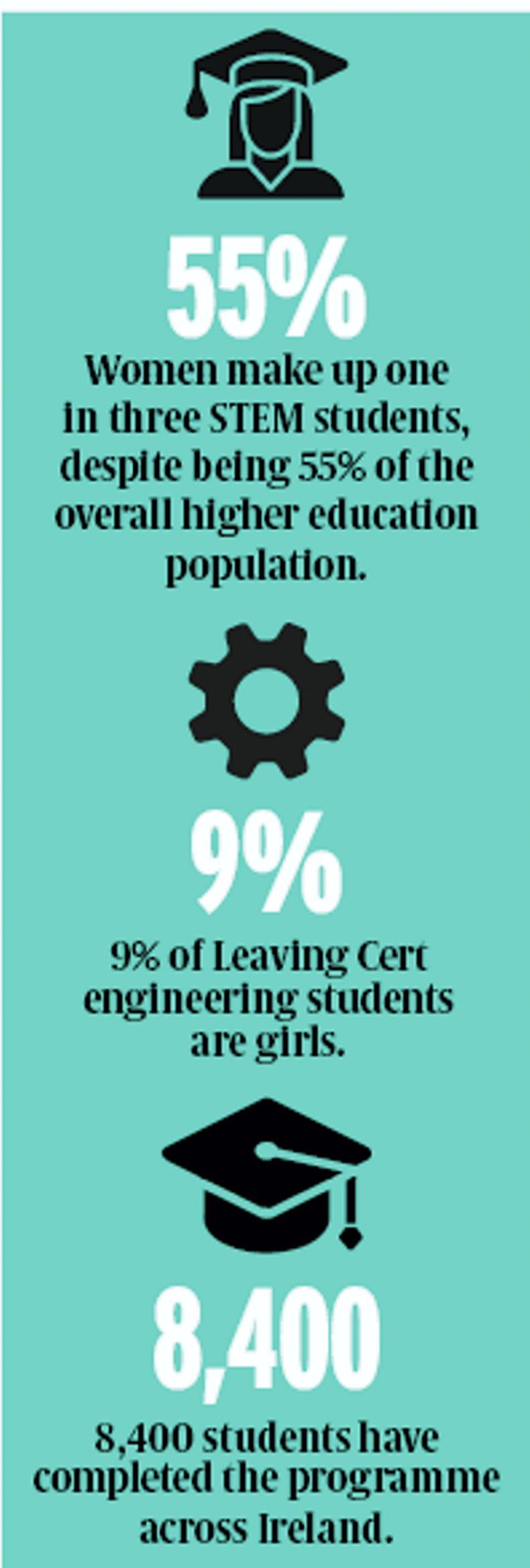
At third level, women make up one in three STEM students, despite being 55% of the overall higher education population.
In specific subjects, the gender imbalance is even more striking: 29% of Leaving Cert physics students are girls, 21% in computer science, 17% in technology, and as low as 9% in engineering – with availability being an issue.
The STEM Passport for Inclusion programme bids to address unequal access to STEM courses and careers among people from underserved communities. Since its pilot in 2021, the programme has expanded across 23 counties, reaching over 8,000 students, the majority of whom are girls from DEIS and rural schools.
Dr Katriona O’Sullivan developed the programme in 2020 to widen participation among women in STEM due to her own education journey and the lack of access to technology during the COVID pandemic, which specifically impacted girls from disadvantaged backgrounds.
“I was from a disadvantaged background. I never knew that I could be a scientist, that I’d be good at science, that I could analyse data. I thought I wasn’t that clever because I failed at school because of my circumstances. Then, I got into university and learned that I am clever and really good at science – I did neuroscience and then a PhD,” says Katriona, who is also the author of bestselling book Poor.
Passion
For a while Katriona was angered about the situation – and this later became passion, “to ensure that everybody gets a chance to demonstrate how good they are and learn that they can do this.”
What she came up with was a programme to ensure every girl leaves school with a STEM qualification, and they meet people who work in high-status professions that would encourage them to look at careers in this area.
“I’m really aware from research that girls are underserved in science, technology, engineering and maths across the board. But when we look at social class, it is especially bad. A lot of the time, the conversation is about the girl. [That] she’s not motivated enough, and she’s not confident enough when the system is the issue,” she explains.
The programme provides Transition Year (TY) students with a Level 6 NFQ university qualification, industry mentoring and educational supports to build confidence and bridge the digital skills gap.
As an accredited Level 6 programme, the STEM Passport qualification awards up to 60 Leaving Certificate bonus points toward higher-education entry, providing a tangible and equitable pathway from secondary school into university STEM courses.
The qualification aspect of the programme was hard to get over the line, but Katriona was adamant about including it to help break down barriers to accessing third-level education for this cohort.
“We hear about the HEAR and DARE scheme, but this recognises DEIS itself as having a disadvantage and science, particularly being disadvantaged.
“Some people really recognise that excellence is everywhere and opportunity is not. We need to shift things, especially around the gender problem in STEM. We need to do things radically and quickly if we are going to change things,” she explains.
Coding
If one person’s life is transformed as a result of doing this programme, that would have been enough for Katriona, but currently, 8,400 students have completed it across Ireland.
“Learning to code, learning about the Sustainable Development Goals, learning how to develop a product that is related to a challenge in the world, that’s all fun. In school, you’re rote learning a lot of the time, you’re sitting down, a teacher’s up the front. I knew the experience would be transformative, because students would experience the classroom in a different way,” explains Katriona.
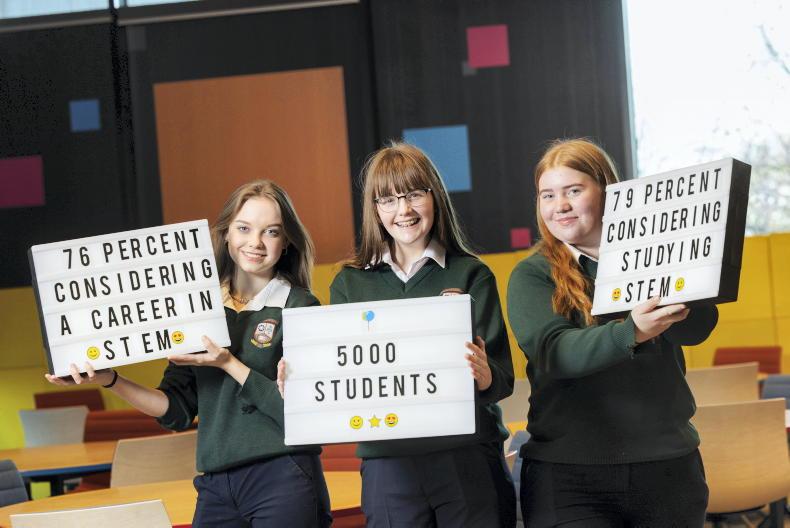
As a result, 79% of participants are now considering studying STEM at third level, 76% express interest in STEM careers, and awareness of STEM has risen from 45% pre-programme to 95% post-programme.
“We shouldn’t need my programme. The dream would be that I didn’t need to do this. The dream is that we have a system where everybody gets access to STEM equally and knows they can be whatever they want to be, but right now, we don’t have that,” she emphasises.
Josephine Wisniewski
Sixth-year student, Errigal College, Letterkenny, Co Donegal
“I started getting involved in stuff like engineering and STEM in TY when we got introduced to the STEM passport for inclusion course.
I had a narrow view of STEM, but the programme really changed that for me. I have applied for different courses on my CAO to do with engineering, and I wouldn’t see myself doing anything else
“It was cool because it wasn’t just like any other subject. We got to try out stuff like Python coding, which is used in the real world. I got involved in VEX Robotics later on. Along with a few of my classmates, we designed a prototype robot called Ecobot, and we won a competition and got to travel to Brussels as part of the Girls in STEM forum.
“It was really interesting to talk to all of the female mentors. I realised I could definitely see myself doing this in the future. Engineering is something that I’ve always been interested in, but the programme really helped me to settle that initial idea of doing it in college. I’ve always had a thing for problem-solving.
“I had a narrow view of STEM, but the programme really changed that for me. I have applied for different courses on my CAO to do with engineering, and I wouldn’t see myself doing anything else.
“It gave me a different view as it was very hands-on learning – it opened up so many possible pathways for me, and it also encouraged girls in my year to try STEM subjects. The way the digital economy is going, we need more people and female representatives to be ready for the future.”
Rachel Creedon
Second year engineering student, Frankfield, Co Cork
“For me, the bits that stuck out the most were working with microchips and coding boards. I ended up using that programming, micro-chips and Arduino breadboards in the first year of college, so I had an idea of what I was doing, which I found really beneficial. I am now studying engineering at Munster Technological University, Tralee. I’m in my second year, and I start my work placement in June. It’s very hands-on with workshops and labs – I’m loving it so far.
“The programme highlighted that STEM and specifically engineering was a career I could go into and a feasible option for me. Growing up, I always had the curiosity of how things work, but speaking to female mentors and hearing how many women are in the field made it more visible. I could see myself doing it.
“I was in an all-girls school, so subject options were very limited and I didn’t have great exposure to STEM subjects. I would have definitely done engineering, woodwork and metalwork, but it wasn’t an option.
“I would advise anyone interested in pursuing a degree in STEM to just go for it, don’t let the possibility being the only girl in the room be the barrier stopping you.”
Led by Prof Katriona O’Sullivan at Maynooth University in partnership with lead and founding partner Microsoft, the STEM Passport for Inclusion programme is funded by Research Ireland, the Department of Education and Youth and Microsoft, as well as by many industry and education partners.


SHARING OPTIONS