


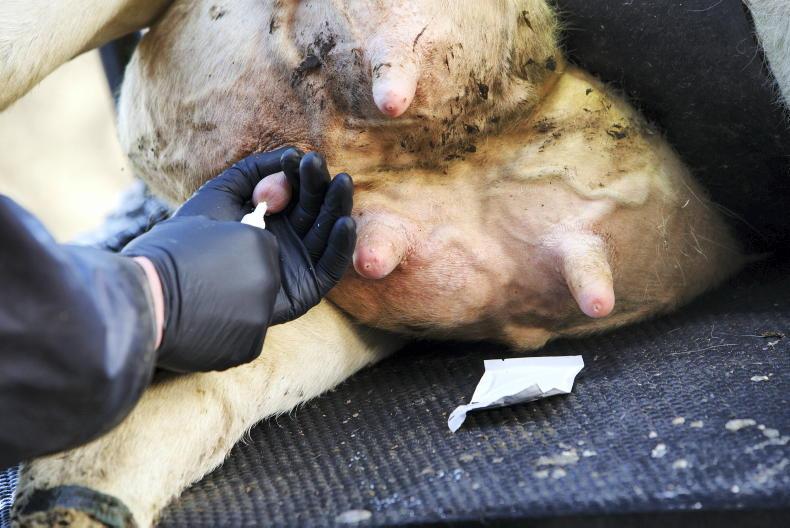
Teat sealing heifers is a bit of a controversial subject among farmers and advisers, with some recommending it and others saying ‘stay away’.
For me, the practice can offer benefits for farmers that have problems with high somatic cell count (SCC) and mastitis in first-calvers in the first few months of lactation.
There is evidence to say that many of these infections occur in the run-up to calving but only manifest themselves in the weeks and months after calving.
This puts the spotlight on heifer management prior to calving and indeed across the winter before calving.
Bagging up
There is also some anecdotal evidence that heifers are bagging up for longer before calving, with the teat canal open leading to milk drop.
Where this coincides with inadequate or poor housing or poor cubicle hygiene, inserting an artificial seal into the teat canal of heifers could be a good solution.
This is exactly what happens in cows, where sealer is used to prevent bacteria from entering the teat canal.
It’s use in dairy heifers has been on the go for a decade or more and while not universally practiced, those that do it tend to stay doing it.
Teagasc has carried out research on the practice which showed benefits, particularly where there is pre-existing mastitis or high SCC problems.
When to do it?
In terms of timing, the traditional advice has been to do it six to eight weeks prior to calving, but a growing number of farmers now carry it out at this time of year, when heifers are still at grass.
By doing it when they are still grazing, it reduces the chance of picking up infection immediately after being tubed, compared to heifers that are housed.
Regardless, hygiene is absolutely crucial and so too is safety. There are specialist operators who carry out the task, typically using turn-over crates so the heifers are fully restrained.
Teats should be thoroughly disinfected prior to administration and only one tube should be used per teat, even if there is product left over.
Finally, my advice for any farmer unsure about it is: if it’s not broken don’t fix it.
If SCC and mastitis incidence is low in first-calvers, then teat sealing heifers is unlikely to bring about any benefits but will increase costs and risk of infection.



SHARING OPTIONS