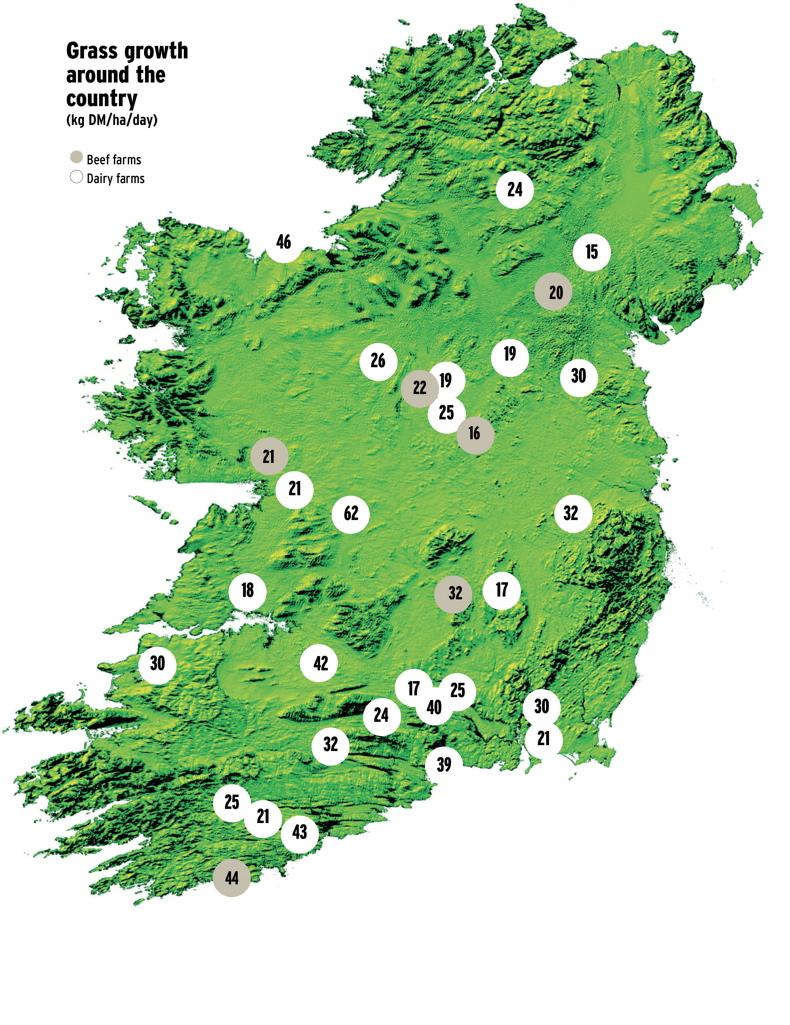
Grass growth rates on our Grass+ farms are averaging 29kg per day. This is more than twice the Moorepark 10-year average for the same week and is a real indicator of the extremely mild weather for the past few weeks.
This has been one of the best autumns in years, and gives us a great opportunity to make some extra cash from grass. While there is rain in the forecast for this weekend and next week, temperatures are to remain in the low teens, so growth rates should hold up well over the coming weeks.
What does this mean? As a result of higher than normal growth rates, there is more grass on the first grazed paddocks than expected and average farm covers have not declined by as much as was expected as the gap between grass demand, (what the cows eat) and grass supply (growth) has been less.
Covers
On the issue of grass covers on the first closed paddocks, I would be very slow to carry through the winter anything with a cover more than 1,250kg/ha. Many first closed paddocks have covers of 1,400kg on them now so I would advise to go back and graze these.
However, don’t lose sight of closing cover. Play around with the figures on your grass software package to see what effect grazing these paddocks will have on average farm cover. The target is to close at between 500kg/ha and 600kg/ha. Now, with growth rates higher than normal, perhaps there is scope to take a risk and go lower than that, in the expectation that growth rates will continue to be higher than normal for the next few weeks.
This is where the cash will be made – by saving money on silage and meal.

Growth rates are more than twice normal levels.Walk your farm to assess average farm cover.Don’t carry over covers greater than 1,250kg/ha.Take advantage of the weather to make some extra cash.Target to close up at between 500-600kg/ha, more if demand is higher next spring. Steven Fitzgerald
Curtins Farm
Stocking Rate (cows/ha) 2.96
Growth Rate (kg/day) 32
Average Farm Cover (kg/ha) 780
Yield (l/cow/day) 14
Fat % 5.64
Protein % 4.37
Milk Solids (kg/cow) 1.44
Supplement Fed (kg/cow/day) 2m/3s
At the moment, 70% of the farm is grazed and, based on current grass covers, we will have enough grass to last until 20 November. The empty cows are being sold this weekend so that will lower demand. There is a cover of 950kg on the first closed paddock. This was grazed on 2 October.
Yield is holding steady, but would be lower if we hadn’t dried off some of the lowest-yielding cows last week. Fat and protein is powering ahead, breaking the 10% mark for the first time. We will be drying off more of the cows over the coming weeks. We are still feeding 3kg of silage after milking.
Donal Patton
Teagasc Ballyhaise
Stocking Rate (cows/ha) 2.9
Growth Rate (kg/day) 26
Average Farm Cover (kg/ha) 718
Yield (l/cow/day) 14.35
Fat % 5.03
Protein % 4.29
Milk Solids (kg/cow) 1.38
Supplement Fed (kg/cow/day) 3
We housed the cows for a couple of nights last weekend and will probably house by night again by this Friday. The target is to close at 650kg and we are getting close to that now, so by housing at night we will stretch the remaining grass for another 10 days or so. There is 90% of the farm closed. The first closed paddocks have covers of 1,400kg, which is more than I would like but we have to carry them through. We will continue to milk most of the herd indoors for all of November and then dry everything off by the middle of December. We have good-quality bales for when milking in the shed.
Denis Finnegan
Coachford, Co Cork
Stocking Rate (cows/ha) 2.93
Growth Rate (kg/day) 36
Average Farm Cover (kg/ha) 717
Yield (l/cow/day) 15.27
Fat % 4.87
Protein % 4.25
Milk Solids (kg/cow) 1.43
Supplement Fed (kg/cow/day) 2
There will be a big demand for grass here next spring as the stocking rate is increasing and more cows are calving in early February. To have enough grass, we are going to close at 650kg/ha. We set a target to graze 70% by 1 November and we managed to graze 68%, so I’m happy with this. The first closed paddock has a cover of 1,200kg now, but it was well grazed out and has good paddock access so I think we will carry it over the winter, even though it will have a cover of close to 2,000kg by the time it is grazed in mid-February. Last year, we grew 7kg/day over the winter. This year, I am hoping that we grow 5kg/day.
Bryan and Gail Daniels
Kilmoganny, Co Kilkenny
Stocking Rate (cows/ha) 1.91
Growth Rate (kg/day) 36
Average Farm Cover (kg/ha) 929
Yield (l/cow/day) 2.8
Fat % 5.1
Protein % 4.38
Milk Solids (kg/cow) 1.25
Supplement Fed (kg/cow/day) 1
Soil temperatures this week are an incredible 14 degrees, so grass is flying it. We are currently grazing some Italian ryegrass that is on the silage ground at the far end of the farm. We graze this in spring and autumn and find it a big help. We have 92% to calve in six weeks next year, so grass demand will be high. I want to close up at 650kg/ha. On a good year we might grow 3kg per day over the winter. I estimate we have grass for another 12 days. No silage has been fed and we are only feeding 1kg of soya hulls, so the milk we are producing is costing us very little to produce at the moment.
Read more
Grass+ beef: Heavy stock housed, with 20-25% of farms still to be grazed
Grass growth rates on our Grass+ farms are averaging 29kg per day. This is more than twice the Moorepark 10-year average for the same week and is a real indicator of the extremely mild weather for the past few weeks.
This has been one of the best autumns in years, and gives us a great opportunity to make some extra cash from grass. While there is rain in the forecast for this weekend and next week, temperatures are to remain in the low teens, so growth rates should hold up well over the coming weeks.
What does this mean? As a result of higher than normal growth rates, there is more grass on the first grazed paddocks than expected and average farm covers have not declined by as much as was expected as the gap between grass demand, (what the cows eat) and grass supply (growth) has been less.
Covers
On the issue of grass covers on the first closed paddocks, I would be very slow to carry through the winter anything with a cover more than 1,250kg/ha. Many first closed paddocks have covers of 1,400kg on them now so I would advise to go back and graze these.
However, don’t lose sight of closing cover. Play around with the figures on your grass software package to see what effect grazing these paddocks will have on average farm cover. The target is to close at between 500kg/ha and 600kg/ha. Now, with growth rates higher than normal, perhaps there is scope to take a risk and go lower than that, in the expectation that growth rates will continue to be higher than normal for the next few weeks.
This is where the cash will be made – by saving money on silage and meal.
Growth rates are more than twice normal levels.Walk your farm to assess average farm cover.Don’t carry over covers greater than 1,250kg/ha.Take advantage of the weather to make some extra cash.Target to close up at between 500-600kg/ha, more if demand is higher next spring. Steven Fitzgerald
Curtins Farm
Stocking Rate (cows/ha) 2.96
Growth Rate (kg/day) 32
Average Farm Cover (kg/ha) 780
Yield (l/cow/day) 14
Fat % 5.64
Protein % 4.37
Milk Solids (kg/cow) 1.44
Supplement Fed (kg/cow/day) 2m/3s
At the moment, 70% of the farm is grazed and, based on current grass covers, we will have enough grass to last until 20 November. The empty cows are being sold this weekend so that will lower demand. There is a cover of 950kg on the first closed paddock. This was grazed on 2 October.
Yield is holding steady, but would be lower if we hadn’t dried off some of the lowest-yielding cows last week. Fat and protein is powering ahead, breaking the 10% mark for the first time. We will be drying off more of the cows over the coming weeks. We are still feeding 3kg of silage after milking.
Donal Patton
Teagasc Ballyhaise
Stocking Rate (cows/ha) 2.9
Growth Rate (kg/day) 26
Average Farm Cover (kg/ha) 718
Yield (l/cow/day) 14.35
Fat % 5.03
Protein % 4.29
Milk Solids (kg/cow) 1.38
Supplement Fed (kg/cow/day) 3
We housed the cows for a couple of nights last weekend and will probably house by night again by this Friday. The target is to close at 650kg and we are getting close to that now, so by housing at night we will stretch the remaining grass for another 10 days or so. There is 90% of the farm closed. The first closed paddocks have covers of 1,400kg, which is more than I would like but we have to carry them through. We will continue to milk most of the herd indoors for all of November and then dry everything off by the middle of December. We have good-quality bales for when milking in the shed.
Denis Finnegan
Coachford, Co Cork
Stocking Rate (cows/ha) 2.93
Growth Rate (kg/day) 36
Average Farm Cover (kg/ha) 717
Yield (l/cow/day) 15.27
Fat % 4.87
Protein % 4.25
Milk Solids (kg/cow) 1.43
Supplement Fed (kg/cow/day) 2
There will be a big demand for grass here next spring as the stocking rate is increasing and more cows are calving in early February. To have enough grass, we are going to close at 650kg/ha. We set a target to graze 70% by 1 November and we managed to graze 68%, so I’m happy with this. The first closed paddock has a cover of 1,200kg now, but it was well grazed out and has good paddock access so I think we will carry it over the winter, even though it will have a cover of close to 2,000kg by the time it is grazed in mid-February. Last year, we grew 7kg/day over the winter. This year, I am hoping that we grow 5kg/day.
Bryan and Gail Daniels
Kilmoganny, Co Kilkenny
Stocking Rate (cows/ha) 1.91
Growth Rate (kg/day) 36
Average Farm Cover (kg/ha) 929
Yield (l/cow/day) 2.8
Fat % 5.1
Protein % 4.38
Milk Solids (kg/cow) 1.25
Supplement Fed (kg/cow/day) 1
Soil temperatures this week are an incredible 14 degrees, so grass is flying it. We are currently grazing some Italian ryegrass that is on the silage ground at the far end of the farm. We graze this in spring and autumn and find it a big help. We have 92% to calve in six weeks next year, so grass demand will be high. I want to close up at 650kg/ha. On a good year we might grow 3kg per day over the winter. I estimate we have grass for another 12 days. No silage has been fed and we are only feeding 1kg of soya hulls, so the milk we are producing is costing us very little to produce at the moment.
Read more
Grass+ beef: Heavy stock housed, with 20-25% of farms still to be grazed







SHARING OPTIONS