


Nineteen prospective dairy farm managers are currently six months into the first year of the new Professional Diploma in Dairy Farm Management. Many farmers will remember that previously the Farm Apprenticeship Board (FAB) would have governed agriculture training of farm managers in Ireland before it was integrated into Teagasc almost 10 years ago now.
This new and updated farm management diploma course is designed effectively to train up and coming students who want to go into farm management, either on their own dairy farm or some other farm.
To take part in the course you must at least have have completed the Green Cert in Agriculture. There is huge variation in background of the current group of students taking part in the diploma – some have completed a certificate in dairy, others in dry stock management and others have already finished degrees.
Most are from farming backgrounds (both dairy and beef) but some have no home farm. Geographically the students are from all over Ireland.
The one thing they all have in common is a passion for dairy farming and a belief that, especially with quotas going, dairying in Ireland can provide a successful and enjoyable career. This may be either on their home farm, as farm managers or perhaps in other farm business structures (e.g. share farming) which may develop in Ireland post 2015.
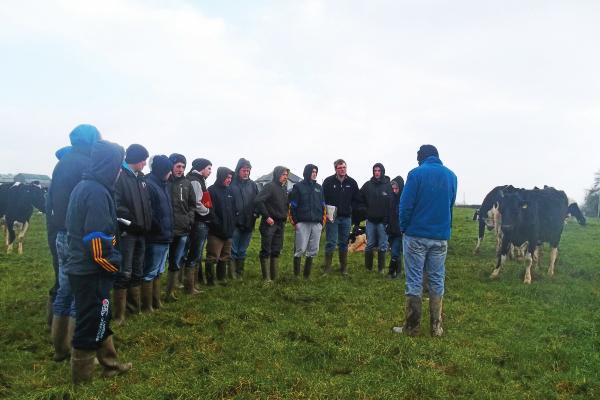
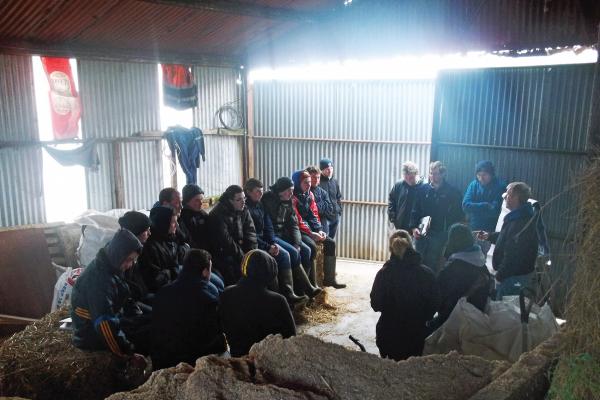
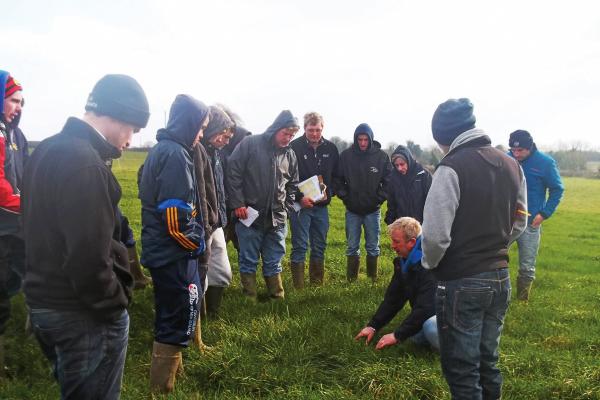
I met the group last week during their monthly discussion group meeting on the farm of Shane O Loughlin in Monasterevin, who is host farmer to student Ricky Oliver. Every month the group meet on one of the host farms and discuss current farm performance. Discussion is facilitated by James Ryan, Teagasc Kildalton.
Diverse systems
Host farms for those in training range in size from 160 to 600 cows, from spring calving systems to split calving and are located all over the country. This brings a wide variety of topics up for discussion at every meeting. Before the meeting students submit current information from their host farms – grass covers, cows calved, milk yield etc – and these are then reviewed when the group comes together.
On Shane’s farm both autumn and spring calving cows were at grass by day and ground conditions were excellent. The group’s consensus was that given the current grass availability on the farm, Shane could start grazing night and day with the cows and also let out the replacement heifers to try and achieve 33% grazed by 1 March.
He was also advised to go with nitrogen as soon as possible to encourage growth rates.
What impressed me about the group meeting was not just the discussion that took place but the focus on actions, hitting key profitability targets and the way the students were being held responsible for their farm’s figures. Students are not just placed on host farms simply to learn what the host does; they are there to query everything, explore other options and contribute to the farm’s performance in any way possible.
Course structure
Students are on their current host farms since the start of the course, September 2012, and will finish on these host farms next August. The option then exists to spend five months in New Zealand to experience the calving and breeding seasons on large scale, grass based farms. In January 2014 students will return to Ireland for another spell on an Irish host farm and they will complete the course on this farm in August 2014.
During the two years students have monthly discussion group meetings and also a total of six weeks breakout sessions in either Moorepark or Kildalton where students are lectured on the most up-to-date best practice on farm management.
Increasing scale and stocking rate requires skilled management. Trained farm managers will have the skills and experience to improve a farm’s performance.
Getting access to training from some of the best farmers in Ireland is a great foundation for a long and successful career in the Irish dairy industry.
Nineteen students are currently completing the Level 7 Professional Diploma in Dairy Herd Management.
Students spend two years working on farms and also complete modules in Moorepark and Kildalton.
Students have the opportunity to work on farms in New Zealand for five months during year two of the course.
Learning profitable and technically correct skills is essential for future farm management.
Name: Ruth Kerrigan
Background: From Newcastle, Co. Dublin. Non farming background.
Previous Education: Degree in Animal and Crop Production, University College Dublin.
Current host farm: Mitchell Hayes, Blarney, Cork.
Comment: I love the practical side of farming which is why I chose this course with its two years’ full work experience. As well as the practical we have modules in everything from animal health to farm business and expansion so I am still developing my theoretical knowledge. Both combined will hopefully give me the skills to be successful dairy farmer in the future.
Future plans: Obviously to own my own farm is the dream but this currently doesn’t look possible in Ireland. Share milking, like in New Zealand, would be brilliant as you wouldn’t just be employed on the farm but you could be linked to its performance which would make working there more enjoyable. I am definitely going to spend some time working in New Zealand but want to farm in Ireland long term.
Name: Ricky Fitzgerald
Background: From dairy farm in Cappoquin, Co. Waterford
Previous Education: Advanced Certificate in Dairy Herd Management
Current host farm: Kevin Twomey in Ballyhooley, Cork
Comment: I was already working on a farm but was encouraged to go back and complete this diploma to get an extra qualification. So far the course has delivered everything it promised. The breakout sessions in Moorepark are intensive but we get to learn from some of the experts in the country on profitable dairying. It’s great getting to know the other people in the course also. We are all progressive young people excited about the future of dairying in Ireland and want to be part of that.
Future plans: I plan to get five to seven years’ experience working on different farms and then possibly return home and grow our home farm. The experience I have got and will get over the next year will be invaluable and the challenge then will be to implement all the best that I have seen on our home farm.
Name: Sean O Connor
Background: From beef and sheep farm near Cahir, Tipperary
Previous Education: Advanced Certificate in Dry Stock Management
Current farm: Eddie and Denis O Donnell, Golden, Co. Tipperary
Comment: During my placement doing the dry stock course I worked on a dairy farm with a beef enterprise and this ignited my interest in dairying. My father advised that if I had an interest then this was the course to do. The amount you learn is huge; between working on this farm, going to Moorepark and also the monthly discussion group meetings where you hear what everyone else is doing.
Future plans: I am definitely going to go to New Zealand, either for six months as part of the course or maybe I will find another Irish farm and after I complete the course I will go there for a year. I will continue to work on dairy farms gaining experience. The experience I am getting now will stand to me in a big way when I return home to farm.
Name: Enda Keaveney
Background: From dairy farm in Ballymoe, Galway.
Previous Education: Degree in construction management from GMIT and Edinburgh.
Current farm: John Payne, Moydow, Co Longford
Comment: A career in dairying at the minute looks really optimistic. For me it’s not just that but the way dairy farming is evolving; from grass measuring to animal breeding there is a lot of science that can deliver huge returns to farmers. In the course we get lectured on the technical detail which maybe you don’t use every day but it’s still good to know in the background. I would definitely recommend it to anyone considering a future in dairying.
Future plans: My parents are currently milking 70 cows at home and I plan to return home eventually and potentially grow the business. I will continue to gain as much experience as I can and plan to go to New Zealand for six months as part of the course. Seeing how dairy farms work out there and picking up what will and won’t work for farms back here is something I am looking forward to as well as travelling.


SHARING OPTIONS