Since returning home from Australia in 2012, Arthur Sweetman has been on a mission to maximise the production and utilisation of grass on his farm in the sunny south east.
Farming a total of 93ha, with a 51ha milking platform, Arthur and his wife Laura are milking 144 cows near Carraig-on-Bannow in south Wexford.
Arthur was recently crowned the sustainable grassland farmer of the year for 2024 in the dairy section of the competition and a farm walk was held last week to mark the achievement.
The win was a result of outstanding performance over the past three years, averaging 15 tonnes DM/ha grown, 10.4 grazings per paddock per year and close to 40% of the milking platform in clover or multispecies.
“This feat is the result of excellent management and attention to detail consistently throughout the years,” said John Maher of Teagasc.
While there are many factors at play, maximising the days spent at grass was a big part of Arthur’s success in the competition.
He aims to have cows grazing for as close to 300 days of the year as he can, getting them out as soon as they calve in February and closing up as late as possible in November.
“It’s a simple enough system, we’re out by early February and we don’t miss many days from then on. If we can get 10 grazings per paddock, we’ll utilise the majority of what we’re growing and keep the inputs down,” Arthur said.
To achieve the 10 grazings, Arthur aims to graze each paddock twice before the first of May, six times between the first of May and the first of September, with one more grazing in October and one in November. This year has been a tougher one on the farm, in terms of grass production, with three significant dry spells throughout the year severely impacting growth on the farm.
Current performance
On the day of the event, Arthur was stocked at 2.82LU/ha on the milking platform with an average farm cover of 543kg DM/ha. Growth was back on the rise at 46kg/day, up from the mid-teens experienced throughout August.
The cows are being heavily supplemented at the moment to try to build up average farm cover towards the target of 1,000kg DM/ha for early September.
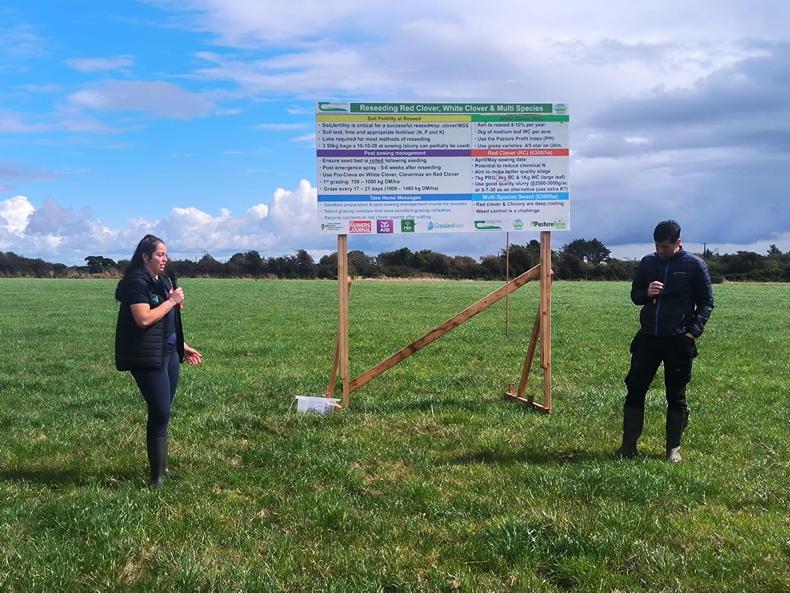
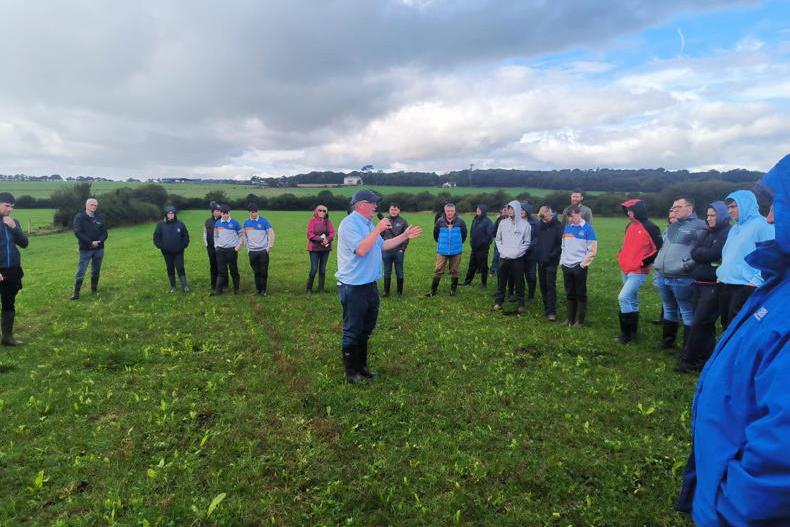
Mary Ellen of Teagasc discussing the role multi-species plays on the farm with Arthur
The cows are currently being allocated 6kg of grass, 4kg of meal, 6kg of maize silage and 4kg of red clover silage. The maize and red clover silage are grown on the farm’s outblocks. Current milk production is sitting at 20 litres cow/day at 5.1% fat and 3.9% protein.
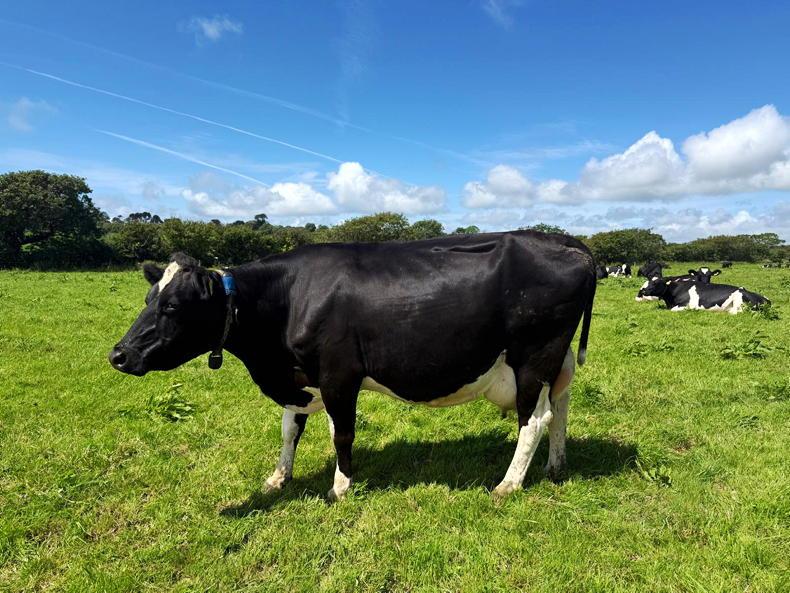
The herd is predominantly Holstein Friesian, with some Jersey crossbreeding done four years ago to improve the fat and protein percentages. Approximately 30% of the herd has some level of Jersey breeding at present.
The current EBI of the herd is €228 and the cows produced 529kg of milk solids in 2024 with 1.2t of concentrates fed per cow.
Stocking rate on the milking platform last year was significantly higher at 3.4LU/ha.
The higher stocking rate in 2024 resulted in higher feeding levels with the target for concentrates fed closer to 900kg per cow in a normal year.
At the beginning of 2025, Arthur got the opportunity to purchase 30 acres of land on the milking platform which allowed him to increase cow numbers from 128 to 144 and cut back the stocking rate to 2.8 LU/ha.
The reduction in stocking rate came at the right time. If the farm was still stocked at the previous level of 3.4 LU/ha, 2025 would have been an expensive year for the business.
All replacement heifers are reared on the outblocks, as well as some of the 0–1-year-old beef calves.
Soil fertility
The soil type of the farm was described as mixed on the day, with some parts of the farm prone to becoming heavy in wet weather.
Before purchasing the additional 30 acres, the soil fertility on the farm had been excellent with only 10% of the farm testing as suboptimal for either pH, P or K.
The new land was an excellent opportunity for the business, but the soil fertility was an issue. With the incorporation of the new land into the platform, the proportion of the farm suboptimal for pH, Ps and Ks increased to about 25%.
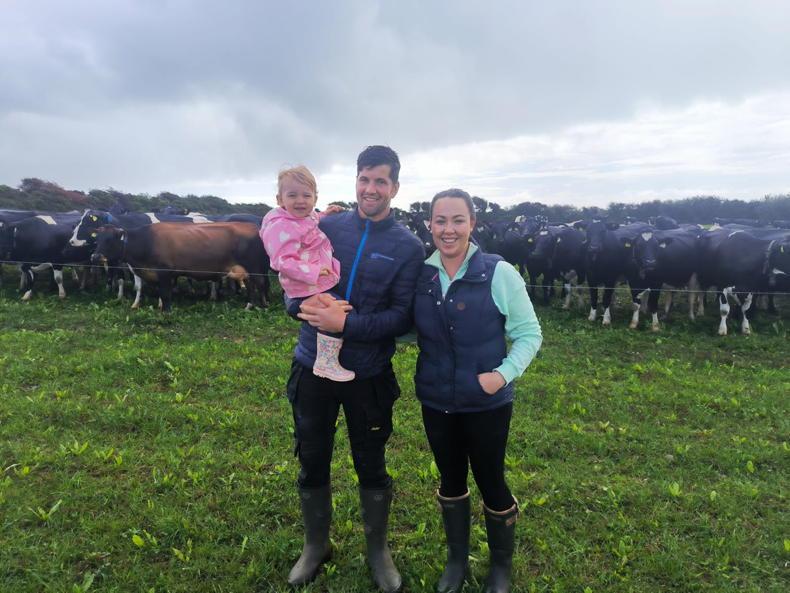
The Sweetman family at the recent walk
Soils are classed as suboptimal if the pH is below 6.3 and the soil is index one or two for Ps and Ks.
Sean McMahon of Grassland Agro discussed the cost of this suboptimal fertility on the day.
“If a soil is suboptimal in either pH, P or K, it will reduce the production potential of the land by 1.5t DM/ha.
“Therefore, a soil suboptimal in all three areas will reduce the potential sward production by a total 4.5t DM/ha.
“At a cost of €250 per tonne of utilised grass and just under 25% of the soils suboptimal, that’s costing Arthur’s farm here approximately €23,000 in potential returns,” Sean said.
In a herd of 144 cows, that’s a potential cost of €160/cow per year.
Multispecies
Red clover and multispecies swards is an area that Arthur has invested heavily in over the years.
With a previous positive experience trialling six acres of multispecies and the attraction of the €300/ha grant available for reseeding using a multispecies mix, Arthur took the decision in the spring of this year to reseed the entire new block of 30 acres on the milking platform.
The mix was made up of perennial ryegrass, plantain, chicory, red clover and white clover. The main challenge with the reseed was the restrictions around post-emergence spraying.
These swards cannot be sprayed and the majority of weed control must be done pre-sowing using a glyphosate spray to burn off ground.
The reseeded paddocks were grazed seven weeks after sowing at a cover of 700kg DM/ha. The second grazing was also done at a lower cover of 1,000kg DM/ha to give the clover a chance to develop.
After the second grazing, the paddocks were topped to cut back any weeds and give the sward space to grow and shade out potential weeds.
A second topping was done at the end of July, for the same reason. Arthur was happy with the performance of the reseeds to date this year.
“They’ve been the only paddock to stay green all year, particularly during the dry spells.
“If it wasn’t for them this year we would have been in serious trouble. Drought is becoming an issue for us so we need something that can keep growing in periods of moisture deficit.”
Arthur’s expectation based on his experience with multispecies he had sown before, was that the chicory and plantain would last for a max of two to three years in the sward.
He was satisfied however, that after the three years he’d be left with a good grass sward and well-established clover.
In terms of production, Arthur would expect the overall tonnage to be back about one tonne of DM/ha on the multispecies but the nitrogen input would be significantly reduced at 80-100kg/ha versus the 200kg/ha applied to the grass only swards.
Arthur started reseeding the silage ground with red clover four years ago, which has been a major success. In a normal year, he aims to take four cuts per year off the crop, which provides an excellent supplement feed if needed in the more challenging periods of the year.
To date he has three cuts taken off the red clover and is planning to take a fourth cut in the coming weeks.
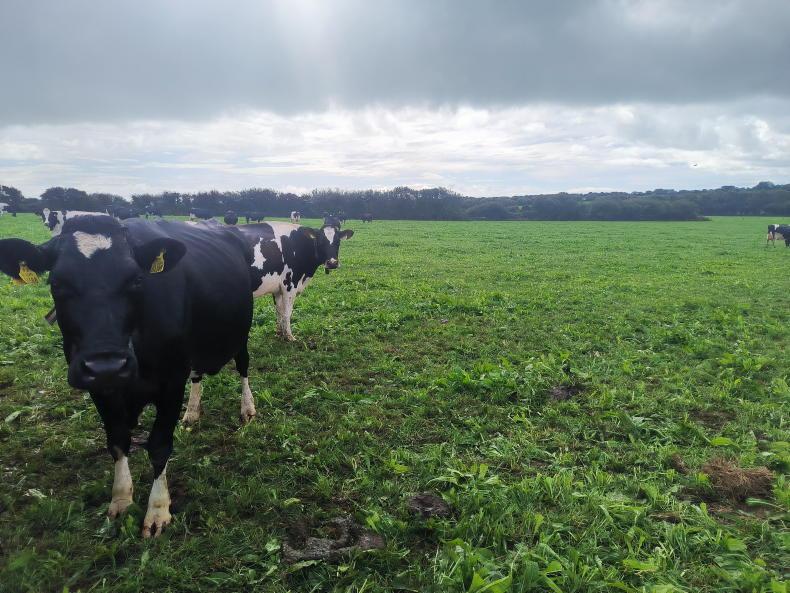
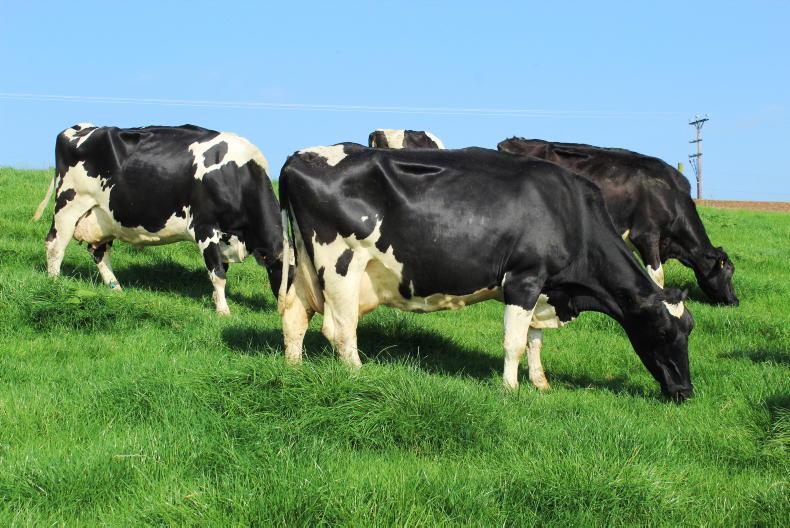
Cows grazing Multi-species on the Sweetman farm
In short
Arthur Sweetman and his wife Laura are milking 144 cows on a 51ha milking platform, stocked at 2.82 cows/ha.The farm grew 15.2t in 2024, with 156kg N/ha of chemical fertiliser spread. They achieved 10.7 grazings per paddock on average.The farm is targeting 300 days at grass, to maximise the utilisation of the cheapest feed available on the farm.The average EBI of the herd is €228. They produced 529kg of milk solids in 2024 with 1.2t of concentrates fed.
Since returning home from Australia in 2012, Arthur Sweetman has been on a mission to maximise the production and utilisation of grass on his farm in the sunny south east.
Farming a total of 93ha, with a 51ha milking platform, Arthur and his wife Laura are milking 144 cows near Carraig-on-Bannow in south Wexford.
Arthur was recently crowned the sustainable grassland farmer of the year for 2024 in the dairy section of the competition and a farm walk was held last week to mark the achievement.
The win was a result of outstanding performance over the past three years, averaging 15 tonnes DM/ha grown, 10.4 grazings per paddock per year and close to 40% of the milking platform in clover or multispecies.
“This feat is the result of excellent management and attention to detail consistently throughout the years,” said John Maher of Teagasc.
While there are many factors at play, maximising the days spent at grass was a big part of Arthur’s success in the competition.
He aims to have cows grazing for as close to 300 days of the year as he can, getting them out as soon as they calve in February and closing up as late as possible in November.
“It’s a simple enough system, we’re out by early February and we don’t miss many days from then on. If we can get 10 grazings per paddock, we’ll utilise the majority of what we’re growing and keep the inputs down,” Arthur said.
To achieve the 10 grazings, Arthur aims to graze each paddock twice before the first of May, six times between the first of May and the first of September, with one more grazing in October and one in November. This year has been a tougher one on the farm, in terms of grass production, with three significant dry spells throughout the year severely impacting growth on the farm.
Current performance
On the day of the event, Arthur was stocked at 2.82LU/ha on the milking platform with an average farm cover of 543kg DM/ha. Growth was back on the rise at 46kg/day, up from the mid-teens experienced throughout August.
The cows are being heavily supplemented at the moment to try to build up average farm cover towards the target of 1,000kg DM/ha for early September.

Mary Ellen of Teagasc discussing the role multi-species plays on the farm with Arthur
The cows are currently being allocated 6kg of grass, 4kg of meal, 6kg of maize silage and 4kg of red clover silage. The maize and red clover silage are grown on the farm’s outblocks. Current milk production is sitting at 20 litres cow/day at 5.1% fat and 3.9% protein.
The herd is predominantly Holstein Friesian, with some Jersey crossbreeding done four years ago to improve the fat and protein percentages. Approximately 30% of the herd has some level of Jersey breeding at present.
The current EBI of the herd is €228 and the cows produced 529kg of milk solids in 2024 with 1.2t of concentrates fed per cow.
Stocking rate on the milking platform last year was significantly higher at 3.4LU/ha.
The higher stocking rate in 2024 resulted in higher feeding levels with the target for concentrates fed closer to 900kg per cow in a normal year.
At the beginning of 2025, Arthur got the opportunity to purchase 30 acres of land on the milking platform which allowed him to increase cow numbers from 128 to 144 and cut back the stocking rate to 2.8 LU/ha.
The reduction in stocking rate came at the right time. If the farm was still stocked at the previous level of 3.4 LU/ha, 2025 would have been an expensive year for the business.
All replacement heifers are reared on the outblocks, as well as some of the 0–1-year-old beef calves.
Soil fertility
The soil type of the farm was described as mixed on the day, with some parts of the farm prone to becoming heavy in wet weather.
Before purchasing the additional 30 acres, the soil fertility on the farm had been excellent with only 10% of the farm testing as suboptimal for either pH, P or K.
The new land was an excellent opportunity for the business, but the soil fertility was an issue. With the incorporation of the new land into the platform, the proportion of the farm suboptimal for pH, Ps and Ks increased to about 25%.

The Sweetman family at the recent walk
Soils are classed as suboptimal if the pH is below 6.3 and the soil is index one or two for Ps and Ks.
Sean McMahon of Grassland Agro discussed the cost of this suboptimal fertility on the day.
“If a soil is suboptimal in either pH, P or K, it will reduce the production potential of the land by 1.5t DM/ha.
“Therefore, a soil suboptimal in all three areas will reduce the potential sward production by a total 4.5t DM/ha.
“At a cost of €250 per tonne of utilised grass and just under 25% of the soils suboptimal, that’s costing Arthur’s farm here approximately €23,000 in potential returns,” Sean said.
In a herd of 144 cows, that’s a potential cost of €160/cow per year.
Multispecies
Red clover and multispecies swards is an area that Arthur has invested heavily in over the years.
With a previous positive experience trialling six acres of multispecies and the attraction of the €300/ha grant available for reseeding using a multispecies mix, Arthur took the decision in the spring of this year to reseed the entire new block of 30 acres on the milking platform.
The mix was made up of perennial ryegrass, plantain, chicory, red clover and white clover. The main challenge with the reseed was the restrictions around post-emergence spraying.
These swards cannot be sprayed and the majority of weed control must be done pre-sowing using a glyphosate spray to burn off ground.
The reseeded paddocks were grazed seven weeks after sowing at a cover of 700kg DM/ha. The second grazing was also done at a lower cover of 1,000kg DM/ha to give the clover a chance to develop.
After the second grazing, the paddocks were topped to cut back any weeds and give the sward space to grow and shade out potential weeds.
A second topping was done at the end of July, for the same reason. Arthur was happy with the performance of the reseeds to date this year.
“They’ve been the only paddock to stay green all year, particularly during the dry spells.
“If it wasn’t for them this year we would have been in serious trouble. Drought is becoming an issue for us so we need something that can keep growing in periods of moisture deficit.”
Arthur’s expectation based on his experience with multispecies he had sown before, was that the chicory and plantain would last for a max of two to three years in the sward.
He was satisfied however, that after the three years he’d be left with a good grass sward and well-established clover.
In terms of production, Arthur would expect the overall tonnage to be back about one tonne of DM/ha on the multispecies but the nitrogen input would be significantly reduced at 80-100kg/ha versus the 200kg/ha applied to the grass only swards.
Arthur started reseeding the silage ground with red clover four years ago, which has been a major success. In a normal year, he aims to take four cuts per year off the crop, which provides an excellent supplement feed if needed in the more challenging periods of the year.
To date he has three cuts taken off the red clover and is planning to take a fourth cut in the coming weeks.

Cows grazing Multi-species on the Sweetman farm
In short
Arthur Sweetman and his wife Laura are milking 144 cows on a 51ha milking platform, stocked at 2.82 cows/ha.The farm grew 15.2t in 2024, with 156kg N/ha of chemical fertiliser spread. They achieved 10.7 grazings per paddock on average.The farm is targeting 300 days at grass, to maximise the utilisation of the cheapest feed available on the farm.The average EBI of the herd is €228. They produced 529kg of milk solids in 2024 with 1.2t of concentrates fed.
SHARING OPTIONS