Tim Fitzgerald was a suckler farmer up until February 2014, when he calved down 72 dairy cows for the first time on his farm near Dromkerry, Killarney, Co Kerry. According to Tim, the big drivers for this major change were a declining Single Farm Payment, smaller rural environment schemes and 180 acres potentially available for grazing milking cows.
Tim wanted a profitable, full-time sustainable agribusiness that could potentially be there for the next generation, so he decided that milking cows was the way to go. Last year, he bought 60 in-calf heifers and 12 cows from four different herds, with the aim of getting as many as possible calving in six weeks in the spring.
Milking investment
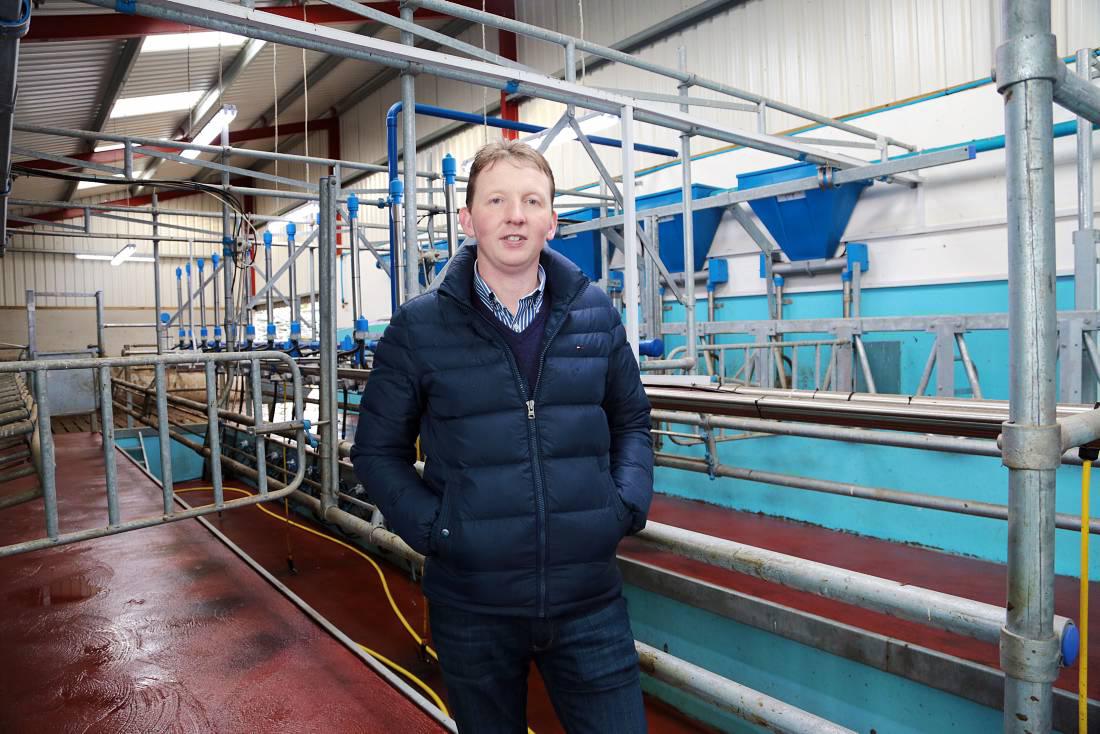
For almost a year, Tim was researching and visiting other dairy farms for ideas on the type of parlour to install. In the end, he went with a 12-unit Dairymaster parlour, with sequential baling and cluster removers, but with stallwork set up for 16 units. At €102,000 (€8,500/unit), I asked him if his parlour investment was too costly. He said: “As we were starting off with all heifers and not used to milking, we wanted good control. All heifers are standing at 2ft 2in centres but the sequential baling locks them into their spot.
‘‘We could have spent a lot more money because we didn’t put in a dump line or milk meters. I felt additional equipment like that could be installed in years to come but the €15,000 for the sequential baling and the air compressor I felt was necessary at this stage. Look at it like this. I’m 40 years old and surely I can get value from this total investment of €150,000 for the engine of my dairy farm.
‘‘That €150,000 includes a 16ft x 45ft slatted tank, a water well and a volume washer. If we were to leave out the slatted tank, etc, the price would be €102,000 in total, including VAT, for the parlour.’’
Tim also purchased feeders and a 13,000-litre bulk tank at a cost of €26,000 but he got back €10,000 in the form of a grant. It has swingover arms with four water droppers and four teat disinfectant droppers in the pit as well. The volume washer cost €1,200 and Tim also installed a plate cooler.
Bulk tank
His bulk milk tank is a 13,000-litre Dairymaster bottom fill tank. He also bought autowash for the bulk tank. It means that all he has to do when the tank is empty is push the button and walk away and the tank washer will go through the different cycles.
I asked Tim if a smaller tank would have served him just as well. He said: “I had the grant to come and, with these bulk tanks, the bigger they get the smaller the cost per extra litre stored in the tank, so I said I’d go big enough. We are dried off now and, out of the 72 cows purchased this time last year, four of those scanned are not in-calf. Therefore, we’ll potentially have 68 cows milking at a peak of 30 litres per day, that’s 2,040 litres per day in total. Our aim is to milk close to 100 cows in the short-term, if possible. We are not finished the spending yet either because we must get water troughs out to the paddocks and that job will probably cost €15,000. When you install 30 troughs at €300 each, you won’t be long moving up through the figures.
Tim said his suckler cows sold well, so that gave him a good start but, he added: “Make no mistake about it;
building eats up cash.”
Dairymaster 12-unit with
sequential baling but with
stallwork installed for 16 units
at a cost of €8,500 per unit.No milk meters or dump line – ‘‘they can wait for another day’’.Grant-aided 13,000-litre direct expansion bulk tank installed with bottom fill for a price of €26,000, but with €10,000 grant aid.
Tim Fitzgerald was a suckler farmer up until February 2014, when he calved down 72 dairy cows for the first time on his farm near Dromkerry, Killarney, Co Kerry. According to Tim, the big drivers for this major change were a declining Single Farm Payment, smaller rural environment schemes and 180 acres potentially available for grazing milking cows.
Tim wanted a profitable, full-time sustainable agribusiness that could potentially be there for the next generation, so he decided that milking cows was the way to go. Last year, he bought 60 in-calf heifers and 12 cows from four different herds, with the aim of getting as many as possible calving in six weeks in the spring.
Milking investment
For almost a year, Tim was researching and visiting other dairy farms for ideas on the type of parlour to install. In the end, he went with a 12-unit Dairymaster parlour, with sequential baling and cluster removers, but with stallwork set up for 16 units. At €102,000 (€8,500/unit), I asked him if his parlour investment was too costly. He said: “As we were starting off with all heifers and not used to milking, we wanted good control. All heifers are standing at 2ft 2in centres but the sequential baling locks them into their spot.
‘‘We could have spent a lot more money because we didn’t put in a dump line or milk meters. I felt additional equipment like that could be installed in years to come but the €15,000 for the sequential baling and the air compressor I felt was necessary at this stage. Look at it like this. I’m 40 years old and surely I can get value from this total investment of €150,000 for the engine of my dairy farm.
‘‘That €150,000 includes a 16ft x 45ft slatted tank, a water well and a volume washer. If we were to leave out the slatted tank, etc, the price would be €102,000 in total, including VAT, for the parlour.’’
Tim also purchased feeders and a 13,000-litre bulk tank at a cost of €26,000 but he got back €10,000 in the form of a grant. It has swingover arms with four water droppers and four teat disinfectant droppers in the pit as well. The volume washer cost €1,200 and Tim also installed a plate cooler.
Bulk tank
His bulk milk tank is a 13,000-litre Dairymaster bottom fill tank. He also bought autowash for the bulk tank. It means that all he has to do when the tank is empty is push the button and walk away and the tank washer will go through the different cycles.
I asked Tim if a smaller tank would have served him just as well. He said: “I had the grant to come and, with these bulk tanks, the bigger they get the smaller the cost per extra litre stored in the tank, so I said I’d go big enough. We are dried off now and, out of the 72 cows purchased this time last year, four of those scanned are not in-calf. Therefore, we’ll potentially have 68 cows milking at a peak of 30 litres per day, that’s 2,040 litres per day in total. Our aim is to milk close to 100 cows in the short-term, if possible. We are not finished the spending yet either because we must get water troughs out to the paddocks and that job will probably cost €15,000. When you install 30 troughs at €300 each, you won’t be long moving up through the figures.
Tim said his suckler cows sold well, so that gave him a good start but, he added: “Make no mistake about it;
building eats up cash.”
Dairymaster 12-unit with
sequential baling but with
stallwork installed for 16 units
at a cost of €8,500 per unit.No milk meters or dump line – ‘‘they can wait for another day’’.Grant-aided 13,000-litre direct expansion bulk tank installed with bottom fill for a price of €26,000, but with €10,000 grant aid. 





SHARING OPTIONS