Sean always wanted to farm, but rather than go straight into agricultural education he decided to study something different to broaden his horizons and completed a degree in Mechanical Engineering in CIT in 2007. He then worked in engineering for a year before taking a year off to go travelling around the world in 2008.
Even in 2008, the Cummins's had a considerable farming business; 160 dairy cows and over 100ha of tillage from mostly owned land in Newtown, near Kilmacthomas in Co Waterford. Bill and Val were working on the farm full-time and part-time help assisted them at the busy times.
Whether it was the lure of home cooking, or the desire to continue playing hurling for local club Newtown Ballydurn, wiry wing back Sean made the decision to come back to Ireland and work on the farm full-time in 2009.
"Coming home to farm in 2009 was always the plan. I completed the Green Cert straight after the degree. I liked engineering and travelling was a great experience but farming is always what I really wanted to do," says Sean.
Despite having a large farm, the Cummins's felt that to provide a decent standard of living for three households, and to have sufficient funds for reinvestment in the business, the pot of money had to be made bigger.
The plan
There is about 100ha around the farmyard that the cows can have access to. Back in 2009, about 40ha of this was in tillage. "The obvious thing to do was to increase dairy cow numbers as the dairy enterprise was more profitable than tillage, but quota was a big problem," explained Val.
To overcome this, the Cummins's made the decision to purchase quota in 2009. This was a brave decision at the time, says Val. "Many experts were predicting that quota would no longer be a constraint. Remember milk price was very low, the weather was atrocious and farmer sentiment towards expansion was minimal. Luckily, we made the decision to buy some quota at that time which allowed us to go up in numbers."
Sean says that buying the quota gave them some breathing space to expand. "We sat down in 2009 and did a plan for where we wanted to be in 2015, when quotas were to be abolished. The general plan was to stock the milking platform at three cows per hectare and use the outside blocks for rearing heifers and cutting silage, and to continue with tillage on land not needed for the dairy enterprise."
I asked Val why was there ever tillage on the farm, putting it to him that most dairy farmers with outside blocks would prefer to use these to rear and sell surplus replacement heifers and/or male calves. Instead, the Cummins's continue to sell all bull calves and only keep whatever heifer calves they need for themselves.
Val says that when you factor in time and labour, the tillage enterprise is more profitable than beef or selling replacement heifers. "We sow mostly winter crops so the busy times at tillage are at quiet times on the dairy front so we feel that with tillage we are balancing labour better. The only jobs we do ourselves are ploughing and spraying as we use a contractor to sow and harvest."
Land is good quality, which was an important factor both in choosing tillage as the second enterprise and in planning a stocking rate of 3 cows/ha on the milking platform. With 100ha being accessible to the milking cows, the Cummins's plan was to milk 300 cows in 2015.
Actual position today
Today, they are milking 296 cows – not bad going for a plan devised six years ago. Effectively, they have doubled cow numbers by converting tillage land to grass and by increasing the overall stocking rate. Having the tillage land available to convert was obviously a big help in achieving this. That said, there are many lessons to be learned from the Cummins' story.
One of the most striking things about Sean and Val is how measured they are in their approach to everything. Val says that before Sean came home they never measured grass, but Sean quickly reminds him that he used to walk every paddock every week and skip over any paddock that was too strong for grazing. Now both men walk the farm together every week, with Sean inputting the figures into the Agrinet app on his phone.
The expansion plan is another example of a measured approach to doing something and doing it successfully. They have twice as many cows now as they had in 2009, they have doubled the size of the milking parlour and collecting yard and they have built an extra 145 cubicles all out of savings and cashflow, with no extra borrowing.
Sean says that while it took them five years to get to 296 cows, quota was a big constraint as the family took the decision that they did not want to pay a big superlevy fine. As it happened, only one bulk tank of milk, or 14,000 litres went over quota in 2015.
Having said that, neither Sean nor Val are sure if they would do anything different now if doing it again – which might serve as a valuable reminder to anybody considering expansion now. Expansion is not a race, cautions Val.
"Sure, if we waited until now to expand we could borrow money, buy in stock and do all the infrastructure work at the one time but would we be any better off? I think we'd be stressed, cash would be tight and current performance would be poor because we'd be focusing on the infrastructure work instead of managing the herd properly," says Val.
Infrastructural changes – what happened?
The Cummins' plan involved gradually growing cow numbers in line with quota availability and carrying out one major infrastructural job every year. In 2009, milk quota was purchased to allow the herd to grow by 30 cows to 190 cows in 2010.
In the summer of 2010, all the existing paddocks were taken up and a new paddock system was designed. The plan was to have 21 paddocks on the grazing block in 2015, with approximately 4.5ha in each paddock. As the area in tillage was gradually reduced over the years, this area was added to the paddock system to make the 21 paddocks that are on the farm at present.
The water system was also upgraded in 2010 with larger bore pipes and bigger water troughs. Fencing and water installation work was completed by the Cummins's themselves making full use of Sean's engineering degree. Paddocks were doubled in size by taking up every second wire. The existing 300-gallon water troughs were retained but there were now two per paddock as opposed to one. The half and three quarter inch water pipes servicing these troughs were all replaced with inch black pipe which was left over-ground but buried at gaps and across roads.
Old ballcocks were replaced with high flow types. In 2011, numbers increased to 220 cows. That winter, the collecting yard was expanded to accommodate the extra cows that were being milked and the extra cows that were coming on stream. The existing rectangular yard was lengthened and widened and now comfortably holds 300 cows.
A backing gate with a scraper was installed also. After each row is milked and released from the parlour, the milker pulls a rope in the pit which flicks a switch and the backing gate automatically moves up 4-5m, just enough fill the next line, says Sean. On its return to the back wall, it scrapes the yard into a tank at the back. A Dairymaster automated drafting system was also installed at the same time.
The next job on the list was the parlour. They had a 16-unit parlour but this was coming under pressure as the herd was expanding and the family was spending more and more time milking. The existing milking parlour was lengthened and the 16 units was replaced with a 31-unit Westfalia herringbone in 2012.
"The original plan was to go with 30 units which would be ten rows but we said we'd go with 31 units because at times of the year we might have a few extra cows or if a bull enters the parlour it would mean having to start another row and we don't like having to milk any more than ten rows," says Sean.
The parlour has automatic cluster removers so one man can milk but Sean says it a lot easier with two people. Cow numbers actually dropped slightly in 2012 to 214 cows to remain within quota.
Cow numbers remained the same for 2013 but more quota was purchased, allowing for numbers to increase again in 2014. This meant that more land had to come into grass so reseeding and converting land that was previously tilled into cow paddocks was the main job after the 2013 harvest.
Purchasing milk quota in 2013 might seem a bit crazy, with only one quota year remaining, but the Cummins's felt it was the right thing to do. "Effectively we paid the superlevy bill for 2015 in 2013 by buying the quota. Milk price was good at the time and buying the quota reduced our tax bill. We were also unsure of what milk price would be like in 2015 and didn't want to get caught with extra cows and a big superlevy fine in a bad milk price year. It gave us peace of mind," said Val.
So in 2014, with the extra quota available, cow numbers increased to 245 cows. The next thing to come under pressure was housing. Existing cubicle accommodation was capable of wintering about 200 cows so in the summer of 2014 a new shed was erected with 144 cubicles at a cost of 1,200 per cow space. They now have cubicles in the one yard for 350 cows.
Which brings us to the present. 296 cows are being milked this summer. They have 88 maiden heifers and 84 heifer calves. 52ha is dedicated to youngstock and silage and 54ha remains in tillage. 40ha of the 106ha out-farms are being rented. Sean, Val and Bill are being helped by two part-time staff, so overall there is put at 3.75 labour units on the farm.
Sean is responsible for the stock and grass, Bill looks after the tillage and machinery side of things, while Val looks after all the bookwork, both compliance and financial, as well as helping out Sean and Bill in their areas. The two part-time workers, Andy and Paul, work three days a week each.
Milking platform
Last year, the milking platform grew 13.2t of grass. Sean says this is something they will be hoping to increase in the coming years. Val pulled out a book with the soil samples results and the amount of nitrogen, phosphorus (P) and potassium (K) that each paddock received since 2009 again this shows great attention to detail.
On average, soil fertility is at Index 3 for P and K.
Sean says this doesn't tell the full story as the organic matter levels are low (less than 3%) in some of the fields that were converted from tillage and while their P and K levels may be okay, they're not performing as well as some of the longer-established grazing paddocks. Upon walking the farm, it is easier to spot the fields that were converted last as the grass tends to grow in clumps in these fields as opposed to a thick, even sward in the older fields.
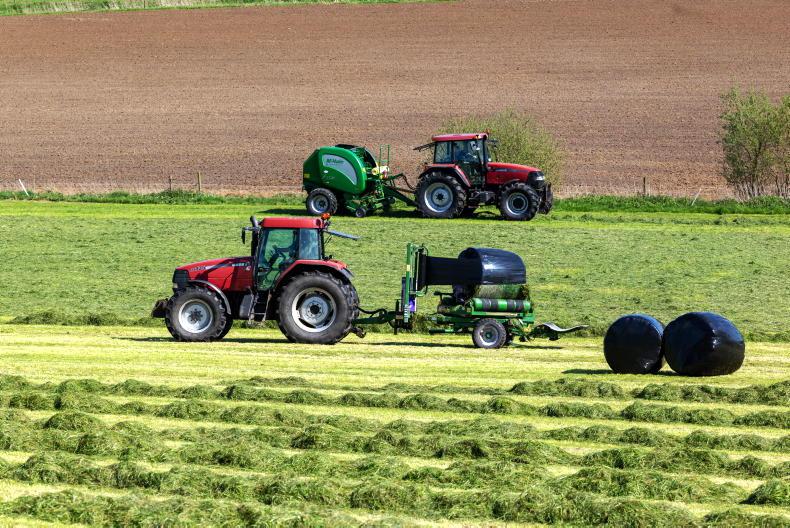
Sean is targeting these fields for extra slurry to build up soil organic matter. Most of the slurry is spread by themselves. They also carry out most of the machinery work for the dairy enterprise except silage making. Most of the silage is produced on the outside blocks but they estimate that about 25% of the cow's silage requirement is made on the home block mostly in the form of surplus bales and some pit silage.
More from dairy this week
Barryroe Co-op tops the KPMG/IFJ Milk Price Review for the fourth year in a row
Sean always wanted to farm, but rather than go straight into agricultural education he decided to study something different to broaden his horizons and completed a degree in Mechanical Engineering in CIT in 2007. He then worked in engineering for a year before taking a year off to go travelling around the world in 2008.
Even in 2008, the Cummins's had a considerable farming business; 160 dairy cows and over 100ha of tillage from mostly owned land in Newtown, near Kilmacthomas in Co Waterford. Bill and Val were working on the farm full-time and part-time help assisted them at the busy times.
Whether it was the lure of home cooking, or the desire to continue playing hurling for local club Newtown Ballydurn, wiry wing back Sean made the decision to come back to Ireland and work on the farm full-time in 2009.
"Coming home to farm in 2009 was always the plan. I completed the Green Cert straight after the degree. I liked engineering and travelling was a great experience but farming is always what I really wanted to do," says Sean.
Despite having a large farm, the Cummins's felt that to provide a decent standard of living for three households, and to have sufficient funds for reinvestment in the business, the pot of money had to be made bigger.
The plan
There is about 100ha around the farmyard that the cows can have access to. Back in 2009, about 40ha of this was in tillage. "The obvious thing to do was to increase dairy cow numbers as the dairy enterprise was more profitable than tillage, but quota was a big problem," explained Val.
To overcome this, the Cummins's made the decision to purchase quota in 2009. This was a brave decision at the time, says Val. "Many experts were predicting that quota would no longer be a constraint. Remember milk price was very low, the weather was atrocious and farmer sentiment towards expansion was minimal. Luckily, we made the decision to buy some quota at that time which allowed us to go up in numbers."
Sean says that buying the quota gave them some breathing space to expand. "We sat down in 2009 and did a plan for where we wanted to be in 2015, when quotas were to be abolished. The general plan was to stock the milking platform at three cows per hectare and use the outside blocks for rearing heifers and cutting silage, and to continue with tillage on land not needed for the dairy enterprise."
I asked Val why was there ever tillage on the farm, putting it to him that most dairy farmers with outside blocks would prefer to use these to rear and sell surplus replacement heifers and/or male calves. Instead, the Cummins's continue to sell all bull calves and only keep whatever heifer calves they need for themselves.
Val says that when you factor in time and labour, the tillage enterprise is more profitable than beef or selling replacement heifers. "We sow mostly winter crops so the busy times at tillage are at quiet times on the dairy front so we feel that with tillage we are balancing labour better. The only jobs we do ourselves are ploughing and spraying as we use a contractor to sow and harvest."
Land is good quality, which was an important factor both in choosing tillage as the second enterprise and in planning a stocking rate of 3 cows/ha on the milking platform. With 100ha being accessible to the milking cows, the Cummins's plan was to milk 300 cows in 2015.
Actual position today
Today, they are milking 296 cows – not bad going for a plan devised six years ago. Effectively, they have doubled cow numbers by converting tillage land to grass and by increasing the overall stocking rate. Having the tillage land available to convert was obviously a big help in achieving this. That said, there are many lessons to be learned from the Cummins' story.
One of the most striking things about Sean and Val is how measured they are in their approach to everything. Val says that before Sean came home they never measured grass, but Sean quickly reminds him that he used to walk every paddock every week and skip over any paddock that was too strong for grazing. Now both men walk the farm together every week, with Sean inputting the figures into the Agrinet app on his phone.
The expansion plan is another example of a measured approach to doing something and doing it successfully. They have twice as many cows now as they had in 2009, they have doubled the size of the milking parlour and collecting yard and they have built an extra 145 cubicles all out of savings and cashflow, with no extra borrowing.
Sean says that while it took them five years to get to 296 cows, quota was a big constraint as the family took the decision that they did not want to pay a big superlevy fine. As it happened, only one bulk tank of milk, or 14,000 litres went over quota in 2015.
Having said that, neither Sean nor Val are sure if they would do anything different now if doing it again – which might serve as a valuable reminder to anybody considering expansion now. Expansion is not a race, cautions Val.
"Sure, if we waited until now to expand we could borrow money, buy in stock and do all the infrastructure work at the one time but would we be any better off? I think we'd be stressed, cash would be tight and current performance would be poor because we'd be focusing on the infrastructure work instead of managing the herd properly," says Val.
Infrastructural changes – what happened?
The Cummins' plan involved gradually growing cow numbers in line with quota availability and carrying out one major infrastructural job every year. In 2009, milk quota was purchased to allow the herd to grow by 30 cows to 190 cows in 2010.
In the summer of 2010, all the existing paddocks were taken up and a new paddock system was designed. The plan was to have 21 paddocks on the grazing block in 2015, with approximately 4.5ha in each paddock. As the area in tillage was gradually reduced over the years, this area was added to the paddock system to make the 21 paddocks that are on the farm at present.
The water system was also upgraded in 2010 with larger bore pipes and bigger water troughs. Fencing and water installation work was completed by the Cummins's themselves making full use of Sean's engineering degree. Paddocks were doubled in size by taking up every second wire. The existing 300-gallon water troughs were retained but there were now two per paddock as opposed to one. The half and three quarter inch water pipes servicing these troughs were all replaced with inch black pipe which was left over-ground but buried at gaps and across roads.
Old ballcocks were replaced with high flow types. In 2011, numbers increased to 220 cows. That winter, the collecting yard was expanded to accommodate the extra cows that were being milked and the extra cows that were coming on stream. The existing rectangular yard was lengthened and widened and now comfortably holds 300 cows.
A backing gate with a scraper was installed also. After each row is milked and released from the parlour, the milker pulls a rope in the pit which flicks a switch and the backing gate automatically moves up 4-5m, just enough fill the next line, says Sean. On its return to the back wall, it scrapes the yard into a tank at the back. A Dairymaster automated drafting system was also installed at the same time.
The next job on the list was the parlour. They had a 16-unit parlour but this was coming under pressure as the herd was expanding and the family was spending more and more time milking. The existing milking parlour was lengthened and the 16 units was replaced with a 31-unit Westfalia herringbone in 2012.
"The original plan was to go with 30 units which would be ten rows but we said we'd go with 31 units because at times of the year we might have a few extra cows or if a bull enters the parlour it would mean having to start another row and we don't like having to milk any more than ten rows," says Sean.
The parlour has automatic cluster removers so one man can milk but Sean says it a lot easier with two people. Cow numbers actually dropped slightly in 2012 to 214 cows to remain within quota.
Cow numbers remained the same for 2013 but more quota was purchased, allowing for numbers to increase again in 2014. This meant that more land had to come into grass so reseeding and converting land that was previously tilled into cow paddocks was the main job after the 2013 harvest.
Purchasing milk quota in 2013 might seem a bit crazy, with only one quota year remaining, but the Cummins's felt it was the right thing to do. "Effectively we paid the superlevy bill for 2015 in 2013 by buying the quota. Milk price was good at the time and buying the quota reduced our tax bill. We were also unsure of what milk price would be like in 2015 and didn't want to get caught with extra cows and a big superlevy fine in a bad milk price year. It gave us peace of mind," said Val.
So in 2014, with the extra quota available, cow numbers increased to 245 cows. The next thing to come under pressure was housing. Existing cubicle accommodation was capable of wintering about 200 cows so in the summer of 2014 a new shed was erected with 144 cubicles at a cost of 1,200 per cow space. They now have cubicles in the one yard for 350 cows.
Which brings us to the present. 296 cows are being milked this summer. They have 88 maiden heifers and 84 heifer calves. 52ha is dedicated to youngstock and silage and 54ha remains in tillage. 40ha of the 106ha out-farms are being rented. Sean, Val and Bill are being helped by two part-time staff, so overall there is put at 3.75 labour units on the farm.
Sean is responsible for the stock and grass, Bill looks after the tillage and machinery side of things, while Val looks after all the bookwork, both compliance and financial, as well as helping out Sean and Bill in their areas. The two part-time workers, Andy and Paul, work three days a week each.
Milking platform
Last year, the milking platform grew 13.2t of grass. Sean says this is something they will be hoping to increase in the coming years. Val pulled out a book with the soil samples results and the amount of nitrogen, phosphorus (P) and potassium (K) that each paddock received since 2009 again this shows great attention to detail.
On average, soil fertility is at Index 3 for P and K.
Sean says this doesn't tell the full story as the organic matter levels are low (less than 3%) in some of the fields that were converted from tillage and while their P and K levels may be okay, they're not performing as well as some of the longer-established grazing paddocks. Upon walking the farm, it is easier to spot the fields that were converted last as the grass tends to grow in clumps in these fields as opposed to a thick, even sward in the older fields.
Sean is targeting these fields for extra slurry to build up soil organic matter. Most of the slurry is spread by themselves. They also carry out most of the machinery work for the dairy enterprise except silage making. Most of the silage is produced on the outside blocks but they estimate that about 25% of the cow's silage requirement is made on the home block mostly in the form of surplus bales and some pit silage.
More from dairy this week
Barryroe Co-op tops the KPMG/IFJ Milk Price Review for the fourth year in a row






SHARING OPTIONS