



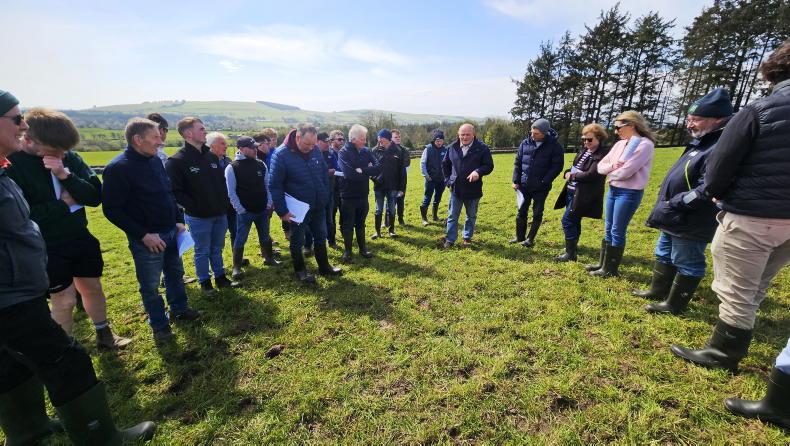
Farmers in the Low Carbon Dairy Farms discussion group have shown that it’s possible to maintain grass growth rates by using lower levels of artificial nitrogen and increasing clover levels.
Meeting to discuss their data from the last five years last week, on average the group grew 13.8t DM/ha using 137kg N/ha in 2025. In 2021 the group averaged 13.9t DM/ha with a nitrogen usage of 197kg N/ha.
Weather variation has been one of the challenges with the lowest grass yield of 12.7t DM/ha across the five years occurring during 2024 when the year was soil temperatures were predominantly colder than usual.
Held on the farm of Jimmy and Ann Cotter, Coachford, Co Cork the meeting was attended by farmers from across the country.
There are over 30 farmers involved and about 20 have been successfully adopting clover while the remaining farmers are still at baseline levels of fertiliser N use.
James Humphreys, principal research officer with Teagasc, facilitates the group.
“At Solohead we developed a profitable system of clover-based milk production with very low reliance on fertiliser N and we want to identify obstacles to adoption and provide solutions for these obstacles,” he said.
“Since 2021 we have been road-testing this system on 20 commercial dairy farms across the country under a range of soil and climatic conditions.
“Farms are converting to clover by reseeding around 10% of the farm area per year. Currently around 50% of the farm areas is under clover; ranging between 30 and 80%.”
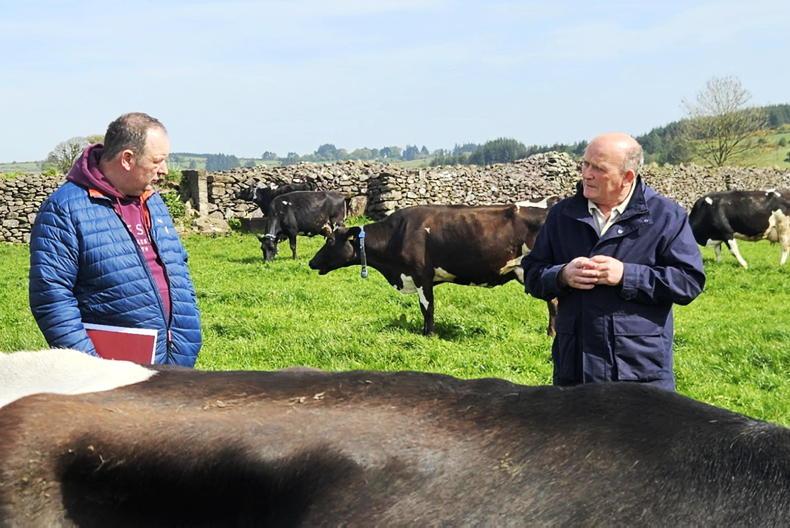
He highlighted that this system proved to be highly profitable during 2022 and 2023 when fertiliser prices soared due to the Russian invasion of Ukraine.
Faced with current uncertainty due to upheaval around the Strait of Hormuz, he said:“It makes sense to diversify and use clover to avoid being solely dependent on nitrogen fertiliser. It is a profitable system, which can lower the carbon footprint of a farm by up to 20%.”
The Solohead farm is no longer being used for clover research and is instead being set up as a dairy demonstration farm in partnership with ArraTipp Co-op where different levels of meal feeding is being compared. The project is being co-ordinated by Teagasc’s Abigail Ryan.



SHARING OPTIONS