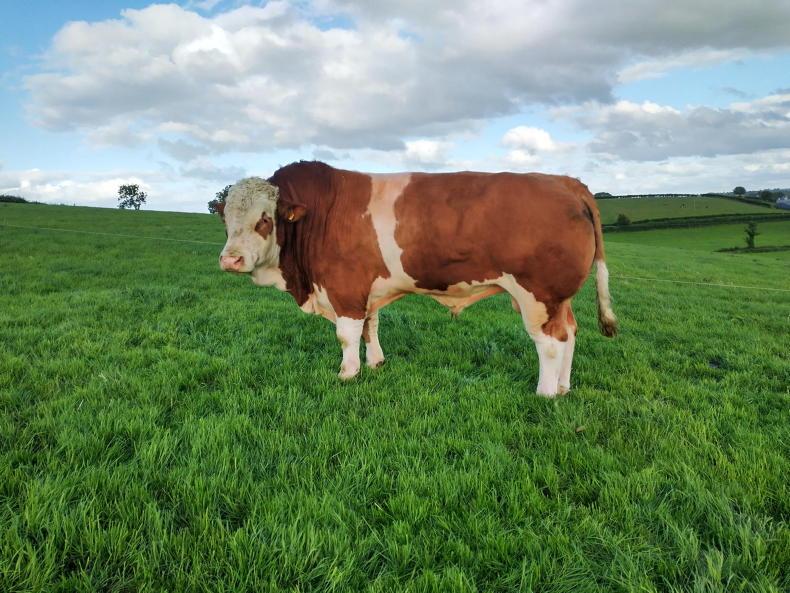
There is a tendency on suckler farms to focus attention on female stock. I’m not to saying that this is wrong, but your stock bull also needs to be fit for the months ahead, and that takes planning.
Over the next 12 weeks the profitability of your business is somewhat out of your hands and in the hands of Mother Nature. Yes, good grassland management, good management at calving, cow selection and keeping a close eye on costs are important. But if your stock bull isn’t firing on all cylinders during the weeks ahead, it will lead to considerable holes in your balance sheet.
For a herd with a tight 12-week calving interval, 60% to 65% of the cows could be bred in the first three weeks of the season. This places a significant demand on the bull.
A target of 95% of cows should be bred during the first nine to 10 weeks of mating. However, this can only happen if your stock bull is fit for purpose and your cows are healthy and cycling ahead of breeding.
Despite its key role, mating performance and fertility of the bull receives much less attention than that of his female counterparts. An infertile or sub-fertile bull can go undetected for a number of weeks or indeed months. It is simply too risky to adopt the theory that just because the bull worked last year he will work again this year.
Optimal fertility
In an ideal situation you would have been conditioning the bull for the past six weeks to ensure he is in good shape ahead of the breeding season. Remember, semen production takes 56 days. Raised body temperature associated with an illness can adversely impact sperm viability and capacity to fertilise an ovum.
Frequently, when bulls run a temperature, their infertility is not immediately adversely affected but is two to three months later. This is why correct management of the stock bull pre-breeding is critical in ensuring good conception rates.
The bull needs to be moving well on his feet and free from any signs of stiffness. If paring is required it should be carried out immediately. Feet should not be pared at the start or during the breeding season. Lameness and/or arthritic conditions will impact on conception rates. Bulls with poor mobility will struggle to serve 40-50 cows within a 12-week period.
Bull to cow ratio
The perfect bull to cow ratio will depend on a number of factors, beginning with the muscularity of the bull. Heavily muscled bulls will tend to have lower levels of mobility. Grazing systems and terrain also need to be taken into account. If cows are paddock-grazed, the stock bull will have to cover a lot less ground and therefore mobility is not as important.
However, if cows are set-stocked on rougher ground, then an excellent level of mobility will be essential. In general, a mature bull should be able to serve from 40-50 cows per season. However, if using exceptionally well-muscled bulls in a set-stocked system or on rougher terrain, I would recommend reducing this to 35 cows.
Veterinary examination
A veterinary examination of a bull one month before the start of the breeding season will identify some bulls with physical abnormalities that might hinder mating ability. An evaluation of a semen sample from a bull can be useful in some instances in identifying infertile bulls but is of less value in identifying sub-fertile bulls. Bulls producing semen with either no sperm, a high proportion of dead sperm, poor motility or a high proportion of sperm with defects are relatively clearcut. However, some produce apparently normal semen and yet fail to impregnate cows. Consequently, vigilance and record-keeping during the breeding season are of utmost importance to monitor the performance of a bull.
Take note during mating:
Having bought a young bull, it is best to supervise the first cows and or heifers that he mates. When you are satisfied that he can successfully mate cows, he can then be introduced to a herd of cows.It is essential that you do not overwork a young stock bull in his first year. 20-25 cows is the maximum he should be allowed to serve in year one.Each season, record the identity of the first cows that are mated. Fitting the bull with a chin-ball marker harness is useful to identify cows mated and also cows repeating. Check these cows for repeats three to four weeks after service. If all or a high proportion of these cows repeat, then take immediate action and start using AI or obtain another bull. It is recommended that the first cows bred by a bull in each season are scanned for pregnancy four to five weeks after service. Scanning can provide reliable pregnancy diagnosis as early as 28 days after breeding. A bull’s ability to get cows pregnant is the best test of his fertility. During the breeding season, the farmer should check cows regularly for repeats and also periodically check the bull for serving ability and for any signs of lameness. By the end of the season, the bull will have lost condition. It is important that he is fed well in order to get him built up again and in good condition before going into the winter. While you don’t want him fat, you want to make sure he is fit.
There is a tendency on suckler farms to focus attention on female stock. I’m not to saying that this is wrong, but your stock bull also needs to be fit for the months ahead, and that takes planning.
Over the next 12 weeks the profitability of your business is somewhat out of your hands and in the hands of Mother Nature. Yes, good grassland management, good management at calving, cow selection and keeping a close eye on costs are important. But if your stock bull isn’t firing on all cylinders during the weeks ahead, it will lead to considerable holes in your balance sheet.
For a herd with a tight 12-week calving interval, 60% to 65% of the cows could be bred in the first three weeks of the season. This places a significant demand on the bull.
A target of 95% of cows should be bred during the first nine to 10 weeks of mating. However, this can only happen if your stock bull is fit for purpose and your cows are healthy and cycling ahead of breeding.
Despite its key role, mating performance and fertility of the bull receives much less attention than that of his female counterparts. An infertile or sub-fertile bull can go undetected for a number of weeks or indeed months. It is simply too risky to adopt the theory that just because the bull worked last year he will work again this year.
Optimal fertility
In an ideal situation you would have been conditioning the bull for the past six weeks to ensure he is in good shape ahead of the breeding season. Remember, semen production takes 56 days. Raised body temperature associated with an illness can adversely impact sperm viability and capacity to fertilise an ovum.
Frequently, when bulls run a temperature, their infertility is not immediately adversely affected but is two to three months later. This is why correct management of the stock bull pre-breeding is critical in ensuring good conception rates.
The bull needs to be moving well on his feet and free from any signs of stiffness. If paring is required it should be carried out immediately. Feet should not be pared at the start or during the breeding season. Lameness and/or arthritic conditions will impact on conception rates. Bulls with poor mobility will struggle to serve 40-50 cows within a 12-week period.
Bull to cow ratio
The perfect bull to cow ratio will depend on a number of factors, beginning with the muscularity of the bull. Heavily muscled bulls will tend to have lower levels of mobility. Grazing systems and terrain also need to be taken into account. If cows are paddock-grazed, the stock bull will have to cover a lot less ground and therefore mobility is not as important.
However, if cows are set-stocked on rougher ground, then an excellent level of mobility will be essential. In general, a mature bull should be able to serve from 40-50 cows per season. However, if using exceptionally well-muscled bulls in a set-stocked system or on rougher terrain, I would recommend reducing this to 35 cows.
Veterinary examination
A veterinary examination of a bull one month before the start of the breeding season will identify some bulls with physical abnormalities that might hinder mating ability. An evaluation of a semen sample from a bull can be useful in some instances in identifying infertile bulls but is of less value in identifying sub-fertile bulls. Bulls producing semen with either no sperm, a high proportion of dead sperm, poor motility or a high proportion of sperm with defects are relatively clearcut. However, some produce apparently normal semen and yet fail to impregnate cows. Consequently, vigilance and record-keeping during the breeding season are of utmost importance to monitor the performance of a bull.
Take note during mating:
Having bought a young bull, it is best to supervise the first cows and or heifers that he mates. When you are satisfied that he can successfully mate cows, he can then be introduced to a herd of cows.It is essential that you do not overwork a young stock bull in his first year. 20-25 cows is the maximum he should be allowed to serve in year one.Each season, record the identity of the first cows that are mated. Fitting the bull with a chin-ball marker harness is useful to identify cows mated and also cows repeating. Check these cows for repeats three to four weeks after service. If all or a high proportion of these cows repeat, then take immediate action and start using AI or obtain another bull. It is recommended that the first cows bred by a bull in each season are scanned for pregnancy four to five weeks after service. Scanning can provide reliable pregnancy diagnosis as early as 28 days after breeding. A bull’s ability to get cows pregnant is the best test of his fertility. During the breeding season, the farmer should check cows regularly for repeats and also periodically check the bull for serving ability and for any signs of lameness. By the end of the season, the bull will have lost condition. It is important that he is fed well in order to get him built up again and in good condition before going into the winter. While you don’t want him fat, you want to make sure he is fit. 





SHARING OPTIONS