A procedure that is commonly used among pedigree breeders is flushing and embryo transfer (ET).
In a bid to exploit the potential of a genetically superior heifer or cow, breeders will often offer their best cows/heifers a course of hormonal treatments to encourage superovulation, then inseminate them to a desired bull, retrieve these fertilised embryos (flushing) and insert them into a number of recipient heifers.
The challenge is to get as many viable and transferable embryos as possible, while also achieving a successful pregnancy with each embryo.
The process, if successful, can significantly speed up the number of offspring from a top quality female.
Some breeders, particularly those getting established, use the procedure to build up herd numbers rapidly.
They choose to go down the ET route rather than buy expensive foundation breeding stock.
Embryo transfer is also used among commercial showmen to produce that ultimate show calf.
In some instances, the commercial donor heifer may never naturally conceive herself as her main function is for showing.
The rate of success is variable. A typical flush can yield eight to 10 embryos with five to seven of suitable quality for transfer.
Then there is the timely challenge of ensuring that the recipient heifer is correctly cycling and is able to accept the embryo, particularly if it’s fresh.
It is imperative, however, that the potential value of the embryo calves that are born alive should more than compensate for the substantial financial cost that is associated with the flushing and transfer process.
Hence, careful selection of the appropriate donor cow is critical.
Apart from the expense of flushing, a pool of money will also be required to buy a number of recipient heifers, if they are not already available on the farm.
In this supplement, Alan Kelly outlines the intricacies of the multiple ovulation and embryo transfer (MOET) process and concludes that, for the procedure to be cost effective, pregnancy rates must be maximised.
Red Ladies sale in Carlisle – reserve champion finds new home in the west
Henry Savage & Sons, Newry, Co Down, took home 5,000gns twice at the Red Ladies Derby in Carlisle earlier this month.
Standing second in her class to the overall champion, the Savages’ first heifer, Trueman Holly, is a March 2012-born Wilodge Cerberus daughter out of a Sympa-bred dam.
She was part of the winning pairs and group of three teams at the Royal Ulster Show and was bought by HJ & A Francis for their Cain herd in Powys.
The same man also secured the Savages’ second heifer at 5,000gns, this time for Trueman Harmonica. Born January 2012, she is a daughter of Objat and is out of the herd’s best cow, Trueman Acoustics – the mother of the 38,000gns Trueman Duet.
Meanwhile, K & C Knox, Irvinestown, Co Fermanagh, took home 4,800gns for their first prize winner, Beachmount Honey.
Born October 2012, she is by Ardlea Dan (by Vivaldi) and out of a Sympa daughter, Beachmount Ebony, whose first calf was a class winner at the 2012 Red Ladies sale and sold then for 5,500gns.
The day’s second top price was paid by a south of Ireland buyer for the overall reserve champion, Fairywater Gabriella.
Exhibited by A Ewing, Annan, she is a September 2011 daughter of the herd’s stock sire Ironstone Diego and is out of Pelletstown Catherine (by Mas du Clo).
The buyer, at 15,000gns, was Michael Philips, Gurteen, Co Sligo. She has a beef value of LM+38.
The top price of the sale went to the supreme champion, Ronick Honey, exhibited by R Dick, Stirling.
This stylish heifer won her class at the Royal Highland show earlier in the summer and also won the best heifer in the 2013 Scottish Limousin Club Herds competition.
Born in February 2012, she is out of the stock sire Rathconville Eugene and sold for the top price of 20,000gns to GR & SC Brooke, Berwickshire. She has a beef value of LM+38.
In the weanling section, joint buyers D Small, Kilkeel, Co Down and J Alexander, Randalstown, Co Antrim, paid 4,500gns for the heifer calf, Ronick Ivory, a Rathconville Eugene daughter.
Overall, 24 maiden heifers sold to average stg£4,500; 20 weaned bull calves averaged stg£2,600 and 34 weaned heifer calves averaged stg£1,974.
Simmental
society news
At the AGM in October, Mayo breeder Tom Maloney from Bohola, Claremorris, was selected as the new Simmental Society president. Tom runs the Carroward Simmental herd which was established in 1998.
This year saw a group of youngsters from the Simmental Young Members Association compete in an international stock judging competition which took place at Enniskillen Show.
The Irish team acquitted themselves admirably with Niamh Oliver being awarded best individual. The Irish team was made up of Eileen McGarry, Ciaran Kinahan, Niamh Oliver and Sean McGarry under the stewardship of Jennie Aherne.
Simmental sales dates for 2014:
Roscommon spring premier – Saturday 15 MarchTullamore – Saturday 19 AprilRoscommon – Friday 16 MayRoscommon autumn premier – Saturday 1 NovemberParthenaise AGM
At the recent Irish Parthenaise AGM in Portlaoise, the following were elected:
President, Gerard Scally, Co Kildare; chairman, Liam Fitzgerald, Co Cork; secretary, Laurie Harney, Co Galway; PRO, Dermot O’Brien, Co Kerry; treasurer, John Whyte, Co Galway.
New Charolais breed development officer
The Irish Charolais Cattle Society has just announced the appointment of a new breed development officer.
Neven McKiernan (24) comes from just outside Ballinagh in Co Cavan. With a very strong background in breeding pedigree cattle, Neven has been involved in the family business since a young age and has hands-on practical experience in producing high quality livestock for sale.
In 2011, he graduated from Dundalk Institute of Technology with an honours degree in sustainable agriculture.
He was then awarded a Walsh Fellowship Masters through the Teagasc/UCD Agricultural Innovation Support Programme and has recently finished working in Ballyhaise Agricultural College.
One of his primary responsibilities in this role was to provide lectures in beef production and animal science.
Neven will work with both pedigree and commercial farmers in his role to drive and develop the Charolais breed in Ireland.
A procedure that is commonly used among pedigree breeders is flushing and embryo transfer (ET).
In a bid to exploit the potential of a genetically superior heifer or cow, breeders will often offer their best cows/heifers a course of hormonal treatments to encourage superovulation, then inseminate them to a desired bull, retrieve these fertilised embryos (flushing) and insert them into a number of recipient heifers.
The challenge is to get as many viable and transferable embryos as possible, while also achieving a successful pregnancy with each embryo.
The process, if successful, can significantly speed up the number of offspring from a top quality female.
Some breeders, particularly those getting established, use the procedure to build up herd numbers rapidly.
They choose to go down the ET route rather than buy expensive foundation breeding stock.
Embryo transfer is also used among commercial showmen to produce that ultimate show calf.
In some instances, the commercial donor heifer may never naturally conceive herself as her main function is for showing.
The rate of success is variable. A typical flush can yield eight to 10 embryos with five to seven of suitable quality for transfer.
Then there is the timely challenge of ensuring that the recipient heifer is correctly cycling and is able to accept the embryo, particularly if it’s fresh.
It is imperative, however, that the potential value of the embryo calves that are born alive should more than compensate for the substantial financial cost that is associated with the flushing and transfer process.
Hence, careful selection of the appropriate donor cow is critical.
Apart from the expense of flushing, a pool of money will also be required to buy a number of recipient heifers, if they are not already available on the farm.
In this supplement, Alan Kelly outlines the intricacies of the multiple ovulation and embryo transfer (MOET) process and concludes that, for the procedure to be cost effective, pregnancy rates must be maximised.
Red Ladies sale in Carlisle – reserve champion finds new home in the west
Henry Savage & Sons, Newry, Co Down, took home 5,000gns twice at the Red Ladies Derby in Carlisle earlier this month.
Standing second in her class to the overall champion, the Savages’ first heifer, Trueman Holly, is a March 2012-born Wilodge Cerberus daughter out of a Sympa-bred dam.
She was part of the winning pairs and group of three teams at the Royal Ulster Show and was bought by HJ & A Francis for their Cain herd in Powys.
The same man also secured the Savages’ second heifer at 5,000gns, this time for Trueman Harmonica. Born January 2012, she is a daughter of Objat and is out of the herd’s best cow, Trueman Acoustics – the mother of the 38,000gns Trueman Duet.
Meanwhile, K & C Knox, Irvinestown, Co Fermanagh, took home 4,800gns for their first prize winner, Beachmount Honey.
Born October 2012, she is by Ardlea Dan (by Vivaldi) and out of a Sympa daughter, Beachmount Ebony, whose first calf was a class winner at the 2012 Red Ladies sale and sold then for 5,500gns.
The day’s second top price was paid by a south of Ireland buyer for the overall reserve champion, Fairywater Gabriella.
Exhibited by A Ewing, Annan, she is a September 2011 daughter of the herd’s stock sire Ironstone Diego and is out of Pelletstown Catherine (by Mas du Clo).
The buyer, at 15,000gns, was Michael Philips, Gurteen, Co Sligo. She has a beef value of LM+38.
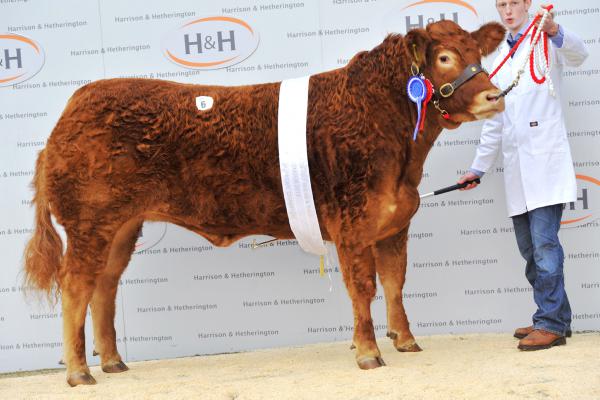
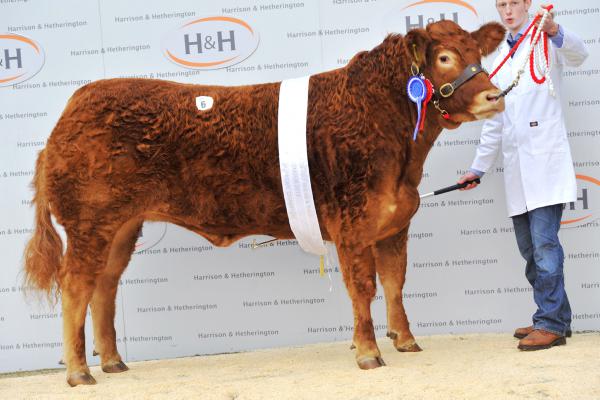
The top price of the sale went to the supreme champion, Ronick Honey, exhibited by R Dick, Stirling.
This stylish heifer won her class at the Royal Highland show earlier in the summer and also won the best heifer in the 2013 Scottish Limousin Club Herds competition.
Born in February 2012, she is out of the stock sire Rathconville Eugene and sold for the top price of 20,000gns to GR & SC Brooke, Berwickshire. She has a beef value of LM+38.
In the weanling section, joint buyers D Small, Kilkeel, Co Down and J Alexander, Randalstown, Co Antrim, paid 4,500gns for the heifer calf, Ronick Ivory, a Rathconville Eugene daughter.
Overall, 24 maiden heifers sold to average stg£4,500; 20 weaned bull calves averaged stg£2,600 and 34 weaned heifer calves averaged stg£1,974.
Simmental
society news
At the AGM in October, Mayo breeder Tom Maloney from Bohola, Claremorris, was selected as the new Simmental Society president. Tom runs the Carroward Simmental herd which was established in 1998.
This year saw a group of youngsters from the Simmental Young Members Association compete in an international stock judging competition which took place at Enniskillen Show.
The Irish team acquitted themselves admirably with Niamh Oliver being awarded best individual. The Irish team was made up of Eileen McGarry, Ciaran Kinahan, Niamh Oliver and Sean McGarry under the stewardship of Jennie Aherne.
Simmental sales dates for 2014:
Roscommon spring premier – Saturday 15 MarchTullamore – Saturday 19 AprilRoscommon – Friday 16 MayRoscommon autumn premier – Saturday 1 NovemberParthenaise AGM
At the recent Irish Parthenaise AGM in Portlaoise, the following were elected:
President, Gerard Scally, Co Kildare; chairman, Liam Fitzgerald, Co Cork; secretary, Laurie Harney, Co Galway; PRO, Dermot O’Brien, Co Kerry; treasurer, John Whyte, Co Galway.
New Charolais breed development officer
The Irish Charolais Cattle Society has just announced the appointment of a new breed development officer.
Neven McKiernan (24) comes from just outside Ballinagh in Co Cavan. With a very strong background in breeding pedigree cattle, Neven has been involved in the family business since a young age and has hands-on practical experience in producing high quality livestock for sale.
In 2011, he graduated from Dundalk Institute of Technology with an honours degree in sustainable agriculture.
He was then awarded a Walsh Fellowship Masters through the Teagasc/UCD Agricultural Innovation Support Programme and has recently finished working in Ballyhaise Agricultural College.
One of his primary responsibilities in this role was to provide lectures in beef production and animal science.
Neven will work with both pedigree and commercial farmers in his role to drive and develop the Charolais breed in Ireland.







SHARING OPTIONS