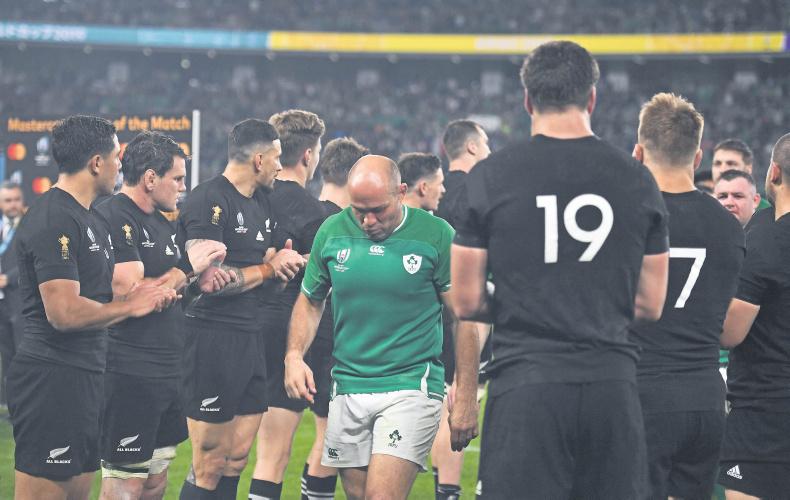
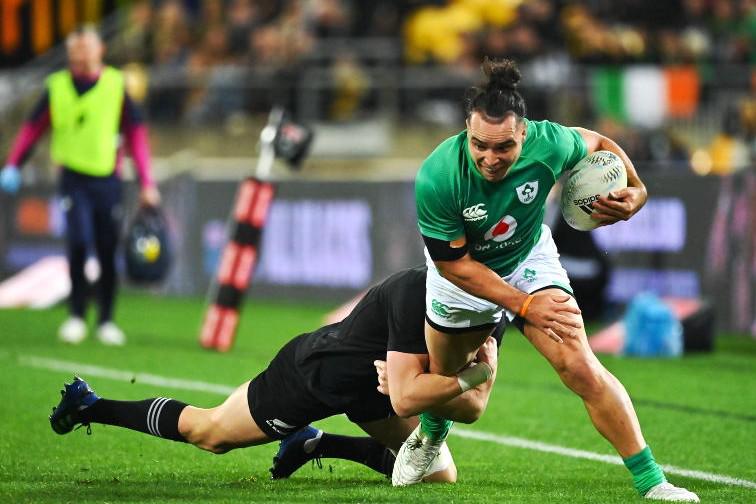
In one sense, Saturday’s Rugby World Cup loss to New Zealand can be said to be just one of those things.
Ireland were the underdogs, going in against a side that has won 17 consecutive games in the competition since the 2007 quarter-final loss to France (18 if their match with Italy hadn’t been cancelled) and a 46-14 defeat can be classed as a fair reflection of the standings of the two countries.
And then, on the other hand, it was yet another crushing disappointment in the annals of Ireland’s history at the Rugby World Cup. This is the sport’s ninth World Cup and it was Ireland’s seventh knockout game, having twice failed to make it out of their group (1987 and 2007). Unfortunately, it’s now zero wins from those nine, with a four-year wait before there’s a chance to put things right.
The noises were that this was the time that things would be different. Having topped their pools in 2011 and 2015 only to lose quarter-finals to second-placed sides Wales and Argentina, everything over the past four years was geared towards making the marginal gains necessary to get over the ever-growing stumbling block.
A deep squad was being established with the aim of peaking at the right time. To a degree, that was done, but the unfortunate thing was that it happened a year too early, with the home win over New Zealand a year ago the high point of the cycle.
Confidence formula
The riddle of creating and maintaining confidence and form affects sportsmen and women at all levels across all sports and until there is a defined formula for the creation of same, we will have the great uncertainties that make us love sport.
Why were all of the passes sticking against the All Blacks at the Aviva in November 2018 and many of the same players were making avoidable errors on Saturday?
We tell ourselves that elite athletes shouldn’t be nervous but then they are human like the rest of us. And, in looking at things through an Ireland prism, we shouldn’t forget that Steve Hansen and his men came to the game looking to win as well.
The problem with millstones is that they become heavier with age and this unwanted statistic is something that will follow Irish rugby – and be used by critics as a stick with which to beat it – until it no longer exists.
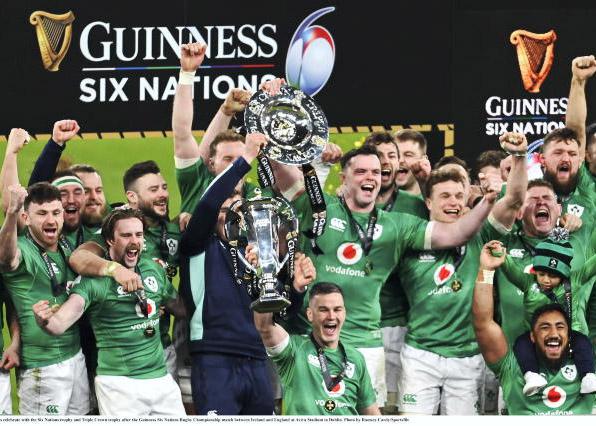
Obviously, it’s a shame that Joe Schmidt’s reign had to end in such a fashion. The New Zealander leaves with three Six Nations wins to his name, including the outstanding grand slam of 2018, and he is the only coach to lead Ireland to a win against the All Blacks. However, the failure on two occasions to advance in the World Cup must go into the debit column.
Japanese failure
Anyone can – and generally does – lose to New Zealand though and it is the pool defeat to Japan which will be what Irish fans, players and management reflect on when the analysis of the tournament performance takes place.
The failure to win that match, after going 12-3 in front, caused the chain-reaction that led to a quarter-final against the All Blacks rather than South Africa, who made tough work of Japan for most of their game on Sunday before eventually pulling away in the closing stages. If Ireland had played, and beaten South Africa, we would now be looking forward to a semi-final against Wales, but obviously there is no point in dealing in what-ifs.
As Andy Farrell takes office, he will know that his tenure will largely be defined by the performance at France 2023, given that Ireland have managed to achieve everything else on the international stage. Harsh perhaps, but anything else but that elusive knockout win would be seen as stagnation.
Football’s second tier gets the green light for 2020
After last week’s discussions on the proposals for a second tier in the inter-county football championship, we were expecting a closer vote, but last Saturday’s Special Congress in Páirc Uí Chaoimh saw the motion passed by just more than three quarters of delegates.
Given that so many players from the counties likely to be taking part, and the GPA, were opposed to the advent of what is effectively a ‘B’ championship – or, at least, opposed to what was being put forward – its fair to wonder as to the levels of disconnect between those on the pitch and those in the boardroom, but that’s a debate for another day.
There have been assurances that the semi-finals and final of the new competition, effectively a resurrection of the old Tommy Murphy Cup, will be shown on television.
However, it was interesting to note the comments of Antrim County Board delegate Ciarán McCavana, who pointed out that similar promises regarding the Joe McDonagh Cup in hurling hadn’t been delivered and that the mooted All-Stars scheme for the competition have also been botched.
As ever, the truth will be in the numbers, in terms of those attending games, watching them once games are shown on television and the revenue generated.
Other motions
With the championship format taking up the bulk of the attention, the other three motions up for discussion flew somewhat under the radar.
Having been in operation in experimental format in this year’s national football league, the ‘advanced mark’, sin-bin and 20 metre restart were all fairly well received and all three passed with huge majorities.
The mark rewards attacking play and will hopefully have a positive effect, while the 20m restart should theoretically make it easier for the middle of the field mark to be achieved.
In terms of stamping out cynical play, 10 minutes playing with reduced numbers should be more of a deterrent than being able to make a substitution.
Too often though, the black card has been used as a cop-out when a red card should be shown, with cast-iron black-card offences then only punished with a yellow. The willingness of referees to properly apply the rules is key.
In one sense, Saturday’s Rugby World Cup loss to New Zealand can be said to be just one of those things.
Ireland were the underdogs, going in against a side that has won 17 consecutive games in the competition since the 2007 quarter-final loss to France (18 if their match with Italy hadn’t been cancelled) and a 46-14 defeat can be classed as a fair reflection of the standings of the two countries.
And then, on the other hand, it was yet another crushing disappointment in the annals of Ireland’s history at the Rugby World Cup. This is the sport’s ninth World Cup and it was Ireland’s seventh knockout game, having twice failed to make it out of their group (1987 and 2007). Unfortunately, it’s now zero wins from those nine, with a four-year wait before there’s a chance to put things right.
The noises were that this was the time that things would be different. Having topped their pools in 2011 and 2015 only to lose quarter-finals to second-placed sides Wales and Argentina, everything over the past four years was geared towards making the marginal gains necessary to get over the ever-growing stumbling block.
A deep squad was being established with the aim of peaking at the right time. To a degree, that was done, but the unfortunate thing was that it happened a year too early, with the home win over New Zealand a year ago the high point of the cycle.
Confidence formula
The riddle of creating and maintaining confidence and form affects sportsmen and women at all levels across all sports and until there is a defined formula for the creation of same, we will have the great uncertainties that make us love sport.
Why were all of the passes sticking against the All Blacks at the Aviva in November 2018 and many of the same players were making avoidable errors on Saturday?
We tell ourselves that elite athletes shouldn’t be nervous but then they are human like the rest of us. And, in looking at things through an Ireland prism, we shouldn’t forget that Steve Hansen and his men came to the game looking to win as well.
The problem with millstones is that they become heavier with age and this unwanted statistic is something that will follow Irish rugby – and be used by critics as a stick with which to beat it – until it no longer exists.
Obviously, it’s a shame that Joe Schmidt’s reign had to end in such a fashion. The New Zealander leaves with three Six Nations wins to his name, including the outstanding grand slam of 2018, and he is the only coach to lead Ireland to a win against the All Blacks. However, the failure on two occasions to advance in the World Cup must go into the debit column.
Japanese failure
Anyone can – and generally does – lose to New Zealand though and it is the pool defeat to Japan which will be what Irish fans, players and management reflect on when the analysis of the tournament performance takes place.
The failure to win that match, after going 12-3 in front, caused the chain-reaction that led to a quarter-final against the All Blacks rather than South Africa, who made tough work of Japan for most of their game on Sunday before eventually pulling away in the closing stages. If Ireland had played, and beaten South Africa, we would now be looking forward to a semi-final against Wales, but obviously there is no point in dealing in what-ifs.
As Andy Farrell takes office, he will know that his tenure will largely be defined by the performance at France 2023, given that Ireland have managed to achieve everything else on the international stage. Harsh perhaps, but anything else but that elusive knockout win would be seen as stagnation.
Football’s second tier gets the green light for 2020
After last week’s discussions on the proposals for a second tier in the inter-county football championship, we were expecting a closer vote, but last Saturday’s Special Congress in Páirc Uí Chaoimh saw the motion passed by just more than three quarters of delegates.
Given that so many players from the counties likely to be taking part, and the GPA, were opposed to the advent of what is effectively a ‘B’ championship – or, at least, opposed to what was being put forward – its fair to wonder as to the levels of disconnect between those on the pitch and those in the boardroom, but that’s a debate for another day.
There have been assurances that the semi-finals and final of the new competition, effectively a resurrection of the old Tommy Murphy Cup, will be shown on television.
However, it was interesting to note the comments of Antrim County Board delegate Ciarán McCavana, who pointed out that similar promises regarding the Joe McDonagh Cup in hurling hadn’t been delivered and that the mooted All-Stars scheme for the competition have also been botched.
As ever, the truth will be in the numbers, in terms of those attending games, watching them once games are shown on television and the revenue generated.
Other motions
With the championship format taking up the bulk of the attention, the other three motions up for discussion flew somewhat under the radar.
Having been in operation in experimental format in this year’s national football league, the ‘advanced mark’, sin-bin and 20 metre restart were all fairly well received and all three passed with huge majorities.
The mark rewards attacking play and will hopefully have a positive effect, while the 20m restart should theoretically make it easier for the middle of the field mark to be achieved.
In terms of stamping out cynical play, 10 minutes playing with reduced numbers should be more of a deterrent than being able to make a substitution.
Too often though, the black card has been used as a cop-out when a red card should be shown, with cast-iron black-card offences then only punished with a yellow. The willingness of referees to properly apply the rules is key.






SHARING OPTIONS