The Christmas and new year period can often be a time of reflection on the year that has just gone by and a time of planning and anticipation of the year that is to come.
This is true both professionally and personally for most people and farmers are no different. Unfortunately, for most farmers in the northwest 2017 is a year that will be remembered for all the wrong reasons.
Flooding
The flooding on 22 August is the first thing that springs to mind, when people had their homes destroyed, farmers lost livestock, fodder, fencing and, in some cases, even sheds, whole fields and large areas of forestry were washed away.
From a farming point of view, 2017 was a reasonable year up until the beginning of August, but the past five months have been nothing short of diabolical.
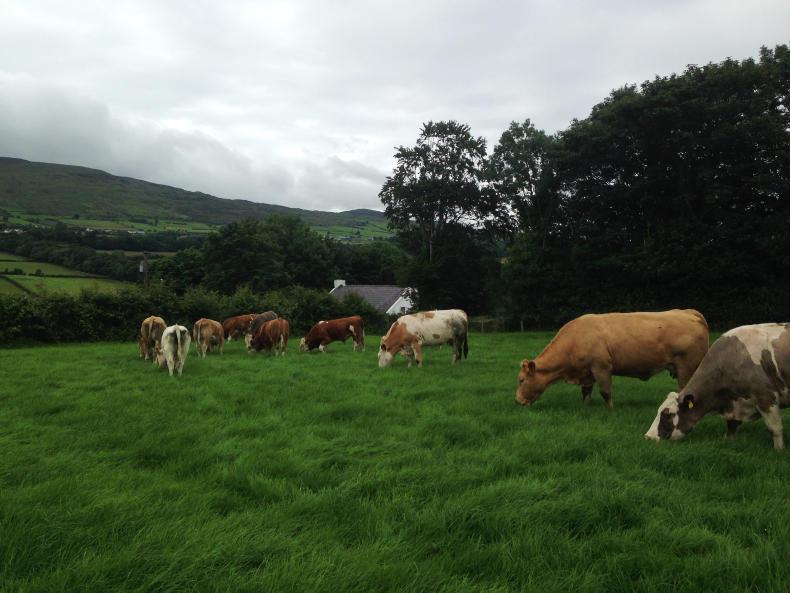
Cattle were housed on many farms from early September
Cattle were housed on many farms from early September. Second-cut silage was not able to be harvested, either due to the flooding or poor ground conditions.
Where farmers did manage to get their second cuts harvested, the quality was often well below where it should be due to the crop growing way too long.
Tillage farmers also got badly hit. Grain yields were down, a lot of straw was never baled and, in some cases, grain crops weren’t harvested at all - a huge loss for the farmers involved.
Sheep also had to be housed early as ground conditions were just saturated.
All in all, it has left the situation whereby many farmers are short of winter fodder and bedding and extra meal is being bought to fill the gap, which is of course an added expense.
Resilient
But enough of the doom and gloom. Farming is a tough business, we’re all aware of that, and the weather can make it 10 times tougher. But farmers are a resilient bunch. We’ll move on and hope for a better 2018.
We can’t control the weather, so there is little point in worrying about it. There are many things that we as farmers have control of inside our farm gate that we can use to make 2018 a better more productive year, whatever the weather.
We can’t control the weather so there is little point in worrying about it
Simple things like doing a profit monitor will help to show the main strengths and weaknesses of the farm. You can then benchmark your figures against the top-performing farms in the country.
Areas where costs can be reduced can very easily be seen at a glance, as well as areas in need of improvement.
Soil testing all or part of the farm will hopefully lead to improved soil fertility by the targeted use of P, K and lime. This will, in turn, lead to more grass grown on the farm, which is the cheapest form of fodder. Extra grass used correctly and turned into beef, lamb or milk will increase profit.
Sentiment
I once read a book written in New Zealand entitled 101 ways to improve your dairy farm. Point number 101 was “plant an orange or lemon tree. They look pretty and smell nice.”
While an orange or lemon tree planted in this country is unlikely to perform very well, the message and sentiment behind the advice can be copied. Small changes can make a huge difference!
Happy new year to all! Let’s make it a good one, no matter what the weather throws at us.
Read more
Farmer Writes: one dead and another with a bizarre ailment
Farmer Writes: New Zealand farmers hung out to dry over water
The Christmas and new year period can often be a time of reflection on the year that has just gone by and a time of planning and anticipation of the year that is to come.
This is true both professionally and personally for most people and farmers are no different. Unfortunately, for most farmers in the northwest 2017 is a year that will be remembered for all the wrong reasons.
Flooding
The flooding on 22 August is the first thing that springs to mind, when people had their homes destroyed, farmers lost livestock, fodder, fencing and, in some cases, even sheds, whole fields and large areas of forestry were washed away.
From a farming point of view, 2017 was a reasonable year up until the beginning of August, but the past five months have been nothing short of diabolical.
Cattle were housed on many farms from early September
Cattle were housed on many farms from early September. Second-cut silage was not able to be harvested, either due to the flooding or poor ground conditions.
Where farmers did manage to get their second cuts harvested, the quality was often well below where it should be due to the crop growing way too long.
Tillage farmers also got badly hit. Grain yields were down, a lot of straw was never baled and, in some cases, grain crops weren’t harvested at all - a huge loss for the farmers involved.
Sheep also had to be housed early as ground conditions were just saturated.
All in all, it has left the situation whereby many farmers are short of winter fodder and bedding and extra meal is being bought to fill the gap, which is of course an added expense.
Resilient
But enough of the doom and gloom. Farming is a tough business, we’re all aware of that, and the weather can make it 10 times tougher. But farmers are a resilient bunch. We’ll move on and hope for a better 2018.
We can’t control the weather, so there is little point in worrying about it. There are many things that we as farmers have control of inside our farm gate that we can use to make 2018 a better more productive year, whatever the weather.
We can’t control the weather so there is little point in worrying about it
Simple things like doing a profit monitor will help to show the main strengths and weaknesses of the farm. You can then benchmark your figures against the top-performing farms in the country.
Areas where costs can be reduced can very easily be seen at a glance, as well as areas in need of improvement.
Soil testing all or part of the farm will hopefully lead to improved soil fertility by the targeted use of P, K and lime. This will, in turn, lead to more grass grown on the farm, which is the cheapest form of fodder. Extra grass used correctly and turned into beef, lamb or milk will increase profit.
Sentiment
I once read a book written in New Zealand entitled 101 ways to improve your dairy farm. Point number 101 was “plant an orange or lemon tree. They look pretty and smell nice.”
While an orange or lemon tree planted in this country is unlikely to perform very well, the message and sentiment behind the advice can be copied. Small changes can make a huge difference!
Happy new year to all! Let’s make it a good one, no matter what the weather throws at us.
Read more
Farmer Writes: one dead and another with a bizarre ailment
Farmer Writes: New Zealand farmers hung out to dry over water








SHARING OPTIONS