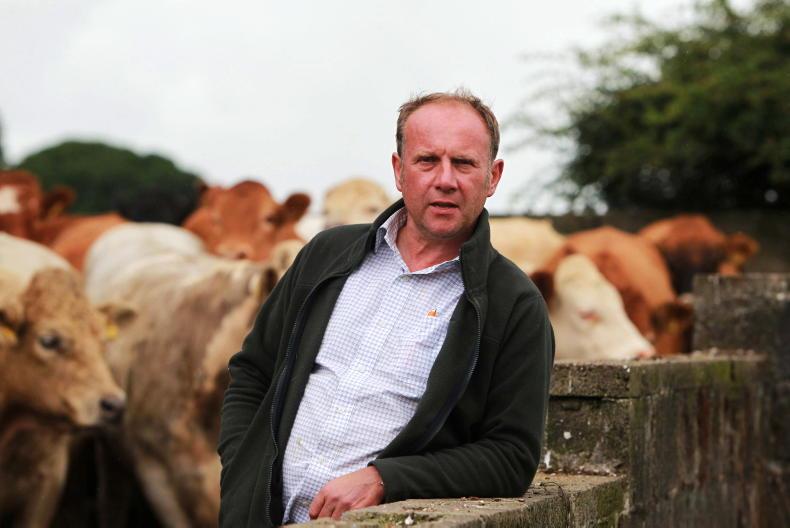
I’ve always had a soft spot for suckler farmers and it’s great news that the decline in suckler cow numbers has halted and is now showing a small increase. Over the past 10 years, successive governments and indeed their sidekick, Teagasc, did their best to wipe out sucklers in favour of more dairy cows.
But the suckler men (and women) have persevered and for the past 18 months are receiving decent money for their weanlings and long may they remain as the backbone of our beef industry. The beef price will have to hang close to €7/kg for this to happen even with a loss of market share in the important UK market.
However, that’s a promotional job for Bord Bia who have lost face and must endeavour to regain credibility with Irish farmers, whose interests they are supposed to serve.
The dry weather since mid-April was very welcome and timely. But soils have remained cold and the emergence of sown crops is taking a while. The beans have taken a month to be properly visible in the row.
I’ve seldom seen our winter crops to be such a mixed bag. I’m now happy with the oilseed rape; it looked to be poorly branched some weeks ago but the PGR/fungicide Caryx certainly helped, as it now looks to be a full crop. Or so I thought while spraying at full flower when everything was a calm sea of dazzling yellow. It’s good that the oilseed rape looks promising as it totals almost a quarter of our tillage area this year.
The winter barley is a different story though. Two decent sized fields are fine and will yield well but then there’s a clatter of fields that range from very, very poor to very average. But it’s entirely a legacy of the six months of continuous rain. The final fungicide is on, so it’s out of my hands now and I’m glad to let it go.
I shall have to be more careful in future to confine winter barley to the fields that suit it better but that doesn’t leave a huge number of options.
Maybe I’ll do a continuous run in those fields that suit it and push the oilseed rape into a longer rotation. That would be a good thing as we’re now seeing the onset of some club root in one rape field. But we’ve never had rape more often than one year in four but maybe we should extend rotation to one year in six.
The wheat is similar and for the same reason. There are a few good crops that I’ll push the boat out with but the rest are unexciting and, all told, between this and the low prices, it’s not going to be a big harvest.
I don’t expect that we will be investing much money into the place or machinery but we’ve had a good run of improvements and re-investment.
I’m very happy with where we are in this regard. The farm and yards look well and we have never been in such a good place machinery-wise. Yes, the combine is 2017 but it’s a keeper and the rest of the equipment is fine – and that includes the 2005 Bateman.
Tractor-wise we are good for years to come and especially so since I traded that horrible Massey Ferguson 5712 and replaced it with a little beauty of a KK 2021 Fendt 516.
You’d imagine I’d have liked the Massey as it’s a typical suckler farmer’s tractor. I thought I would, but the local gurus knew better.
But ironically the little Fendt probably belonged to a suckler farmer. It can’t have been a dairy farmer’s – it’s far too smart for that.