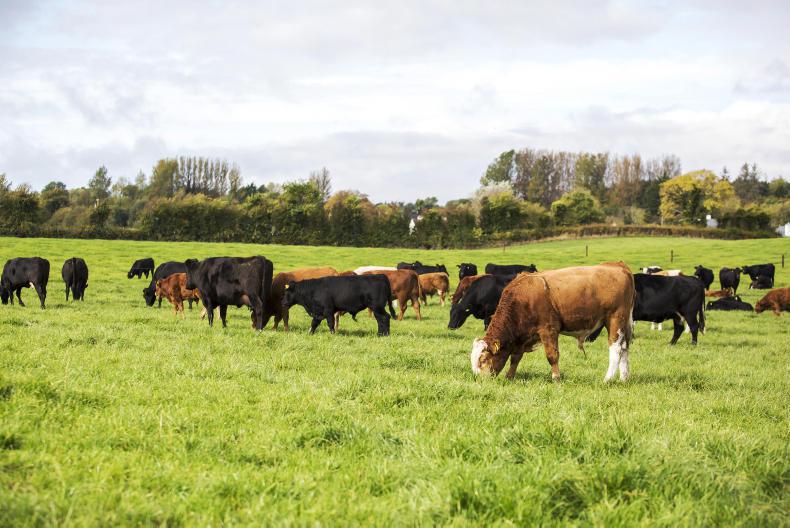
Recently, I was delighted to be invited by the Irish Farmers Journal to visit its beef and sheep farm in Tullamore.
On the flight over I reminisced about the Ashton Clinton Cowtel, which was established in the 1960s by the English Farming Journal to milk a thousand cows, an incredible number in those days. Since it was run by journalists, it failed.
On arrival at Tullamore, I was immediately impressed by the commitment of the farm manager and the sheer standard to which the farm was run.
It was refreshing to encounter a research farm that had everything on show – its successes and the occasional failure.
There was some debate about the initial start-up cost, but the project was designed to portray the opportunities on the running of a beef and sheep farm, not on the establishment of one.
I was reminded of the phrase my mother once taught me: “Scratch an Irishman and you will find a farmer.”
It would appear that all the staff at the Irish Farmers Journal are no more than one step from the land, which means that any of the Journal staff involved in the Tullamore project has a complete understanding of agriculture.
Farmer writers
It was good to meet up with other Farmer Writes columnists and the WhatsApp exchanges that followed were quite entertaining.
The subject of Brexit hardly got discussed, which I think was a shame, because the mood in Ireland is that it will be a disaster for Irish agriculture. I fear that I am a lone voice: predicting great disasters hide great opportunities.
I’m sure the entrepreneurial Irish spirit will bring Irish agriculture through, definitely for milk, and if you remember that Kerrygold is the biggest selling butter in Germany based on the ethic of milk from grass, surely there is sales potential in Irish beef from grass?
No investment
Here at home, after 40 years of virtually no investment, with the stronger milk price we feel we can start investing in the building infrastructure, which is in a very sorry state.
The first step was a new 20-20 milking parlour and covered collecting yard. We have also put in a clamp for maize that was delivered yesterday, supplied and bought by the tonne (£30/t).
This was thought to be much needed because first and second cuts were minimal – only about three-quarters of the winter supply needed, though the only word to describe the grass growth since is prodigious.
One two-acre paddock which has been grazed nine times was then shut up, cut and baled, and produced 25 big, round bales. The grass is still growing just, but we are offering cows four big bales of silage a day for the sake of the autumn calvers.
Sensitive area
Since we have moved into a catchment sensitive area (thanks to our polluted brook), there are now capital grants available to improve the water quality.
Thus we are currently ripping up and relaying all the concrete yards, which is grant-funded.
We are also able to source grants to roof existing concrete and to cover feed areas, which is the next project. All this financial help is very welcome.
Read more
Farmer Writes: farming in politically unstable Catalonia
Farmer Writes: calendar farming doesn’t work
Recently, I was delighted to be invited by the Irish Farmers Journal to visit its beef and sheep farm in Tullamore.
On the flight over I reminisced about the Ashton Clinton Cowtel, which was established in the 1960s by the English Farming Journal to milk a thousand cows, an incredible number in those days. Since it was run by journalists, it failed.
On arrival at Tullamore, I was immediately impressed by the commitment of the farm manager and the sheer standard to which the farm was run.
It was refreshing to encounter a research farm that had everything on show – its successes and the occasional failure.
There was some debate about the initial start-up cost, but the project was designed to portray the opportunities on the running of a beef and sheep farm, not on the establishment of one.
I was reminded of the phrase my mother once taught me: “Scratch an Irishman and you will find a farmer.”
It would appear that all the staff at the Irish Farmers Journal are no more than one step from the land, which means that any of the Journal staff involved in the Tullamore project has a complete understanding of agriculture.
Farmer writers
It was good to meet up with other Farmer Writes columnists and the WhatsApp exchanges that followed were quite entertaining.
The subject of Brexit hardly got discussed, which I think was a shame, because the mood in Ireland is that it will be a disaster for Irish agriculture. I fear that I am a lone voice: predicting great disasters hide great opportunities.
I’m sure the entrepreneurial Irish spirit will bring Irish agriculture through, definitely for milk, and if you remember that Kerrygold is the biggest selling butter in Germany based on the ethic of milk from grass, surely there is sales potential in Irish beef from grass?
No investment
Here at home, after 40 years of virtually no investment, with the stronger milk price we feel we can start investing in the building infrastructure, which is in a very sorry state.
The first step was a new 20-20 milking parlour and covered collecting yard. We have also put in a clamp for maize that was delivered yesterday, supplied and bought by the tonne (£30/t).
This was thought to be much needed because first and second cuts were minimal – only about three-quarters of the winter supply needed, though the only word to describe the grass growth since is prodigious.
One two-acre paddock which has been grazed nine times was then shut up, cut and baled, and produced 25 big, round bales. The grass is still growing just, but we are offering cows four big bales of silage a day for the sake of the autumn calvers.
Sensitive area
Since we have moved into a catchment sensitive area (thanks to our polluted brook), there are now capital grants available to improve the water quality.
Thus we are currently ripping up and relaying all the concrete yards, which is grant-funded.
We are also able to source grants to roof existing concrete and to cover feed areas, which is the next project. All this financial help is very welcome.
Read more
Farmer Writes: farming in politically unstable Catalonia
Farmer Writes: calendar farming doesn’t work






SHARING OPTIONS