Last year saw increased demand for calves from farmers and rearers throughout the country. The superlevy situation resulted in some dairy farmers rearing additional calves to soak up some of the surplus milk, while high cattle prices caused other farmers to buy calves and rear them instead of investing everything in weanlings and stores.
There is no doubt that we are in a new era this year. With no superlevy situation, many dairy farmers will most likely look at selling calves as soon as possible off-farm. Although it is too early to tell what demand will be like this year, those who are considering buying calves should choose very carefully when sourcing them.
If there is any doubt as to the health of the calves, it may be worth checking the temperature of some calves, especially those which may appear to be dull. The most efficient method is to use a rectal thermometer, as this gives the most accurate reading. A temperature of above 39.5°C indicates a fever and the calf should not be purchased.
Choosing right type for the system
It is not just about the health of the calf at purchase – you also need to look at the type of calf you are buying and the market you are intending on selling the calf into.
In terms of a Friesian calf to beef system, quality is essential. Bulls or steers need to be produced to a minimum specification to avoid price penalties. If Friesian bulls are being selected for a bull beef system, then they need to be of good enough quality to hit the required specification.
The minimum specification for an under-16-month bull is O=2+ with a carcase weight over 240kg. If you are considering producing bulls over 16 months of age to higher carcase weights, then ensure that you have an avenue to slaughter these when they are fit.
Calf selection is critical to sourcing bulls that will meet this target. While the fat score can be achieved through nutrition and management, conformation can be a sticky one.
Calf quality should be the number one focus at purchase, followed by health and price. While price is important, the difference between a carcase price that hits target and one that doesn’t will often be greater than the difference in the initial price difference in the calves. When selecting a calf, ensure that it:
Has a good frame.Good straight top loin.Is not excessively narrow at the shoulder or hindquarter.Has a good bone structure.Has not got a large belly.Angus and Hereford calves
There has been an increase in demand for Angus and Hereford calves in recent years due to price premiums attainable from the various abattoirs for these finished cattle.
In some cases, premiums of up to 40c/kg or €120 on a 300kg carcase are available. This is a big carrot to dangle in front of a beef producer, but before you go out and pay over the odds for the calf at purchase, you need to remember that the finished animal needs to tick all of the boxes to get this premium.
It is estimated that almost 20% of the Angus cattle that are slaughtered each year do not meet the required specification to attain the price premium.
With the majority of the schemes you need an animal that will have a confirmation of O= or better; if the animal grades O- worse, not only will you be down the bonus payment, but you will also be down the 12c QA bonus. Calf quality for these systems is essential in order to ensure price premiums are obtained.
A factory by factory table of what is available can be found on www.farmersjournal.ie in the archive section on pages 44-45 of the edition published on 19 May 2015. This will be updated in May 2016.
To get the premium payments, planning well ahead is essential, as is being a member of one of the groups. Bonuses vary with the season and number of cattle supplied and northern readers should note in particular the Tesco scheme, which bases its bonus on the British price which has been much higher than the NI price recently.
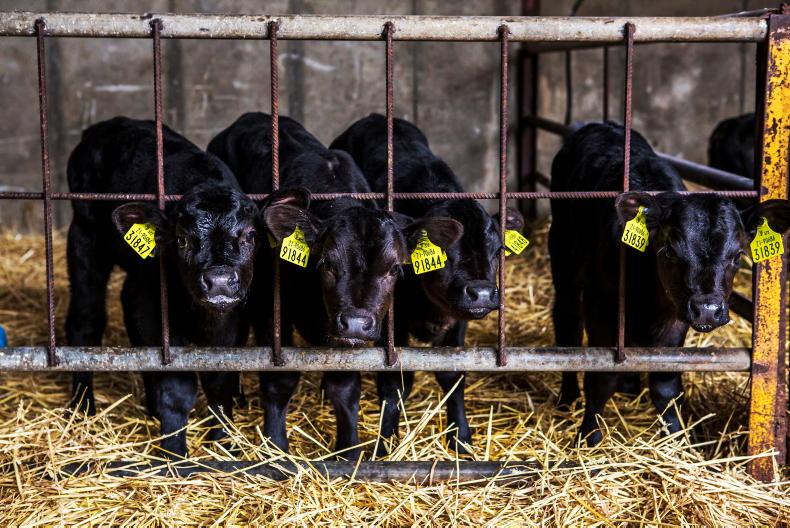
Angus and Hereford calves made up the majority of the extra calves born in 2015, particularly in the dairy herd. Of the 120,000 additional calves that were born last year as a result of quotas ending and dairy expansion, two thirds of these were Angus and Hereford, both up 20% on the previous year.
The big downside of these breeds is that they don’t produce as much beef to sell. However, there are compensations. They finish much quicker than continentals, with little or no meal supplement required. Faster finishing gets money into the farmers’ pockets quicker and absence of intensive meal feeding saves on purchase costs. Given the smaller-sized carcases and early finishing, the chances of getting penalised in the factories because of being overweight or over 30 months are slim.
Read more
Read the full Calf Focus supplement
Last year saw increased demand for calves from farmers and rearers throughout the country. The superlevy situation resulted in some dairy farmers rearing additional calves to soak up some of the surplus milk, while high cattle prices caused other farmers to buy calves and rear them instead of investing everything in weanlings and stores.
There is no doubt that we are in a new era this year. With no superlevy situation, many dairy farmers will most likely look at selling calves as soon as possible off-farm. Although it is too early to tell what demand will be like this year, those who are considering buying calves should choose very carefully when sourcing them.
If there is any doubt as to the health of the calves, it may be worth checking the temperature of some calves, especially those which may appear to be dull. The most efficient method is to use a rectal thermometer, as this gives the most accurate reading. A temperature of above 39.5°C indicates a fever and the calf should not be purchased.
Choosing right type for the system
It is not just about the health of the calf at purchase – you also need to look at the type of calf you are buying and the market you are intending on selling the calf into.
In terms of a Friesian calf to beef system, quality is essential. Bulls or steers need to be produced to a minimum specification to avoid price penalties. If Friesian bulls are being selected for a bull beef system, then they need to be of good enough quality to hit the required specification.
The minimum specification for an under-16-month bull is O=2+ with a carcase weight over 240kg. If you are considering producing bulls over 16 months of age to higher carcase weights, then ensure that you have an avenue to slaughter these when they are fit.
Calf selection is critical to sourcing bulls that will meet this target. While the fat score can be achieved through nutrition and management, conformation can be a sticky one.
Calf quality should be the number one focus at purchase, followed by health and price. While price is important, the difference between a carcase price that hits target and one that doesn’t will often be greater than the difference in the initial price difference in the calves. When selecting a calf, ensure that it:
Has a good frame.Good straight top loin.Is not excessively narrow at the shoulder or hindquarter.Has a good bone structure.Has not got a large belly.Angus and Hereford calves
There has been an increase in demand for Angus and Hereford calves in recent years due to price premiums attainable from the various abattoirs for these finished cattle.
In some cases, premiums of up to 40c/kg or €120 on a 300kg carcase are available. This is a big carrot to dangle in front of a beef producer, but before you go out and pay over the odds for the calf at purchase, you need to remember that the finished animal needs to tick all of the boxes to get this premium.
It is estimated that almost 20% of the Angus cattle that are slaughtered each year do not meet the required specification to attain the price premium.
With the majority of the schemes you need an animal that will have a confirmation of O= or better; if the animal grades O- worse, not only will you be down the bonus payment, but you will also be down the 12c QA bonus. Calf quality for these systems is essential in order to ensure price premiums are obtained.
A factory by factory table of what is available can be found on www.farmersjournal.ie in the archive section on pages 44-45 of the edition published on 19 May 2015. This will be updated in May 2016.
To get the premium payments, planning well ahead is essential, as is being a member of one of the groups. Bonuses vary with the season and number of cattle supplied and northern readers should note in particular the Tesco scheme, which bases its bonus on the British price which has been much higher than the NI price recently.
Angus and Hereford calves made up the majority of the extra calves born in 2015, particularly in the dairy herd. Of the 120,000 additional calves that were born last year as a result of quotas ending and dairy expansion, two thirds of these were Angus and Hereford, both up 20% on the previous year.
The big downside of these breeds is that they don’t produce as much beef to sell. However, there are compensations. They finish much quicker than continentals, with little or no meal supplement required. Faster finishing gets money into the farmers’ pockets quicker and absence of intensive meal feeding saves on purchase costs. Given the smaller-sized carcases and early finishing, the chances of getting penalised in the factories because of being overweight or over 30 months are slim.
Read more
Read the full Calf Focus supplement






SHARING OPTIONS