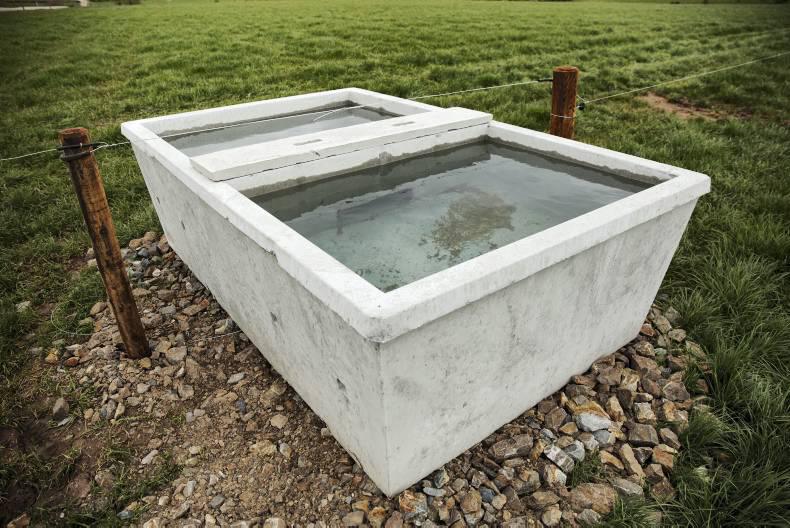
Livestock can survive for a period of time without food but they will not survive without water. Water supply is becoming more of an issue in recent times on farms, with a combination of GLAS and water charges from local county councils. Some farmers participating in GLAS fenced off their rivers from cattle because they opted for the protection of watercourses from bovines and now face the dilemma of how to supply water to their stock during the grazing season.
Rainwater harvesting from shed roofs may start to play a greater role in water supply on the farm as the cost of water hits home, especially on dairy farms where large volumes of water are being used for hosing down yards. However, grant aid for rainwater harvesting is only available in the Organic Capital Investment Scheme in TAMS II and this is probably due to the low uptake of rainwater harvesting in the original TAMS. Perhaps it may be worth including grant aid for rainwater harvesting in the other TAMS II schemes.
On pages 52 and 53 the specifications of rainwater harvesting for the Organic Scheme in TAMS II are set out and the typical costs of purchasing a new tank are shown.
ADVERTISEMENT
Another way to supply water is of course sinking your own well. On page 55 Anthony Jordan looks at how to go about drilling a well on the farm and the costs involved in doing so.
For some farmers who have a river flowing on their farm there may be an option available to them to pump water from the river without the use of fuel or electricity. William Conlon details on pages 56 and 57 how this can be achieved with the use of a ram pump that just uses the force of the river and simple design to pump water to a trough in a field without fuel. This system may suit farmers who are in GLAS and now have their rivers fenced off from cattle, especially if there is no electricity nearby to power a pump.
Finally, on page 54 we look at how a sewage treatment system for a farm household should work. Many of these treatment systems are not working as efficiently as they should and may need upgrading. Unfortunately, grant aid is not available until an inspector finds problems with your treatment system and gives recommendations in an advisory notice.
Read more
To read the full Water and Septic tanks focus supplement click here.
Register for free to read this story and our free stories.
This content is available to digital subscribers and loyalty code users only. Sign in to your account, use the code or subscribe to get unlimited access.
The reader loyalty code gives you full access to the site from when you enter it until the following Wednesday at 9pm. Find your unique code on the back page of Irish Country Living every week.
CODE ACCEPTED
You have full access to the site until next Wednesday at 9pm.
CODE NOT VALID
Please try again or contact support.
Livestock can survive for a period of time without food but they will not survive without water. Water supply is becoming more of an issue in recent times on farms, with a combination of GLAS and water charges from local county councils. Some farmers participating in GLAS fenced off their rivers from cattle because they opted for the protection of watercourses from bovines and now face the dilemma of how to supply water to their stock during the grazing season.
Rainwater harvesting from shed roofs may start to play a greater role in water supply on the farm as the cost of water hits home, especially on dairy farms where large volumes of water are being used for hosing down yards. However, grant aid for rainwater harvesting is only available in the Organic Capital Investment Scheme in TAMS II and this is probably due to the low uptake of rainwater harvesting in the original TAMS. Perhaps it may be worth including grant aid for rainwater harvesting in the other TAMS II schemes.
On pages 52 and 53 the specifications of rainwater harvesting for the Organic Scheme in TAMS II are set out and the typical costs of purchasing a new tank are shown.
Another way to supply water is of course sinking your own well. On page 55 Anthony Jordan looks at how to go about drilling a well on the farm and the costs involved in doing so.
For some farmers who have a river flowing on their farm there may be an option available to them to pump water from the river without the use of fuel or electricity. William Conlon details on pages 56 and 57 how this can be achieved with the use of a ram pump that just uses the force of the river and simple design to pump water to a trough in a field without fuel. This system may suit farmers who are in GLAS and now have their rivers fenced off from cattle, especially if there is no electricity nearby to power a pump.
Finally, on page 54 we look at how a sewage treatment system for a farm household should work. Many of these treatment systems are not working as efficiently as they should and may need upgrading. Unfortunately, grant aid is not available until an inspector finds problems with your treatment system and gives recommendations in an advisory notice.
Read more
To read the full Water and Septic tanks focus supplement click here.
If you would like to speak to a member of our team, please call us on 01-4199525.
Link sent to your email address
We have sent an email to your address. Please click on the link in this email to reset your password. If you can't find it in your inbox, please check your spam folder. If you can't find the email, please call us on 01-4199525.
ENTER YOUR LOYALTY CODE:
The reader loyalty code gives you full access to the site from when you enter it until the following Wednesday at 9pm. Find your unique code on the back page of Irish Country Living every week.





SHARING OPTIONS