


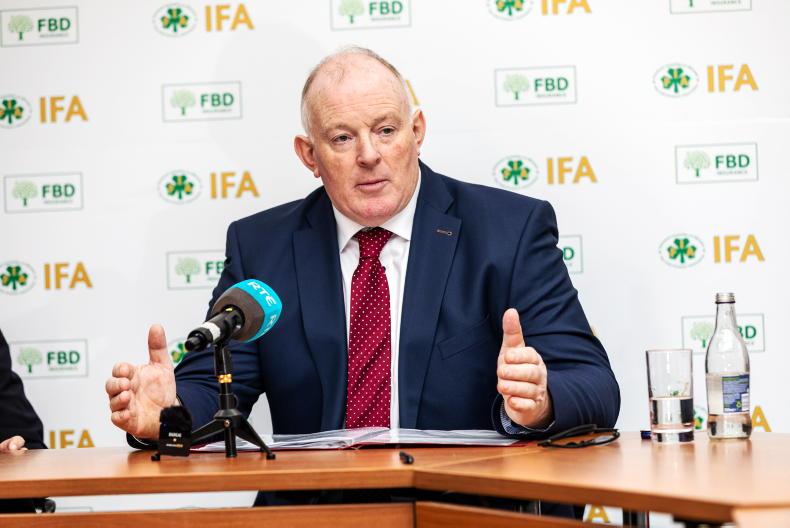
The Irish Farmers Association (IFA) held a beef webinar on Wednesday night with livestock chair Declan Hanrahan, association president Francie Gorman, Bord Bia's Joe Burke, and National Farmers Union (NFU) livestock board chair David Barton all contributing to the meeting.
Joe Burke outlined the 2025 performance which saw a 39% increase to an average price of €7.51/kg. So far in 2026, the Irish price has fallen by 70c/kg and is now €1/kg behind the same period in 2025.
The British price is back approximately 50p/kg since the beginning of the year. This leaves the latest price differential running about 40c/kg behind the UK price.
Burke also outlined that the prime Irish composite price has been running 26c/kg behind the prime export benchmark for the last week.
In terms of outlook, Burke pointed to the fact that there is some recovery expected in the national kill towards the second half of 2026.
As of 1 April, there was 58,929 head of cattle aged between 24 and 30 months in the system. He added that this number wasn’t anything to be concerned about, as we were starting from a very low base from 2025.
Carcase weights
Carcase weights have seen a big recovery for the first four months of 2026, with bullocks coming in 22.9kg heavier at 359kg from January to April 2026.
Heifers are up 16kg, young bulls are up 15.5kg and cows are up 9kg to 302kg.
Better breeding and stock being kept longer due to high replacement costs are some of the reasons for the gains in carcase weights. Carcase weights have dropped back a little in April, but the increased weight is offsetting some of the effects of lower numbers for the factories.
Irish export markets
Retail sales of beef in the UK have been under pressure, with prices up 18.5%, coupled with a 8.8% decline in volume sales. Steak cuts have seen a 10.9% reduction in sales volume in 2026.
Food service volumes are also under pressure, with cheaper exports putting pressure on the Irish share of the food service market.
The EU beef market is a little more stable, with EU beef production down 4.2%. The EU market is also under pressure from cheaper imports. In terms of customer decision-making, beef price still has a huge influence on whether they buy beef or not.
“The data showed that Irish prices were the first to fall in the last few weeks. While Irish beef is many European countries' first choice of imported beef, it is still their second choice behind beef produced in their own country.
"The increases in Australia and New Zealand beef imports is important, but these countries are still concentrating their bigger volumes of beef exports to their more conventional markets.”
English view
NFU livestock board chair David Barton said that he was currently receiving around £6/kg, which translates into €6.95/kg, and this price is back 84p on where it was this time last year. He pointed to the conflict in Iran affecting consumer confidence in the UK and food inflation was also causing concern for consumers.
“I don’t have some sympathy with processors on the imported product and the fact that the imported product is coming in is pulling back the price,” Barton said.
“We have to try and be positive. I don’t think anyone expected that a correction wouldn’t happen, but we didn’t see quite the level of correction that happened,” he added.
Barton also added that, in his view, the decline in the Irish beef price hasn’t affected the UK price.
On further trade deals in the UK, Barton said: “Last week, the British government signed a trade deal with the gulf states that has some good opportunities for lamb in that trade deal. I think lessons were learned on the rushed trade deals that were done in the past and I don’t see that happening again.”
Closing the meeting, IFA president Francie Gorman said: “We met with the board of Meat Industry Ireland this week and outlined the issues our members are facing.
"The issues of price contracts were also discussed with the major beef factories. The IFA [has] been working on the development of a supply contract to be available to be in place for autumn 2026.”



SHARING OPTIONS