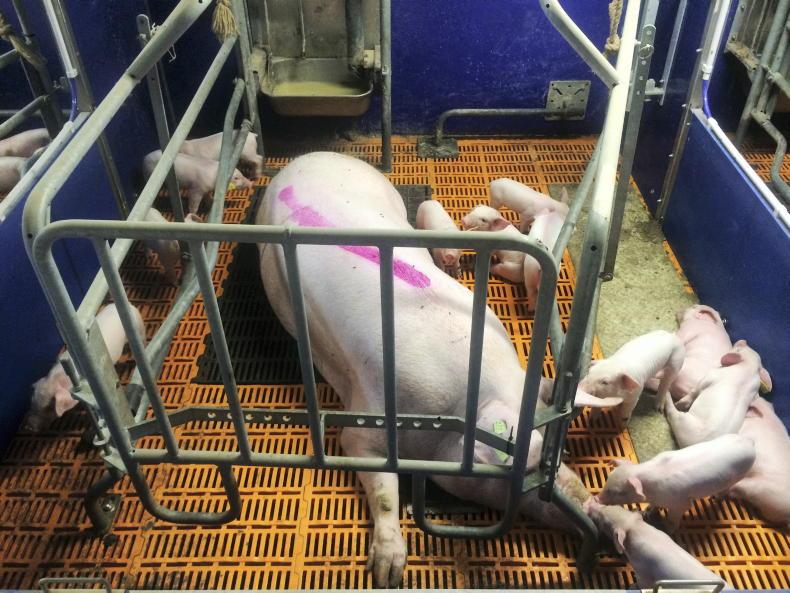
The farrowing house is the foundation for pig performance, health and ultimately, farm profitability.
While much of the focus in recent years has been on increasing litter size and the number of pigs weaned per sow, it is important that we do not lose sight of another key measure of performance: the effect of weaning age and weight on pig lifetime performance.
Most units have a standard five weeks farrowing accommodation (one week pre-farrow and four weeks post-farrow), which delivers an average piglet weaning age of 26-27 days.
At this stage, the piglets’ starch digestive enzymes are increasing in concentration, and these are vital to enable the pig to break down the nutrients in solid food.
The older the pig becomes, the higher the level of digestive enzymes for solid food and therefore, better digestion/performance.
If piglets have lower levels of digestive enzymes at weaning, due to the piglet being younger/weaker, then a higher proportion of the nutrients are not digested in the small intestine and will be passed into the large intestine.
These nutrients will then provide energy for the bacteria we don’t want – E coli, salmonella etc. This in turn can cause scours, oedema and higher mortality in these piglets.
If you can delay the weaning age until 31-32 days, then the piglet has more time to consume dry creep in the farrowing house, which in turn stimulates more enzyme production.
This higher enzyme level means less undigested nutrients are escaping to feed the harmful bacteria in the large intestine.
An additional benefit is that the pig’s immune system is developing rapidly day-by-day and an extra five days gives the pig a much better defence against diseases (See Figure 1).
A case study was undertaken on a pig unit that built an extra week’s farrowing accommodation (34 crates). The cost of this extra accommodation was €210,000. Their weaning age increased from an average of 27 days to 32 days, and the weaning weight rose from 7.2kg to 8.7kg (See Table 1).
Even though the litters/sow/year dropped from 2.35 to 2.30 as weaning age increased, there was a reduced mortality rate in weaners and finishers (by 1.0% and 0.5% respectively) in the older pigs. Therefore, the number of pigs sold /sow/year were nearly identical at 30.2 vs 30.1. However, a big difference / gain was the superior efficiency of the older pigs.
This translated into lowering the cost of production in these older pigs by 5.7c/kg dwt or €5.10 per pig – this figure included the capital costs of the new farrowing house, spread over 10 years.
However, increasing weaning age across the whole herd can be challenging for some units due to their layout. In these situations, a portacabin could provide additional farrowing accommodation, allowing the selection of nurse sows and 20% of the piglets (lightest/youngest) to continue for another week.
If these sow and litters are moved into this house, the normal week’s washing can still be accomplished in the main farrowing house.
This could provide an opportunity to increase the weaning age and weight of the most ‘at-risk’ piglets, thereby reducing mortality and increasing profitability.
Ultimately, an increased potential profitability per year of €108,000 for an average-sized herd needs to be explored. This is even more pertinent in the light of recent grading changes having reduced sale-weights, thereby increasing the cost of production.