


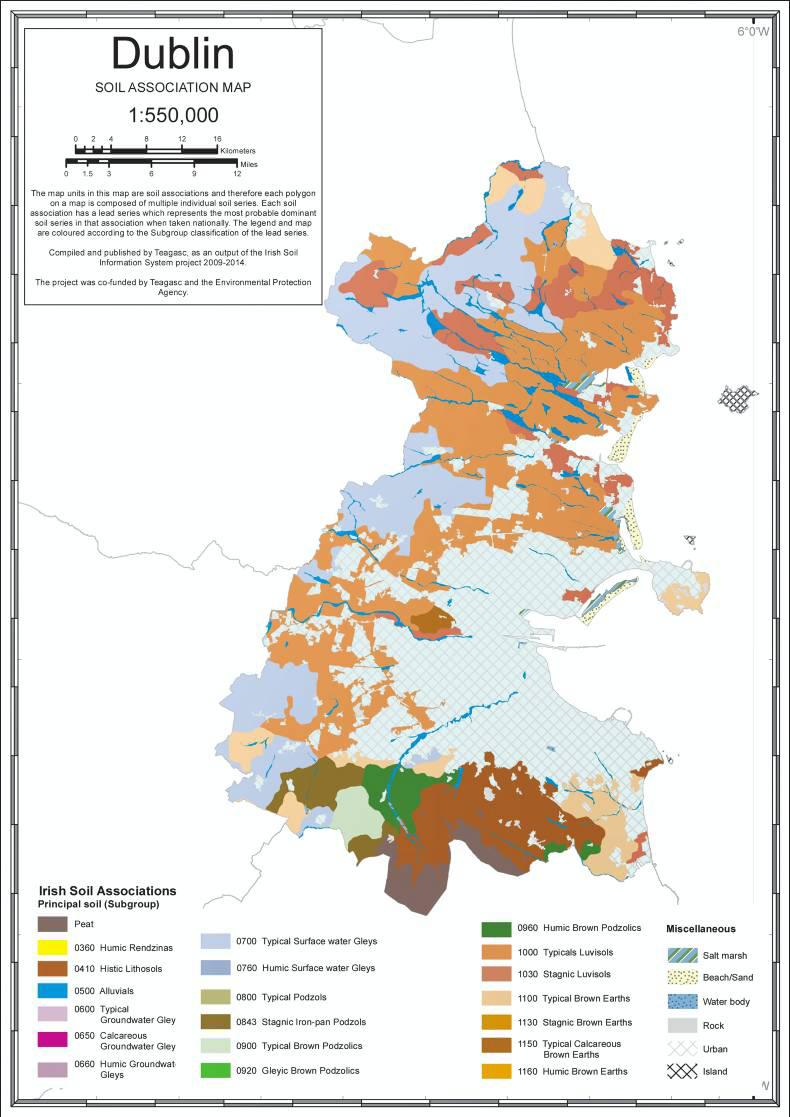
Globally, soil sealing is considered a major soil threat and is associated with the rapid expansion of urbanisation. Sealing refers to the covering of the soil surface with impermeable materials and infrastructure. The greater Dublin area is home to approximately 1.2 million residents. Consequently, a large part of the county has already undergone soil sealing.
This means that these soils are no longer productive for traditional agricultural production because they have been covered over – a process that is generally irreversible. Notably, this does affect the surrounding soil quality due to changes in the water flow patterns or the disintegration of habitats.
Outside of the city, the landscape is mostly lowland areas comprised of limestone glacial till giving rise to luvisols (movement of clay down the soil profile) and rendzinas (shallow soils) on outcropping (exposed) limestone pavement and peat. This is typical from Balbriggan in the northeast to Rathcoole in the south-west. In the northwest, around Garristown, although the landscape is still lowland limestone, here it tends to be wetter and is dominated by surface-water gleys (slowly permeable subsurface layer), interspersed with luvisols.
Overall, luvisols are the most prevalent soil type found in Co Dublin, all of which are the Elton series (found in association 1000a led by subgroup 1000). These are soils in which clay material has moved from the topsoil and has been deposited in the subsoil. This means that they are very good agricultural soils due to their higher clay content as they retain nutrients well.
Poorly draining
However, the increased clay in the subsoil can slow down the movement of water through the profile, meaning that these soils can be moderately to poorly draining, depending on the soil texture.
Despite the fact that Dublin is mostly considered in its urban context, there is good agricultural potential in the county, with these soils found throughout, particularly on the fringes of the city, stretching to the west and to the north, especially towards the coast around Donabate and Rush.
Around Fingal, there is sizeable vegetable production, which benefits from the proximity to such a large domestic market.
Surface-water gleys are the second most prevalent soil type found, the most common being the ‘Straffan’ series (found in association 0700d led by subgroup 0700). These are most obvious along the western county boundary from Balbriggan to the areas around Smithfield and Newcastle.
These surface-water gleys are found on heavy glacial till which gives rise to heavy textured sub-soils and as a result are poorly drained, making them difficult to work with.



SHARING OPTIONS