


The TAMS II Young Farmers Capital Investment Scheme and the general, all-purpose Animal Welfare, Safety and Nutrient Storage Scheme offer grant aid for fixed cattle handling equipment.
Some farmers who have outfarms may be thinking about upgrading their cattle handling facilities on these outblocks with the aid of a TAMS II grant.
To be grant-aid acceptable, all handling facilities need planning permission from a local authority, as well as detailed drawings and a farmyard sketch.
Condon Engineering in Co Louth kindly drew up plans for a typical steel cattle crush that a farmer might build on an outfarm for 20 suckler cows and their calves (Figure 1). In the diagram, the facility is made up of three pens combined with a cattle crush race and semi-automatic skulling gate. It is 57ft long and just over 16ft wide.
According to the Department of Agriculture this permanent facility must meet a number of specifications to be grant acceptable. One aspect that farmers may not be aware of if building a crush to the Department spec is the fact that drainage channels have to be included combined with a holding tank for effluent.
Floor specifications:
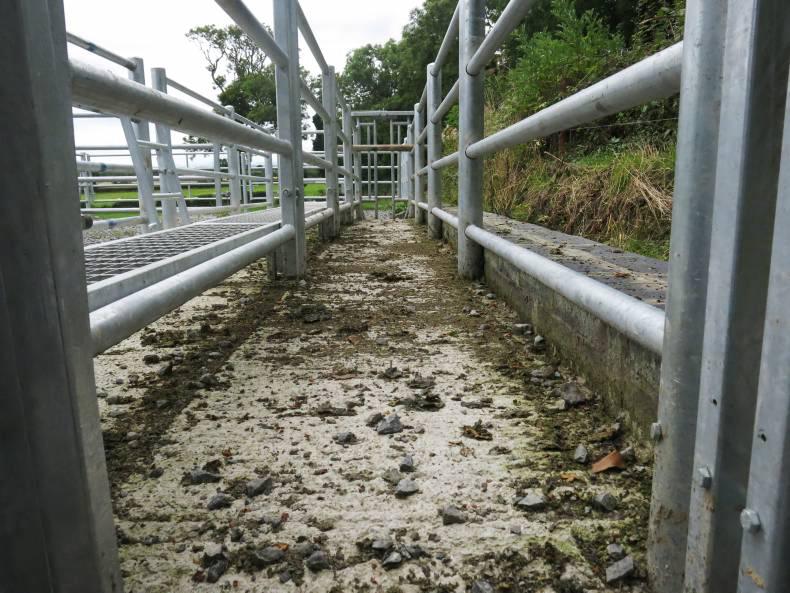
According to the Department, the crush and race has to have a concrete floor. The floor and an area outside the rails (extend to a minimum of 600mm) should have a concrete slab 125mm thick over a 150mm hardcore base. The concrete has to be finished with a non-slip finish or diagonal grooves at 100mm intervals to prevent animals slipping.
A slope of 1 in 60 has to be incorporated into the floor to prevent water build up. The slope shall be directed to suitable drainage channels. People should remember that a concrete certificate is required before grant aid will be paid.
Posts and rails specifications
For posts and rails, all uprights shall be tubular steel at least 76.1mm outer diameter x 5mm thick or hollow section steel 80 x 80 x 4mm thick. They have to be fitted in a 300mm x 300mm x 450mm concrete base at 1.8m centres except skulling gate section, which shall be 1.4m. All side rails, retaining bars and steel sections used in gates have to be tubular steel 48.3mm outer diameter x 3mm thick, or hollow section steel 50mm square x 3mm thick. A minimum of three rails have to be provided equally spaced with the bottom rail 440mm off the ground.
Channels specifications
According to the Department, drainage channels have to be positioned in suitable locations throughout the enclosure. The entire area has to have a concrete base. A slope of 1 in 60 shall be directed to the drainage channels and on to a soiled water or effluent tank.
Seventy-five millimetre channels have to be 75mm deep also, with the edges of the channel tapering inwards slightly. Care should be taken when forming the channel to ensure that adequate depth and fall is maintained during construction and that sufficient concrete is provided at the sides and under the invert of the channel. The foundation for the channel shall be 150mm (from the base of the channel) concrete on top of a 150mm hardcore base. A clean water diversion system shall be installed for runoff after the enclosure has been cleaned and not in use.
A diversion plug of a short length of pipe has to be used to block the flow to the effluent tank. Pipe joints have to be carefully constructed and shall be watertight. All effluent or soiled water must be collected in an approved effluent tank or other approved storage facility and only clean water runoff can be diverted from the storage facility.
Cost
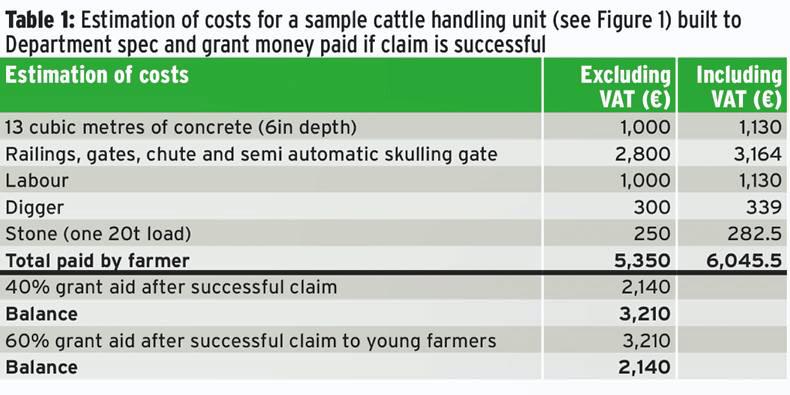
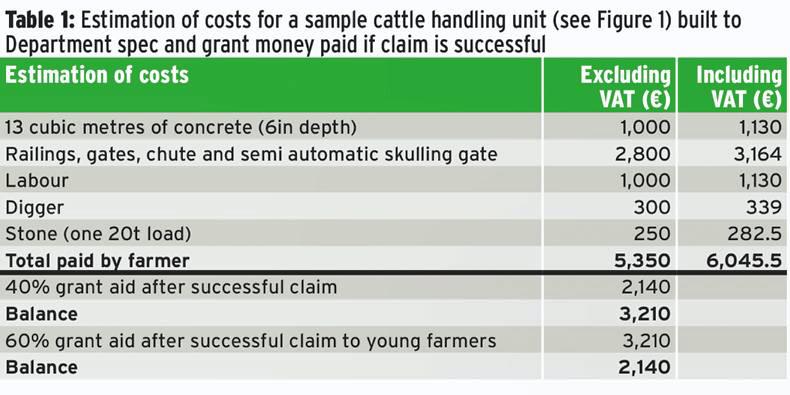
In total we estimate that this cattle handling facility would cost €5,350 excluding VAT (see Table 1). With the grant a farmer would receive €2,140 towards the cost. Under the young farmers scheme a young farmer would receive grant aid of €3,210 towards the cost. All the specifications for farm buildings and cattle handling facilities are on the Department website. When submitting a claim for a grant farmers should make sure their receipts/invoices are itemised and marked paid by a company rep on company headed paper. A date of issue should also be marked and these dates should correspond with the dates an item was paid for. An applicant’s Tax clearance certificate should also be included.
Read more articles from our Livestock Handling focus here.



SHARING OPTIONS