The last few days have been very busy for Alistair, as the very wet summer made way for some sunshine. He has now finished his harvest and is starting to plant crops for next year.
The winter barley averaged 3t/ac. The 10-way variety mix ended up being by far the best on the farm.
There were two fields of it, one ploughed and one min-tilled. The ploughed field had some scutch grass in it, and yielded 3.2t/ac and 4.5 8x4x2.5 bales/ac.
The min-till field did better, with no grass, at 4t and 6 bales/ac. Each bale weighs around 350kg.
The winter wheat, which looked poor all year, and which Alistair was considering ploughing in, yielded 2.5t/ac at 17% to 19% moisture. Alistair says this was better than expected given how poor it looked, and that it will return more than if he had established a spring barley crop.
The winter oilseed rape exceeded expectations too. This was grazed last winter, and was behind other crops in the area, but yielded close to 2t/ac.
This led Alistair to plant 40ac of winter oilseed rape last week.
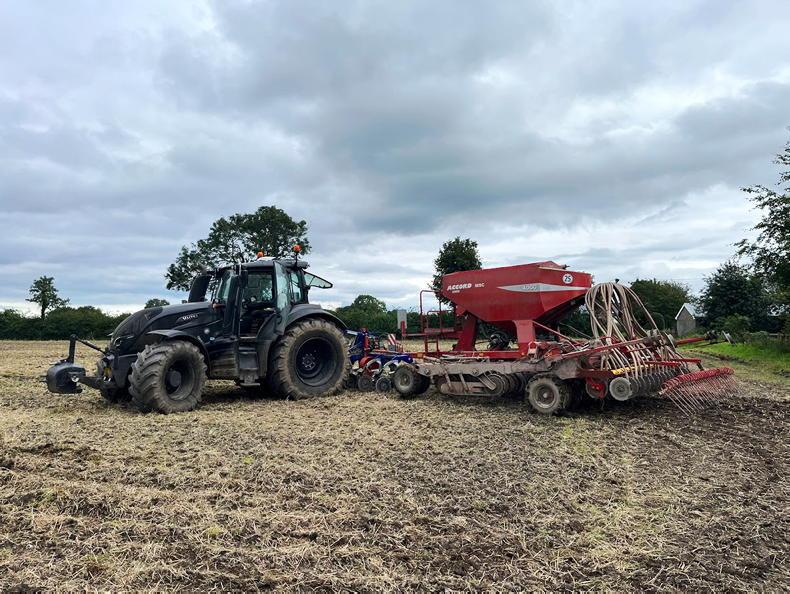
This was established by min-till, with a number of companion crops planted alongside the oilseed rape, including two types of clover, buckwheat, sunflowers and vetch.
The spring beans have been wholecropped. He experimented with three methods, mowing, mowing with a grouper and harvesting using a wholecrop header.
The wholecrop header was by far the best, due to a lot of losses and soil contamination using the two mowing methods. It was also impossible to rake the crop that was mowed and not grouped due to how loose the soil was. However, there were still some losses with the direct cut method.
Alistair is also sowing winter rye this week. He is including some winter wheat with this to help increase the starch of the feed when wholecropped.
Two types of clover and vetch have also been planted as companion crops.
The good weather has returned just after Eamonn finished his harvest, with planting of winter oilseed rape now ongoing.
The winter wheat did well overall, ranging from 4.2t/ac to just over 5t/ac, with the average coming in at 4.6t/ac to 4.7t/ac.
Graham yielded very well but Eamonn found it slightly more difficult to control septoria on this variety this year.

Three John Deere tractors came to the rescue after the combine became stuck on Eamonn Cogan's farm. The header was removed separately by a teleporter.
Champion yielded very well and was earlier to ripen than the other varieties. More Champion will be planted this autumn. Eamonn also says that KWS Dawsum looks like a good variety, and it stood very well in some high winds.
The spring barley was not quite as good, with yields coming in around 2t/ac.
Eamonn was expecting this, and says the worst thing about the barley was getting a combine stuck quite badly in soft ground.
The harvest was then finished with the spring oats.
They yielded 2.7t/ac to 2.8t/ac, which was pretty good considering the hardship it has faced.
A lot of straw was chopped this year, both in the Straw Incorporation Measure and outside of it. Any wet areas were chopped along with headlands as it would be too difficult to get the straw baled.
Eamonn has now started to plough for winter oilseed rape. It is on heavy soils and is just about dry enough to work this week.
He will not have that much this year as he is trying to lengthen the rotation and not take any chances when it comes to clubroot due to experiencing some this year.
Beatrix CL, a Clearfield variety, will be planted as there is a good bit of charlock in the fields to be drilled.
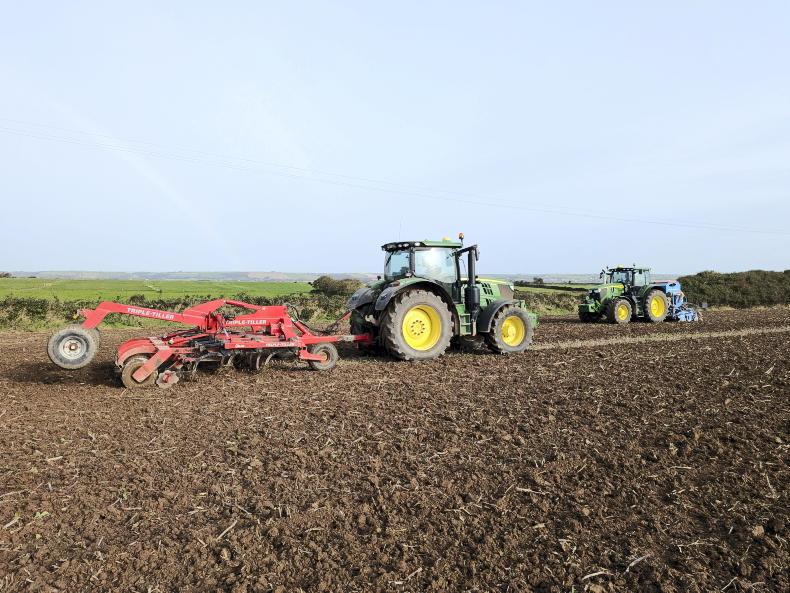
Eamonn also says he has had a couple of cultivators out on demo. He will experiment with some min-till winter wheat this year to see how it will do on his heavy clay soils.
There has been a big break in the harvest at Kildalton College with nearly a month between the last winter crops and the first spring crops being harvested.
This did allow time for cover crops to be established in the first half of August on any winter stubbles that were destined for spring crops.
Common and hairy vetch, phacelia, and linseed was the mix chosen as Damien is trying to steer clear of brassica species due to clubroot concerns.
The spring oats were cut on 27 August and yielded 2.5t/ac at 17% moisture content.
They had a disappointing hectolitre weight of 49kph, due to the grains not filling during the damp, overcast July.

Winter oilseed rape was planted last week at Kildalton College.
They were planted in early March, while some mid-April planted oats were to be harvested imminently when speaking to Damien on Monday.
Variable
The spring barley was very variable during harvesting, with heads ranging from being overripe to still being green due to secondary regrowth.
It was cut on 27 August and yielded 2.5t/ac at 17% moisture and a poor bushel weight of 60kph. All of the straw was due to be baled in the past couple of days.
The spring wheat is ready for harvest. There was also secondary regrowth and a lot of weeds in this. Damien is not expecting a good yield from the spring wheat.
The beans are ready to be cut. The weeds started to take over so the beans were sprayed off, which should help to make the crop easier to harvest and to bring down the moisture content of the beans.
Winter oilseed rape
Winter oilseed rape was planted at Kildalton College last Wednesday, 30 August.
Aurelia was the chosen variety, and the field was ploughed and one-passed, before rolling.
It was planted at 2.5kg/ha, which is equivalent to 55 seeds/m2. Katamaran Turbo was then applied at 2.5l/ha as a pre-emergence herbicide.
The last few days have been very busy for Alistair, as the very wet summer made way for some sunshine. He has now finished his harvest and is starting to plant crops for next year.
The winter barley averaged 3t/ac. The 10-way variety mix ended up being by far the best on the farm.
There were two fields of it, one ploughed and one min-tilled. The ploughed field had some scutch grass in it, and yielded 3.2t/ac and 4.5 8x4x2.5 bales/ac.
The min-till field did better, with no grass, at 4t and 6 bales/ac. Each bale weighs around 350kg.
The winter wheat, which looked poor all year, and which Alistair was considering ploughing in, yielded 2.5t/ac at 17% to 19% moisture. Alistair says this was better than expected given how poor it looked, and that it will return more than if he had established a spring barley crop.
The winter oilseed rape exceeded expectations too. This was grazed last winter, and was behind other crops in the area, but yielded close to 2t/ac.
This led Alistair to plant 40ac of winter oilseed rape last week.
This was established by min-till, with a number of companion crops planted alongside the oilseed rape, including two types of clover, buckwheat, sunflowers and vetch.
The spring beans have been wholecropped. He experimented with three methods, mowing, mowing with a grouper and harvesting using a wholecrop header.
The wholecrop header was by far the best, due to a lot of losses and soil contamination using the two mowing methods. It was also impossible to rake the crop that was mowed and not grouped due to how loose the soil was. However, there were still some losses with the direct cut method.
Alistair is also sowing winter rye this week. He is including some winter wheat with this to help increase the starch of the feed when wholecropped.
Two types of clover and vetch have also been planted as companion crops.
The good weather has returned just after Eamonn finished his harvest, with planting of winter oilseed rape now ongoing.
The winter wheat did well overall, ranging from 4.2t/ac to just over 5t/ac, with the average coming in at 4.6t/ac to 4.7t/ac.
Graham yielded very well but Eamonn found it slightly more difficult to control septoria on this variety this year.

Three John Deere tractors came to the rescue after the combine became stuck on Eamonn Cogan's farm. The header was removed separately by a teleporter.
Champion yielded very well and was earlier to ripen than the other varieties. More Champion will be planted this autumn. Eamonn also says that KWS Dawsum looks like a good variety, and it stood very well in some high winds.
The spring barley was not quite as good, with yields coming in around 2t/ac.
Eamonn was expecting this, and says the worst thing about the barley was getting a combine stuck quite badly in soft ground.
The harvest was then finished with the spring oats.
They yielded 2.7t/ac to 2.8t/ac, which was pretty good considering the hardship it has faced.
A lot of straw was chopped this year, both in the Straw Incorporation Measure and outside of it. Any wet areas were chopped along with headlands as it would be too difficult to get the straw baled.
Eamonn has now started to plough for winter oilseed rape. It is on heavy soils and is just about dry enough to work this week.
He will not have that much this year as he is trying to lengthen the rotation and not take any chances when it comes to clubroot due to experiencing some this year.
Beatrix CL, a Clearfield variety, will be planted as there is a good bit of charlock in the fields to be drilled.
Eamonn also says he has had a couple of cultivators out on demo. He will experiment with some min-till winter wheat this year to see how it will do on his heavy clay soils.
There has been a big break in the harvest at Kildalton College with nearly a month between the last winter crops and the first spring crops being harvested.
This did allow time for cover crops to be established in the first half of August on any winter stubbles that were destined for spring crops.
Common and hairy vetch, phacelia, and linseed was the mix chosen as Damien is trying to steer clear of brassica species due to clubroot concerns.
The spring oats were cut on 27 August and yielded 2.5t/ac at 17% moisture content.
They had a disappointing hectolitre weight of 49kph, due to the grains not filling during the damp, overcast July.

Winter oilseed rape was planted last week at Kildalton College.
They were planted in early March, while some mid-April planted oats were to be harvested imminently when speaking to Damien on Monday.
Variable
The spring barley was very variable during harvesting, with heads ranging from being overripe to still being green due to secondary regrowth.
It was cut on 27 August and yielded 2.5t/ac at 17% moisture and a poor bushel weight of 60kph. All of the straw was due to be baled in the past couple of days.
The spring wheat is ready for harvest. There was also secondary regrowth and a lot of weeds in this. Damien is not expecting a good yield from the spring wheat.
The beans are ready to be cut. The weeds started to take over so the beans were sprayed off, which should help to make the crop easier to harvest and to bring down the moisture content of the beans.
Winter oilseed rape
Winter oilseed rape was planted at Kildalton College last Wednesday, 30 August.
Aurelia was the chosen variety, and the field was ploughed and one-passed, before rolling.
It was planted at 2.5kg/ha, which is equivalent to 55 seeds/m2. Katamaran Turbo was then applied at 2.5l/ha as a pre-emergence herbicide.
SHARING OPTIONS