Price is a function of supply and demand” and today the world has too much grain, according to Dan Basse of AgResource Company.
The expert in commodity markets told the R&H Hall and Barnett Hall Customer Conference last week that grain prices are set to remain at similar levels for the next three years and this price is about equivalent to the cost of production.
“One theme and thesis that keeps coming forward is that we lack that big driver of demand that will change overall price trends. Major weather problems are absent” and Dan explained a major weather problem is what would get markets out of this range, adding that at present markets look to be going sideways.
“We still have oversupplies of grain which is why these markets can’t seem to get off their feet,” he said.
Grain is plentiful and the Chicago-based analyst said he is no longer worried about feeding nine billion people.
Technology on current acres will reach these goals. After all, acres have increased. The world has increased its major crop area of corn, wheat, barley and soybeans by 20m hectares or 50m acres since 1980.
However, the yield gain is slowing with rising global temperatures he explained.
Brazil the behemoth
Brazil is a country that has increased acres and Dan described it as a behemoth, saying the country’s grain growers would eat our lunch in terms of costs of producing grain and soybeans. Soybeans never seem to have a crop failure and the country will export 115m tonnes this year. The country can meet all of China’s demand.
Crucially, Brazil is also creating demand for its own products. Ethanol factories are being built to use the country’s corn off the market.
Burning grain for energy production
As Brazil puts more grain into ethanol production it can help to stabilise prices. It’s a demand driver and that is what Dan said markets need.
He spoke about the need for new Government policies. When asked about lobbying for the grain farmer he said countries need to burn grain. By this he means create energy.
While prices are not at levels of profit now Dan said farmers will not have these price forever. He said policy needs to ensure that grain does not build up in stores and then take years to get rid of.
Policy needs to support the farmer and get rid of the grain.
He said: “unfortunately the only way I can figure that out is to burn it. We need to somehow get to green fuels.”

Dan Basse, President, AgResource Company. \ Claire Nash
Its not easy though. Environmentalists want drivers to move to electricity; petrol companies don’t want the ethanol.
Ethanol production is running close to capacity in the US, but there is room in Europe.
“If we’re going to be burning more green fuels, we need to be building more facilities. I don’t see that happening,” he said.
But that is what will get prices moving up again, new Government policies and industry initiatives that use corn, wheat and soybeans in a way that we’re not seeing today.
Producing below the cost of production
No matter what part of the world you are in Dan said “every grain farmer is struggling”, adding that if you have protein to sell you’re making some money.
“I do worry a lot about the grain farmers and I don’t quite know when their appetite will come back.”
He predicts that the price will remain similar for the next three years.

Some of the delegates at the Barnett Hall Conference. \ Claire Nash
Usually when we look ahead in markets there is a premium on grain for the coming months or the following year because there is a storage and handling cost to consider, but at present the market is sitting at the cost of production.
“The market knows it is sitting at the price that is breakeven going forward for the American farmer and remember that Chicago Board of Trade is used globally. So when you think about grain prices it’s the same for everyone across the board.”
Dan said grain farmers are losing money worldwide. Corn (maize) demand has plateaued. In the US there is a record large corn crop.
His analysis shows that at the USDA projection of 16.7mmt of corn production, the average farm gate price in America should be somewhere in the vicinity of $3.75/bu.
However, American farmers need $4.72c/bu to breakeven.
“Every farmer is losing $1/bu on corn that they produce.
“This is the third year in a row that farmers globally have been losing money on grain production. The only compensation is the farmer will have more bushels to sell which lessens the load.”
But, he said the corn market will struggle to get much above $4.25-4.30/bu. US and Black Sea farmers are holding onto grain but, eventually will have to sell.
China has peaked for soybeans
This year there has been a lot of talk about tariffs, particularly tariffs between the US and China. US farmers moved to corn for fear of a poor market for their soybeans and there is a huge amount of corn available in markets, which is not helping grain prices.
However, Dan noted: “China has become such a small player in grain imports. We do believe that China has also peaked in terms of soybean imports.”
Some of the delegates at the Barnett Hall Conference. \ Claire Nash
With grain imports slow in China and the country reported to be adopting GM seed and achieving good yields Dan actually thinks it won’t be long until China actually becomes a net exporter of grain. Brazil is producing more and more corn and soybeans and this again highlights the need for new markets for grain.
Another thing Dan noted is that China has been cutting fertiliser exports.
The country supplies about 43% of the phosphate market.
About a year ago Dan said they cut their exports down to near nothing.
Phosphate and fertiliser prices are high and farmers are struggling with this.
US corn crop still big, despite rust
Earlier this year the Irish Farmers Journal took part in the Pro Farmer Crop Tour and reported back on record corn yields.
Dan said those yields have fallen, but are still massive crops. Dan is a commodities expert supplying data and analysis to traders and farmers all over the world. He is also a farmer himself and AgResource carried out its own crop tour this year in the US once again.
“The rust hit them and corn yield is coming down. On soybeans the yield is coming down slightly because of the dry weather. It turned very dry in the middle of August and that continued all the way to early October. It’s been enough to take the top end off corn and soybean yields.
“These are still big crops in the US, but they could have been a lot bigger.
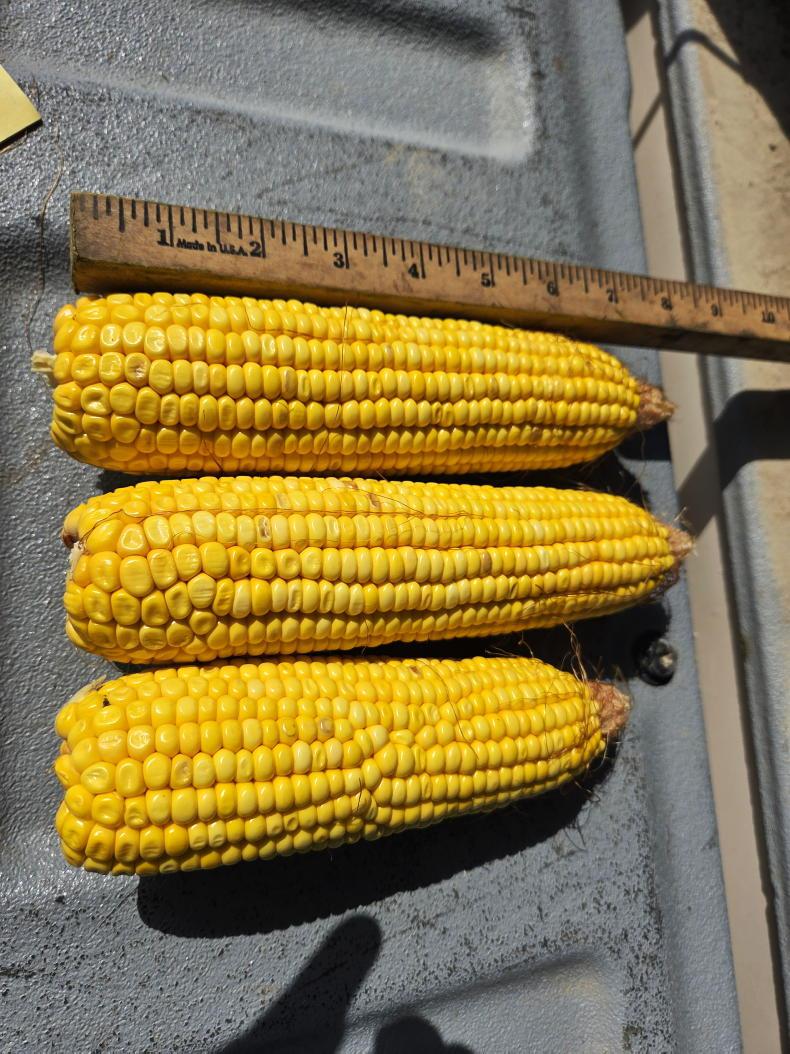
Corn ears in the US this summer.
“We believe at AgResource when we did our counts in the field, before it got dry and before disease came in, that we had 191-194bu/ac corn and a soybean yield as big as 57bu/ac. We are taking crops down, but there’s still a very sizeable crop there.”
Dan said farmers are in an extremely difficult position.
“The mood is horrific. The farmer is struggling for the third year in a row.
“The price of corn throughout much of the [US] Midwest is somewhere between $3.75-4.10/bu. His average cost of production will be up around $4.60-4.70/bu. He’s losing on every bushel he sells.
“Yes, he’s got more bushels, but it’s not a good year and it’s really starting to cut into his balance.”
Dan said it will be an anxious winter to see if US farmers can get the money to plant next year’s crop.
At present farmers look to be continuing to plant.
“Even though we have these oversupplied markets in Europe and the United States and, to a lesser degree, south-east Asia, no one’s cutting back yet that would allow for a recovery,” Dan added.
96% of Chicago trades are non-human
A massive 96% of trades made at the Chicago Board of Trade (CBOT) or non-human according to Dan Basse of AgResource Company.
There are no humans pushing a buy or sell button behind these trades. The CBOT trades grains, oilseeds, livestock, oil, gas, energy, gold, treasury bonds and much more. Basse said Artificial Intelligence (AI) can change the world, but it will take longer than we think as humans need to be trained to use it properly and this costs money.
Mark Kelly, president of AI Ireland, had told the Barnett Hall conference earlier that Irish animal feed mills have large amounts of data that can help them move towards predictive logistics and dynamic formulation. Using AI. Kelly said smaller mills can use AI to digitise orders and deliveries, to collect quality control data in a structured way and to pilot advisory and logistics dashboards. He advised millers to start with the data they have and layer AI into the business gradually.

Taking notes at the Barnett Hall Conference. \ Claire Nash

Some of the crowd at the Barnett Hall Conference last week. \ Claire Nash
Price is a function of supply and demand” and today the world has too much grain, according to Dan Basse of AgResource Company.
The expert in commodity markets told the R&H Hall and Barnett Hall Customer Conference last week that grain prices are set to remain at similar levels for the next three years and this price is about equivalent to the cost of production.
“One theme and thesis that keeps coming forward is that we lack that big driver of demand that will change overall price trends. Major weather problems are absent” and Dan explained a major weather problem is what would get markets out of this range, adding that at present markets look to be going sideways.
“We still have oversupplies of grain which is why these markets can’t seem to get off their feet,” he said.
Grain is plentiful and the Chicago-based analyst said he is no longer worried about feeding nine billion people.
Technology on current acres will reach these goals. After all, acres have increased. The world has increased its major crop area of corn, wheat, barley and soybeans by 20m hectares or 50m acres since 1980.
However, the yield gain is slowing with rising global temperatures he explained.
Brazil the behemoth
Brazil is a country that has increased acres and Dan described it as a behemoth, saying the country’s grain growers would eat our lunch in terms of costs of producing grain and soybeans. Soybeans never seem to have a crop failure and the country will export 115m tonnes this year. The country can meet all of China’s demand.
Crucially, Brazil is also creating demand for its own products. Ethanol factories are being built to use the country’s corn off the market.
Burning grain for energy production
As Brazil puts more grain into ethanol production it can help to stabilise prices. It’s a demand driver and that is what Dan said markets need.
He spoke about the need for new Government policies. When asked about lobbying for the grain farmer he said countries need to burn grain. By this he means create energy.
While prices are not at levels of profit now Dan said farmers will not have these price forever. He said policy needs to ensure that grain does not build up in stores and then take years to get rid of.
Policy needs to support the farmer and get rid of the grain.
He said: “unfortunately the only way I can figure that out is to burn it. We need to somehow get to green fuels.”
Dan Basse, President, AgResource Company. \ Claire Nash
Its not easy though. Environmentalists want drivers to move to electricity; petrol companies don’t want the ethanol.
Ethanol production is running close to capacity in the US, but there is room in Europe.
“If we’re going to be burning more green fuels, we need to be building more facilities. I don’t see that happening,” he said.
But that is what will get prices moving up again, new Government policies and industry initiatives that use corn, wheat and soybeans in a way that we’re not seeing today.
Producing below the cost of production
No matter what part of the world you are in Dan said “every grain farmer is struggling”, adding that if you have protein to sell you’re making some money.
“I do worry a lot about the grain farmers and I don’t quite know when their appetite will come back.”
He predicts that the price will remain similar for the next three years.
Some of the delegates at the Barnett Hall Conference. \ Claire Nash
Usually when we look ahead in markets there is a premium on grain for the coming months or the following year because there is a storage and handling cost to consider, but at present the market is sitting at the cost of production.
“The market knows it is sitting at the price that is breakeven going forward for the American farmer and remember that Chicago Board of Trade is used globally. So when you think about grain prices it’s the same for everyone across the board.”
Dan said grain farmers are losing money worldwide. Corn (maize) demand has plateaued. In the US there is a record large corn crop.
His analysis shows that at the USDA projection of 16.7mmt of corn production, the average farm gate price in America should be somewhere in the vicinity of $3.75/bu.
However, American farmers need $4.72c/bu to breakeven.
“Every farmer is losing $1/bu on corn that they produce.
“This is the third year in a row that farmers globally have been losing money on grain production. The only compensation is the farmer will have more bushels to sell which lessens the load.”
But, he said the corn market will struggle to get much above $4.25-4.30/bu. US and Black Sea farmers are holding onto grain but, eventually will have to sell.
China has peaked for soybeans
This year there has been a lot of talk about tariffs, particularly tariffs between the US and China. US farmers moved to corn for fear of a poor market for their soybeans and there is a huge amount of corn available in markets, which is not helping grain prices.
However, Dan noted: “China has become such a small player in grain imports. We do believe that China has also peaked in terms of soybean imports.”
Some of the delegates at the Barnett Hall Conference. \ Claire Nash
With grain imports slow in China and the country reported to be adopting GM seed and achieving good yields Dan actually thinks it won’t be long until China actually becomes a net exporter of grain. Brazil is producing more and more corn and soybeans and this again highlights the need for new markets for grain.
Another thing Dan noted is that China has been cutting fertiliser exports.
The country supplies about 43% of the phosphate market.
About a year ago Dan said they cut their exports down to near nothing.
Phosphate and fertiliser prices are high and farmers are struggling with this.
US corn crop still big, despite rust
Earlier this year the Irish Farmers Journal took part in the Pro Farmer Crop Tour and reported back on record corn yields.
Dan said those yields have fallen, but are still massive crops. Dan is a commodities expert supplying data and analysis to traders and farmers all over the world. He is also a farmer himself and AgResource carried out its own crop tour this year in the US once again.
“The rust hit them and corn yield is coming down. On soybeans the yield is coming down slightly because of the dry weather. It turned very dry in the middle of August and that continued all the way to early October. It’s been enough to take the top end off corn and soybean yields.
“These are still big crops in the US, but they could have been a lot bigger.
Corn ears in the US this summer.
“We believe at AgResource when we did our counts in the field, before it got dry and before disease came in, that we had 191-194bu/ac corn and a soybean yield as big as 57bu/ac. We are taking crops down, but there’s still a very sizeable crop there.”
Dan said farmers are in an extremely difficult position.
“The mood is horrific. The farmer is struggling for the third year in a row.
“The price of corn throughout much of the [US] Midwest is somewhere between $3.75-4.10/bu. His average cost of production will be up around $4.60-4.70/bu. He’s losing on every bushel he sells.
“Yes, he’s got more bushels, but it’s not a good year and it’s really starting to cut into his balance.”
Dan said it will be an anxious winter to see if US farmers can get the money to plant next year’s crop.
At present farmers look to be continuing to plant.
“Even though we have these oversupplied markets in Europe and the United States and, to a lesser degree, south-east Asia, no one’s cutting back yet that would allow for a recovery,” Dan added.
96% of Chicago trades are non-human
A massive 96% of trades made at the Chicago Board of Trade (CBOT) or non-human according to Dan Basse of AgResource Company.
There are no humans pushing a buy or sell button behind these trades. The CBOT trades grains, oilseeds, livestock, oil, gas, energy, gold, treasury bonds and much more. Basse said Artificial Intelligence (AI) can change the world, but it will take longer than we think as humans need to be trained to use it properly and this costs money.
Mark Kelly, president of AI Ireland, had told the Barnett Hall conference earlier that Irish animal feed mills have large amounts of data that can help them move towards predictive logistics and dynamic formulation. Using AI. Kelly said smaller mills can use AI to digitise orders and deliveries, to collect quality control data in a structured way and to pilot advisory and logistics dashboards. He advised millers to start with the data they have and layer AI into the business gradually.
Taking notes at the Barnett Hall Conference. \ Claire Nash
Some of the crowd at the Barnett Hall Conference last week. \ Claire Nash






SHARING OPTIONS