The story of Lisnavagh House and the Bunbury family (later McClintock Bunbury) begins in the turbulent aftermath of the English Civil War. As William explains: “The Bunburys had been on the Royalist side; a Bunbury came here to Ireland and rented a farm from the Butlers, who were also a Royalist family at the time.”
Around 1670, Benjamin Bunbury settled near Carlow, and by 1696, the family had built their first house at Lisnavagh. Though not a grand residence, it marked the start of a long and evolving relationship with the land. Over time, their status grew both “politically and legally and they became magistrates and all that sort of jazz” – and with it, their architectural ambitions.
In the 19th century, the family commissioned architect Daniel Robertson, who, as William recalls, “designed a 30,000 sq ft mansion, plus a model farmyard down below, and then there were all these cottages and walls. He also laid out all the woods”.
The result was a vast country house at the heart of an extensive estate in the Tudor Gothic style.
“It was a massive house and a very mixed farm enterprise. It was a self-sufficient estate and the payroll on the farm was about 70 people. And then there were 19 staff living in this house,” adds William.
Yet the grandeur proved difficult to sustain. After the second world war, with high costs and no staff, the family faced a stark choice.
Guided by the drawings of William’s artistic grandmother, they chose to shrink two-thirds of the house rather than sell it.
Today’s Lisnavagh House is the product of that bold reinvention: smaller in scale, but rich in layers of landed power, architectural ambition, survival and eccentric family character – all still very much alive in William and his wife Emily’s daily lives.
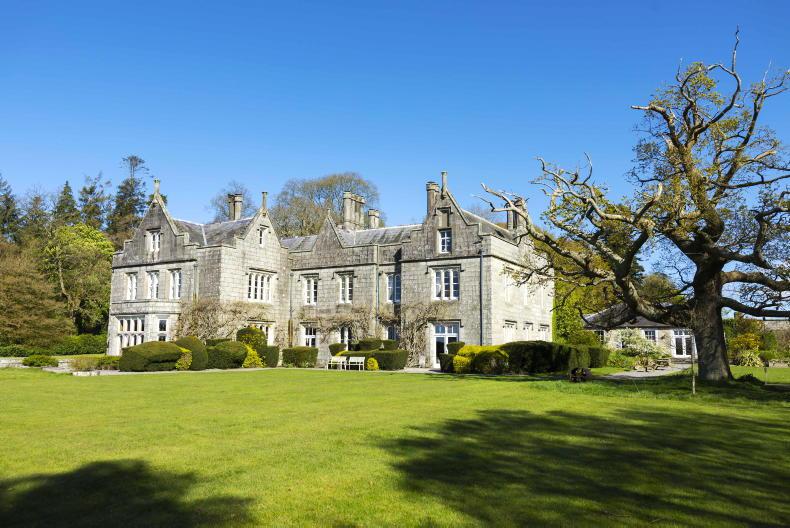
Views of Lisnavagh House, Rathvilly, Co Carlow. \ Patrick Browne
The estate at Lisnavagh evolved into one of the most advanced and efficient farms in the country. In 1879, Thomas McClintock Bunbury of Lisnavagh succeeded his uncle to become Lord Rathdonnell. His great-grandson, Benjamin, the late Lord Rathdonnell, succeeded to Lisnavagh in 1959. He looked after the estate for 40 years before passing the reins over to his son, William, in 2000, who brought the estate into the 21st century.
William says, “I was away at school, and after that I went to two agricultural colleges in Ireland and England: Gurteen and Cirencester in Gloucestershire, England. The course I did was rural estate, and I learned to manage it. I ended up qualifying as a rural practice-chartered surveyor, also known as a land agent,” he explains.
With the size of the estate, William and his wife Emily looked into ways they could utilise it and diversify the business to ensure the history was preserved while also moving with the modern times.
Emily says, “We came up with a feasibility study for the house and gardens to run weddings and events. We went from there, really. The weddings organically grew, then we got the stable courtyard rooms done up, which are cute glamping pods that are perfect for coming to events.”
In 2016, they added a structured venue called the garden wing, which has been a dream because it is so versatile.
“Fifteen years ago, we started doing yoga retreats with Pam Butler, a local yoga teacher. William’s aunt, Rosebud, was involved and used to make all the salads. It was very much a family thing.
“People wanted to come to the retreat, switch off, eat nice food and recharge,” says Emily.
As people are now looking for more experiences and something different, Emily developed a festival four years ago, called Hidden Hearth Wellness Festival.
“It was amazing. So many wanted to come and be in that holistic environment and be surrounded by wellness. It took off for the first three years, which is why we took a break last year, but it has returned now, and a new plan and team are working on that,” she says.
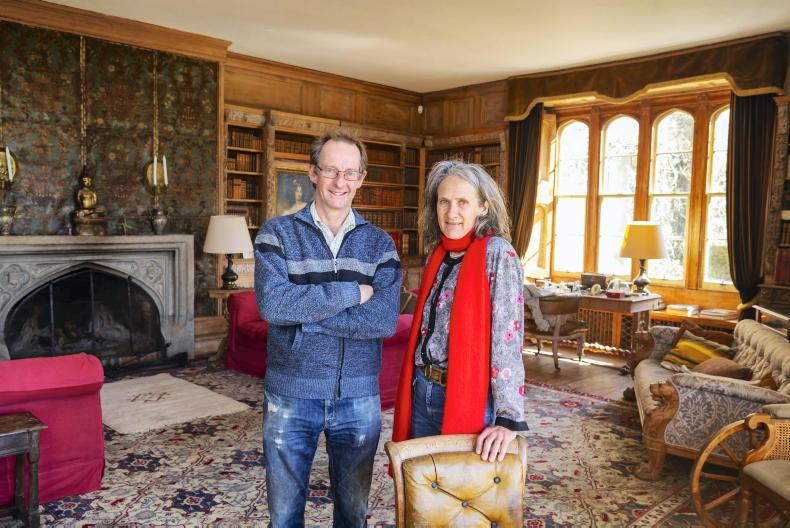
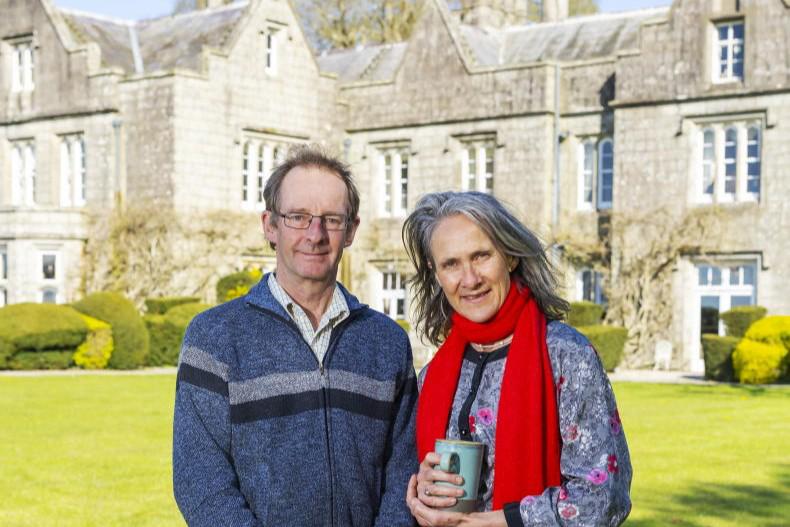
Owners Emily and William Bunbury in the library. \ Patrick Browne
Moving with the trends
During COVID-19, the couple pivoted the business and now take a smaller number of weddings each year. They have developed other enterprises at the property, including cottages, a new sauna and the restoration of the walled garden.
“Since the pandemic, the six cottages have never been empty. We hope to invest and restore a few more cottages at the farmyard, where we have recently finished renovations on a stable cottage. It is a fantastic building as the history is incredible,” says Emily.
Her main passion project is the walled garden and maximising its homegrown nature.
“The idea with the garden is to bring it back to its former life. It started two years ago with our gardener, Andrew, and he is very experienced in companion planting and permaculture. There is a lot to it. It’s not just about putting a potato in the ground,” says Emily.
They also have a pop-up coffee stand and stall where people can buy products made in Lisnavagh, which will open on Friday mornings from May through the summer. Emily makes everything to order, and products can be purchased from their website.
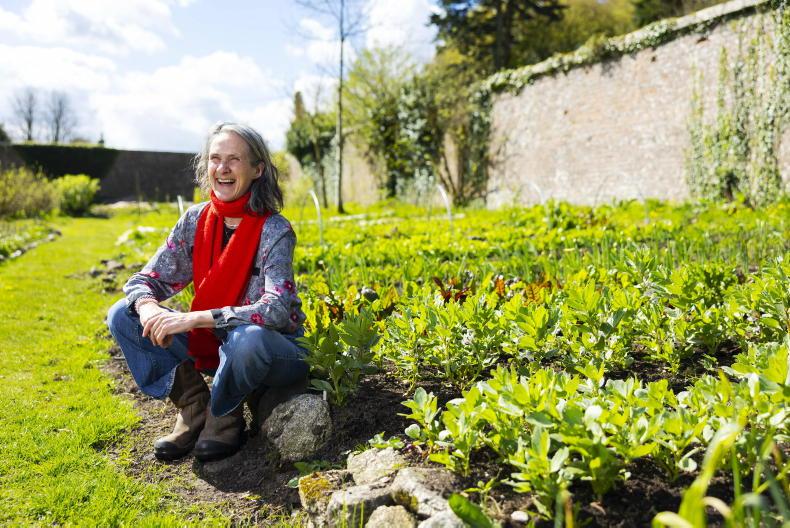
Owner Emily Bumbury in the walled garden at Lisnavagh House, Rathvilly, Co Carlow. \ Patrick Browne
Timber Project
Another venture on the estate is William’s passion, the Lisnavagh Timber Project, which shows how every fallen tree can tell a bigger story.
“In 2001, we were doing some work in the woods, and I had this idea about adding value to the timber that was coming down. We had three lorry loads of ash that Pat Staunton took to his sawmill, 60 tons of logs. We got the timber planks and dried them up in Bray. I did an add-on on our website, lisnavagh.com, which my dad, in his wisdom, had registered” says William.
The experiment grew into a fully traceable Irish timber enterprise, with every plank numbered and dried on-site.
The Lisnavagh Timber Project is now recognised throughout Ireland for its leading role in supplying “clear conscience” timber to furniture makers, woodworkers, homeowners and retail outlets all over Ireland and in other countries.
Along the way, William’s Bunbury Boards hand-crafted chopping boards reached “every shop you could dream of, from Harrods to Marks & Spencer, John Lewis,” and now his workshop turns even twisted off-cuts into coveted B Corp plaques and engraved awards with a laser machine that, as William puts it, “paid for itself in minutes”.
William and Emily have pivoted over the years to ensure the estate is self-sufficient and a viable enterprise. They are currently working on restoring the old farmyard back to the economic hub it once was, and in turn are hoping to bring in different local producers on-site. With constant projects and retreats/events on site, Lisnavagh is a beehive of activity.
“We’re constantly ducking and diving and trying to juggle everything,” Emily says, with a smile.
Over the years, she has learned to “think outside the box and move with the trends”.
“I think that people who run places like this tend to do things that interest them. I’m quite interested in wellness and growing your own food.
“You tend to go that way. It’s a sanctuary, and ultimately that’s what we’re trying to do here; it is as simple as that,” says Emily.
See lisnavagh.com
The story of Lisnavagh House and the Bunbury family (later McClintock Bunbury) begins in the turbulent aftermath of the English Civil War. As William explains: “The Bunburys had been on the Royalist side; a Bunbury came here to Ireland and rented a farm from the Butlers, who were also a Royalist family at the time.”
Around 1670, Benjamin Bunbury settled near Carlow, and by 1696, the family had built their first house at Lisnavagh. Though not a grand residence, it marked the start of a long and evolving relationship with the land. Over time, their status grew both “politically and legally and they became magistrates and all that sort of jazz” – and with it, their architectural ambitions.
In the 19th century, the family commissioned architect Daniel Robertson, who, as William recalls, “designed a 30,000 sq ft mansion, plus a model farmyard down below, and then there were all these cottages and walls. He also laid out all the woods”.
The result was a vast country house at the heart of an extensive estate in the Tudor Gothic style.
“It was a massive house and a very mixed farm enterprise. It was a self-sufficient estate and the payroll on the farm was about 70 people. And then there were 19 staff living in this house,” adds William.
Yet the grandeur proved difficult to sustain. After the second world war, with high costs and no staff, the family faced a stark choice.
Guided by the drawings of William’s artistic grandmother, they chose to shrink two-thirds of the house rather than sell it.
Today’s Lisnavagh House is the product of that bold reinvention: smaller in scale, but rich in layers of landed power, architectural ambition, survival and eccentric family character – all still very much alive in William and his wife Emily’s daily lives.

Views of Lisnavagh House, Rathvilly, Co Carlow. \ Patrick Browne
The estate at Lisnavagh evolved into one of the most advanced and efficient farms in the country. In 1879, Thomas McClintock Bunbury of Lisnavagh succeeded his uncle to become Lord Rathdonnell. His great-grandson, Benjamin, the late Lord Rathdonnell, succeeded to Lisnavagh in 1959. He looked after the estate for 40 years before passing the reins over to his son, William, in 2000, who brought the estate into the 21st century.
William says, “I was away at school, and after that I went to two agricultural colleges in Ireland and England: Gurteen and Cirencester in Gloucestershire, England. The course I did was rural estate, and I learned to manage it. I ended up qualifying as a rural practice-chartered surveyor, also known as a land agent,” he explains.
With the size of the estate, William and his wife Emily looked into ways they could utilise it and diversify the business to ensure the history was preserved while also moving with the modern times.
Emily says, “We came up with a feasibility study for the house and gardens to run weddings and events. We went from there, really. The weddings organically grew, then we got the stable courtyard rooms done up, which are cute glamping pods that are perfect for coming to events.”
In 2016, they added a structured venue called the garden wing, which has been a dream because it is so versatile.
“Fifteen years ago, we started doing yoga retreats with Pam Butler, a local yoga teacher. William’s aunt, Rosebud, was involved and used to make all the salads. It was very much a family thing.
“People wanted to come to the retreat, switch off, eat nice food and recharge,” says Emily.
As people are now looking for more experiences and something different, Emily developed a festival four years ago, called Hidden Hearth Wellness Festival.
“It was amazing. So many wanted to come and be in that holistic environment and be surrounded by wellness. It took off for the first three years, which is why we took a break last year, but it has returned now, and a new plan and team are working on that,” she says.

Owners Emily and William Bunbury in the library. \ Patrick Browne
Moving with the trends
During COVID-19, the couple pivoted the business and now take a smaller number of weddings each year. They have developed other enterprises at the property, including cottages, a new sauna and the restoration of the walled garden.
“Since the pandemic, the six cottages have never been empty. We hope to invest and restore a few more cottages at the farmyard, where we have recently finished renovations on a stable cottage. It is a fantastic building as the history is incredible,” says Emily.
Her main passion project is the walled garden and maximising its homegrown nature.
“The idea with the garden is to bring it back to its former life. It started two years ago with our gardener, Andrew, and he is very experienced in companion planting and permaculture. There is a lot to it. It’s not just about putting a potato in the ground,” says Emily.
They also have a pop-up coffee stand and stall where people can buy products made in Lisnavagh, which will open on Friday mornings from May through the summer. Emily makes everything to order, and products can be purchased from their website.

Owner Emily Bumbury in the walled garden at Lisnavagh House, Rathvilly, Co Carlow. \ Patrick Browne
Timber Project
Another venture on the estate is William’s passion, the Lisnavagh Timber Project, which shows how every fallen tree can tell a bigger story.
“In 2001, we were doing some work in the woods, and I had this idea about adding value to the timber that was coming down. We had three lorry loads of ash that Pat Staunton took to his sawmill, 60 tons of logs. We got the timber planks and dried them up in Bray. I did an add-on on our website, lisnavagh.com, which my dad, in his wisdom, had registered” says William.
The experiment grew into a fully traceable Irish timber enterprise, with every plank numbered and dried on-site.
The Lisnavagh Timber Project is now recognised throughout Ireland for its leading role in supplying “clear conscience” timber to furniture makers, woodworkers, homeowners and retail outlets all over Ireland and in other countries.
Along the way, William’s Bunbury Boards hand-crafted chopping boards reached “every shop you could dream of, from Harrods to Marks & Spencer, John Lewis,” and now his workshop turns even twisted off-cuts into coveted B Corp plaques and engraved awards with a laser machine that, as William puts it, “paid for itself in minutes”.
William and Emily have pivoted over the years to ensure the estate is self-sufficient and a viable enterprise. They are currently working on restoring the old farmyard back to the economic hub it once was, and in turn are hoping to bring in different local producers on-site. With constant projects and retreats/events on site, Lisnavagh is a beehive of activity.
“We’re constantly ducking and diving and trying to juggle everything,” Emily says, with a smile.
Over the years, she has learned to “think outside the box and move with the trends”.
“I think that people who run places like this tend to do things that interest them. I’m quite interested in wellness and growing your own food.
“You tend to go that way. It’s a sanctuary, and ultimately that’s what we’re trying to do here; it is as simple as that,” says Emily.
See lisnavagh.com
SHARING OPTIONS