



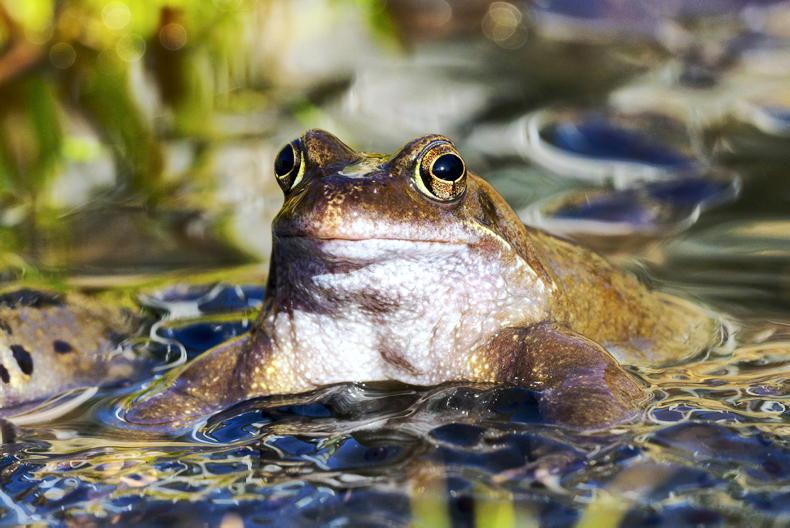
It is no longer something that is done, but when I was in primary school in the 1970s, there was a glass globe of wonder in the corner of the classroom. Each morning would see a cluster of wide-eyed school children in short pants staring at the tiny dots in of frog spawn. The dots wriggling around before they eventually emerged as tail-wagging tadpoles darted around in all directions.
As the time passed, they grew fat and bloated, and we looked on in awe observing their mouths and gills develop. The real joy came when those who had survived the confines of the large goldfish bowl would climb on to a little rock perched at its centre, still with their tails on but for all the world as tiny little frogs or ‘froglets’.
By the time the summer holidays came, the froglets were dispatched back to the same pool whence the frog spawn came. It takes two to three years before the adult frogs become mature and are able to breed. Like so many wonderous species, just like the bees and salmon, the frog will travel and return back to the exact same pond where it began life, to mate and reproduce.
There has been an ongoing controversy as to whether the frog Rana temporaria is native to Ireland and when and how it may have been introduced. The long-held assumption based on historical references from Gerald of Wales and others is that Ireland was ‘frogless’ until the Anglo-Normans introduced them in the 12th century.
Predicting weather
However, radio-carbon dating of some frog bones suggests that the frog is native and has been hopping around Ireland since the Ice Age. Whatever about their antiquity, frogs and frog spawn feature as significant players in the folk traditions of Ireland.
Frogs can change the colour of their skin from bright green or yellow to a buffed dark brown and Irish people used to look at their bright colour to predict good weather and the dark as an indicator of rain.
Likewise, if the frog was to lay its frog spawn near the edge of the pond or pool, it was a forecast of a wet summer and when the spawn was deep in the centre of the water it meant it would be a dry one.
The gelatinous frog spawn was used to treat all manner of aches and pains. There were some who were afraid to handle the spawn as they believed that it gave you warts.
When it was collected it was put into a bottle or jam jar and then buried under the soil for a month or so. This process, out of the light and in the constant temperature of the earth, turned the frog spawn into an oil and this was rubbed on sore rheumatic joints to ease pain.
The strikingly uncomfortable nature of the process might have functioned to provide a sort of placebo effect
This oil was also very good for corns on the feet while frog spawn itself was considered highly effective when rubbed on the cheek of someone who had a bad toothache. Others preferred to place it directly on the troubled tooth along with whiskey, bluestone or mustard.
Frog in your mouth
The most extraordinary and widely recorded folk remedy for toothache in Ireland involved not the spawn but the frogs themselves. The recommended practice was to take a live frog and place it directly into the mouth of the person who had pain in their tooth.
The frog was kept there until it screeched out three times, most likely as the person was biting down on it. The strikingly uncomfortable nature of the process might have functioned to provide a sort of placebo effect.
I discussed this bizarre practice with one of my mature students, Dr Eleanor O’Sullivan, an experienced dental surgeon who worked for many years teaching in the Dental Hospital in Cork. Eleanor took time to do some scientific research and came up with detail that suggests some credibility to the ‘frog-in-the-mouth’ Irish folk remedy.
Frogs all over the world secrete different substances to protect themselves. Some are poisonous, with others hallucinogenic. A mucous secretes from the skin of all frogs when they are highly stressed. The secretions are at a maximum when they screech or make high-pitched barks.
Analysis of such secretions has shown that they regularly contain temporins which have a positive anti-bacterial effect. They also produce epibatidine which is effective in reducing pain while peptides result in increasing blood flow and healing.
Whether the native Irish frog’s secretions delivered compounds that provided real and positive medical effects is a question that certainly needs some further investigation.
Shane Lehane is a folklorist and works in UCC and Cork College of FET, Tramore Road Campus. He is contactable on slehane@ucc.ie





SHARING OPTIONS