



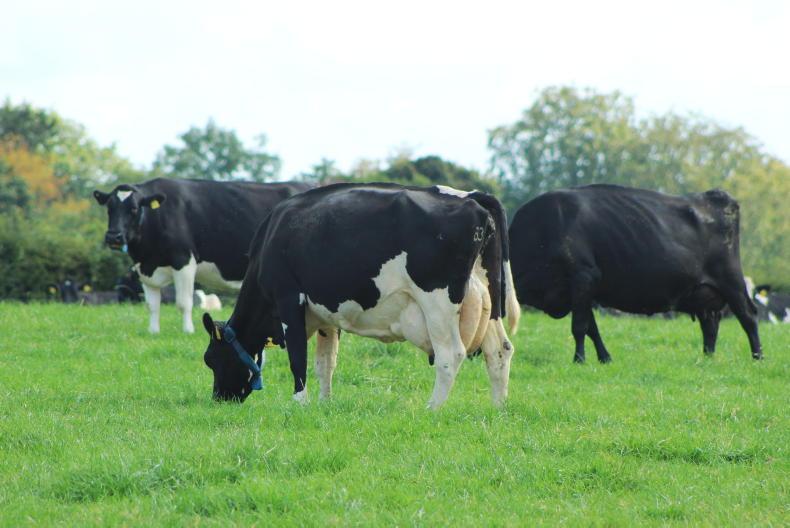
Substantial reconfiguration of land use will be necessary for Ireland to meet its legally binding 2050 climate targets from the current position, a new draft report for the Environmental Protection Agency (EPA) claims.
In order to reach net zero emissions, we would have to cut livestock numbers by 30%, and rewet 90% of drained peatlands.
In addition, annual forestry plantings would have to increase to nearly 35,000ha. This would mean 875,000ha of new forestry over the next three decades. Overall, over a quarter of grassland would be lost from livestock production.
The report was commissioned by the EPA and funded by the Departments of Environment and Agriculture.
The EPA clarified on Monday that “any opinions, findings or recommendations expressed in the research report are those of the authors and do not reflect a position or recommendation of the EPA”.
It combines different levels of change in the hectarage of afforestation, grassland, rewetted peatland and predicts the net emissions from land use that this would return.
Extreme scenarios
Only a handful of the most extreme scenarios meet the binding target Ireland has signed up to under the Paris Agreement of the International Panel on Climate Change (IPCC)
It is important to understand that this report does not look at the emissions from farming in isolation – it is focused on the potential to achieve net-zero greenhouse gas (GHG) emissions for the combined agriculture and land use, land use change and forestry (LULUCF) sectors in 2050.
The combined category is known as agriculture, forestry and other land use (AFOLU).
Forestry
The report hinges huge importance on a massive ramp-up of afforestation. It says that about 35,000ha would have to be planted annually. While native broadleaf species are better for biodiversity and pose less threat to water quality, they are slower-growing.
Conifers are faster-growing, and thus will sequester more carbon. If a lot of broadleaf trees are planted, annual targets might have to be increased to reach net zero emissions. Currently, only 27% of the total forestry area is under broadleaf trees.
The current annual target is 8,000ha of new forestry. That would have to be quadrupled to reach the target identified in this report. To put this figure in context, it would take 400 years at 2022 planting rates to reach the total target of 875,000ha.
Livestock
The report concludes that numbers of cattle, sheep and goats – ruminant animals – would have to be cut by 30% in the effort to reach net-zero by 2050.
There are two separate challenges facing livestock farming. One is the need to reduce the emissions on a per-animal basis, known as emissions intensity.
A 30% reduction in emissions intensity from agriculture is the maximum that can be achieved using current technologies, the report says. This suggests that the only way to reduce emissions by more than 30% is to cut farming output.
The other issue is the diversion of grassland from livestock production to other uses.
With 875,000ha of land required for forestry and 300,000ha of grassland to be rewetted, there could be a 25% reduction of Ireland’s 3.9m hectares of grassland.
The report also highlights the potential for bioenergy crops to improve the overall emissions profile, which would be a further pressure on grassland.
Positive
On the positive side, the report says that it is likely that the 10% allocation of “space for nature” (biodiversity and associated ecosystems) is already achieved on many Irish grassland farms.
While the authors highlight that economic analysis is not within the remit of the report, there was no analysis of any potential negative effect of a reduction in food production output from a non-economic standpoint.
Peatlands
The report calls for almost all of Ireland’s peatlands to undergo rewetting. The Government has spoken of 33,000ha of exploited peatland (where turf and peat has been harvested) and 80,000ha of drained peatland currently under grass being rewetted. This report says that over 80% of Ireland’s peatlands are degraded due to extraction, farming, and forestry plantation.
It states that 302,000ha of peat grassland would need to undergo rewetting to achieve net zero. This is 90% of all peat grassland across the country.
It’s hard to envisage any voluntary programme achieving such a target, so if this were to become policy, farmers could be forced into change. A much-increased area of exploited peatland – 70,000ha – would also undergo rewetting.
Recommendations
The report says that better integration between livestock and crop farming could improve sustainability and nutrient recycling. It cites a “redesign” of farming with an emphasis on organic farming, agroforestry and intercropping. It acknowledges market development, market access and the need for investment as barriers to adoption of such farming systems. The report also identifies a need “for more effective knowledge sharing and innovation development with land managers, to enable effective and timely climate actions”.
It also highlights a number of areas where there are gaps in knowledge or data. A lack of land-use data is mentioned, as is the value to climate action of semi-natural land.
However, the vexed question of methane accounting is not mentioned. Current accounting methods, which have been called into question by IPCC scientist Dr Myles Allen, are used in the report’s calculations.



SHARING OPTIONS