




All share similar design principles of a chain and slat floor, rotor and blowing flywheel as opposed to, perhaps one of the other key players in the market Teagle, which has a rotating tub.
Kverneland Group Ireland’s John Colgan brought the Kverneland down hot on the heels of the McHale, which had just departed.
For the 2012 season, Kverneland revised its bale chopper/feeder range with a number of improvements, principally to its chopper and blower elements.
The Kverneland Taarup 853 Pro is a 3m3 machine with a capacity for two round bales or one very large square bale.
Kverneland does produce a three-point linkage machine, the 852, and a larger trailed machine, the 856, plus a couple of self-loaders.
The 853 Pro, however, is likely to be the firm’s most popular machine on the Irish market.
Taarup 853 Pro features
John went through the many features of the 853 before we did any work.
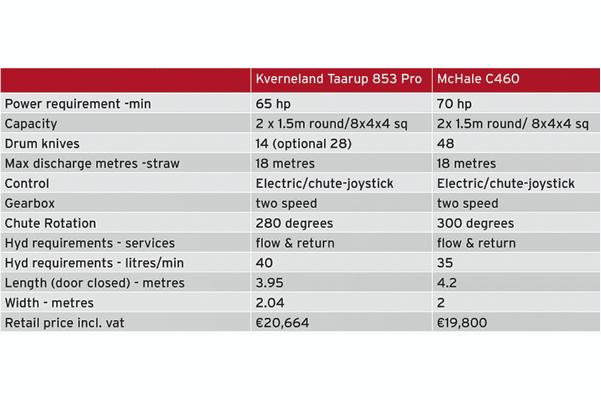
In many regards, the Kverneland Taarup 853 Pro and McHale are quite similar, sharing the basic design principles as mentioned earlier.
Having run both machines, I think it is, at the very least, interesting to point out the differences between them.
John says that standard on this Kverneland is a wide angle pto equipped with slip clutch and over-run clutch.
Like the McHale, this is driving a two-speed Comer gearbox with the lower speed for feeding out silage and the higher speed for straw blowing.
Kverneland uses a horizontal rotor with combine harvester-like sections to pull the bale apart and feed the flywheel to blow out the feeding or bedding material.
A double-acting hydraulic service is required or, alternatively, a single-acting service with a quick coupling returning oil to the tractor’s hydraulic system.
A good electrical supply is needed as Kverneland uses electrical linear motors, which are an electrical version of a hydraulic ram, in two positions instead of hydraulic rams. These are controlled from the in-cab control box in the same manner as the hydraulic services.
There are 14 knives attached to the rotor and John says that this can be doubled to 28 for more aggressive action on the bale. The rotor is belt-driven with four belts but, unlike the McHale, drive to the rotor is constant.
Above the rotor, Kverneland introduced its new drum feed control system (DCFS) on its new Pro versions.
Using an electrical linear motor, the DCFS unit is raised or lowered above the feed rotor to control the flow of material into the flywheel, as John demonstrates.
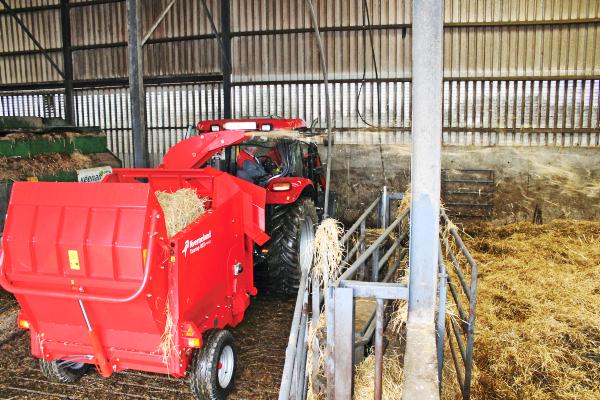
Loading the machine again requires a bale to be placed in the scoop-like tailgate or reverse the robust-looking tailgate under a bale which is ‘anchored’ against a wall.
The tailgate and hydraulically driven floor can be operated by switches from the ground, allowing you to keep an eye on proceedings.
These are placed far more forward than the McHale version, which doesn’t quite give you as clear a picture of the tailgate closing.
Bedding and Feeding results
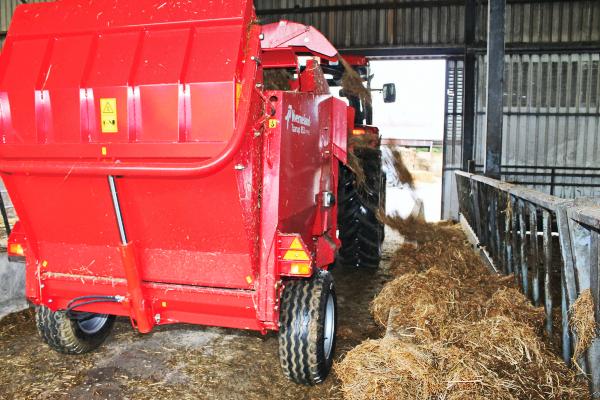
We took a run up the road to Stephen Nolan’s farm to both blow straw into his shed and feed out a bale of silage.
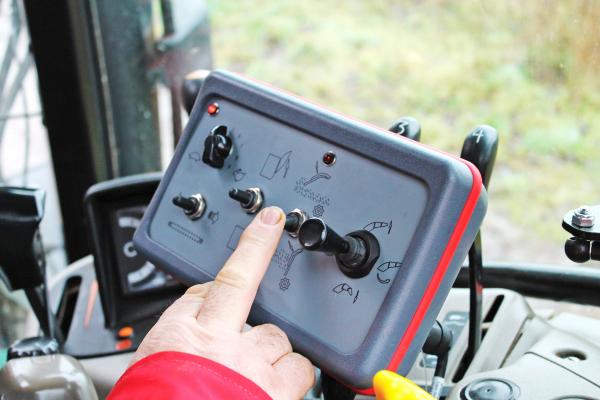
In the cab, the Kverneland controls seem to be laid out better than the McHale unit; more intuitive and they are not as intimidating when you are using them for the first time.
You are always conscious of doing something stupid and blocking up the machine so this is important, because things get very busy and move very fast when either blowing out straw or feeding out silage.
The pto start-up takes a bit more grunt with the Kverneland because you are starting both the flywheel and rotor at the same time.
This could be taxing on lower horsepower tractors if you were close to the machine’s minimum power requirement.
Once loaded and up to pto speed, the floor is set in motion with the first switch and a dial above it controls floor speed. Like the McHale, floor movement is indicated by a spinning disc at the lower front right-hand corner of the machine.
Feeding or blowing out rate is controlled by a combination of the floor speed and Kverneland’s DCFS system.
Chopping and blowing out straw was absolutely no problem and the joystick-controlled chute directed it wherever it was needed.
Feeding out silage was a bit trickier because we were using a non-chopped bale which would probably have required the fitting of the extra knives on the rotor to help even the feed-out rate and loading on the tractor.
The main thing though was that it could do it and do it without blocking. John tells us that a flywheel shear bar knife is available for tougher materials.
The chute uses a hydraulic motor for rotating it and a linear motor for controlling its curvature. Both are operated by the joystick on the control box to control material direction.
The silage in this case was blown directly into the trough because, while the Kverneland did have a feed-out tray, it was not as adjustment friendly as the McHale version.
Comparison thoughts
Overall, the Kverneland seemed to be a simpler machine to use and operate in comparison to the McHale.
The McHale, on the other hand, appears to be better equipped to handle a broader variation of materials and better suited to lower horsepower tractors.
We’ve provided our thoughts on what we felt were the positives and negatives of both.
√ Drive to rotor can be engaged-dis-engaged, easier to start up for lower hp tractors.
√ McHale rotor equipped with 48 knives as standard. Flywheel shear bar knife also standard. Overall it handled a broader range of material better.
√ Speed selection better – can select speed with spring loaded mechanism and will go into gear on pto start-up if didn’t go first time.
√ Tailgate looked seriously robust and incorporated square bale bar stop. Very handy – two pins and swings up into position.
√ In-cab controls simpler to operate – controls laid out better and no rotor to engage.
√ Controls clear but not as intuitive as Kverneland’s unit.
√ Wear pads on the floor to prevent slats making contact with floor and wearing it.
√ McHale incorporate clever aid for unblocking flywheel through front bulkhead and holes in flywheel.
√ Excellent adjustable feed-out tray.
√ Three stage chute (softer angle).
X Start-up harder than McHale because rotor permanently driven.
X Rotor does not have as many knives even with the option ones fitted - 24 in total. Flywheel shear bar blade optional.
X Changing speeds on a tractor with a braked pto required stopping the tractor to release the pto and engage gear.
X Tailgate perfectly okay, just Kverneland version supersized it and McHale uses fiddly bars and chain to retain square bale.
Thanks
Thanks to all involved – John Colgan of Kverneland Group Ireland Ltd, David Curran of Donohoe Agri and Stephen Nolan on whose farm we ran the Kverneland unit. In the previous McHale test, our thanks to John McHale from McHale, and Aidan Murphy for allowing us onto his farm to use the machine.



SHARING OPTIONS