




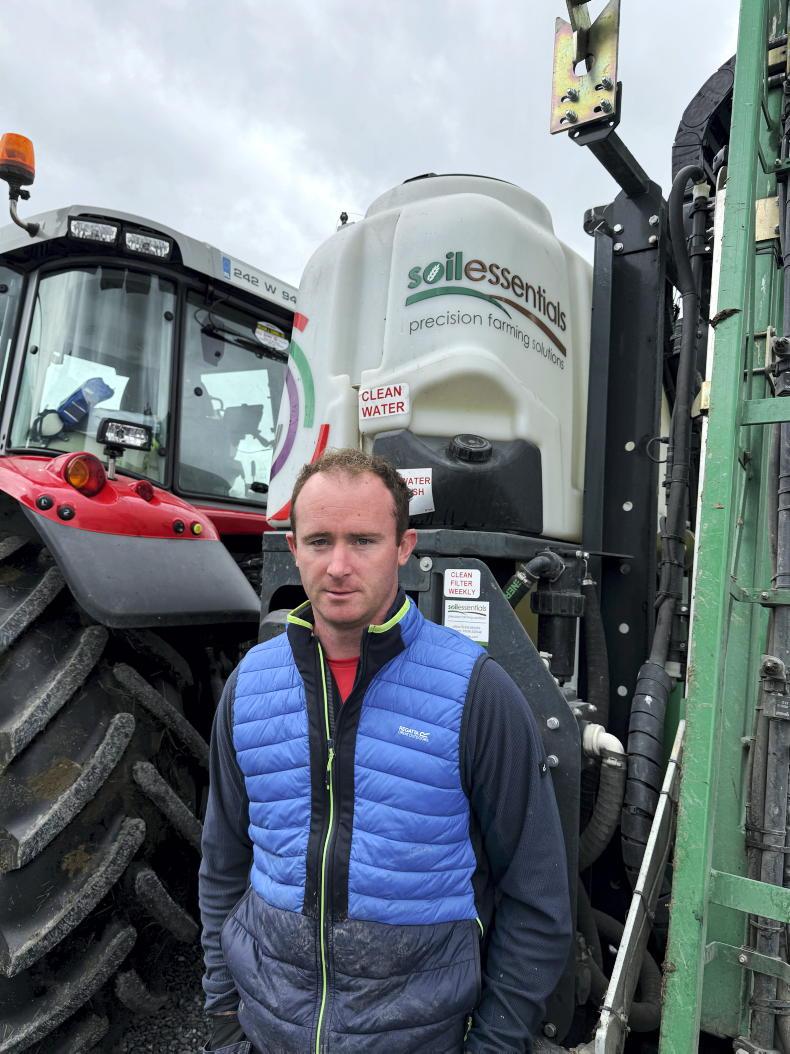
Situated in the village of Rossmore, Co Tipperary, Laurence Loughman is a second-generation dairy farmer, who farms alongside his son Caileam. The duo run a herd of 90 spring-calving cows and rear all their own replacements on-farm.
After completing his Green Cert, Caileam spent five years working with neighbouring dairy farmers and driving for local agricultural contractors during the summer months. This was followed by five-year stint in Melbourne, Australia, working in construction, mainly operating large track machines.
Caileam’s long-term plan was always to become more involved in the family farm alongside his parents. But with his father Laurence still a young man and for the move to be financially viable, Caileam knew that an additional income stream would be needed alongside the dairy herd.
“A video of the SKAi Spot Sprayer caught my eye last August. With tightening regulations around herbicide use and the limited choice of clover safe sprays, combined with the potential savings, I felt that a spot spraying service was bound to be a success.
“I thought to myself, ‘It’s a specialist service that requires one man and one tractor’. I could be at home most of the winter and on the shoulders of the year, and then go spraying in the spring and summer when the farm workload eases off,” Caileam explained.
Caileam made contact with the Grasstec Group, who had recently been appointed Irish agent for the SoilEssential SKAi sprayer. With no machines working in Ireland at the time, Grasstec brought Caileam and Laurence across to Scotland to learn more about the system and see a machine in action.
Spot-spraying benefits
The potential benefits of spot-spraying were a major selling point for Caileam, and something he felt would help sell the service to farmers.
While the contractor rate is inevitably higher than that of a traditional blanket-spraying outfit due to the increased level of technology, the reduction in chemical use and other associated benefits help offset the difference, provided weed populations are not too high.
Where weeds are widespread in a sward, blanket-spraying may still be the better option.
The practical benefits of spot-spraying include: avoiding the checking or stunting of grass, and clover can be kept in the sward even when using non-clover safe sprays as only the weed is targeted.
The other major benefit is around chemical savings.
“Chemical usage this summer ranged from as low as 6% to 45%, with the latter being a field bad with docks,” Caileam said.
“There was one 100-acre job that comes to mind, it took 15l of Forefront T which is between 5-6% chemical use or a 94-95% chemical reduction. Although it wouldn’t be realistic to blanket spray all that area at once, but if I was to, it would have taken 81l of chemical,” he explained.
Based on a rough cost of €100 for a 2l drum of Forefront T and a maximum application rate of 2l/ha – the cost of product to spot-spray the 100-acre job was €607 versus €4,046 if it was a blanket application.
Who are SoilEssentials and SKAi?
SoilEssentials is a Scottish agricultural technology company specialising in precision farming solutions designed to improve efficiency, accuracy and sustainability at farm level. Its work includes soil sampling and mapping, GPS guidance and steering systems, and variable-rate application maps.
The company combines practical agricultural knowledge with technologies including GPS, mapping, sensors and artificial intelligence (AI).
SoilEssentials has been working on machine vision and targeted weed spraying since as far back as 2016, with the aim of eventually developing a commercial system. In 2022, the company won a silver innovation award at the Royal Highland Show for the SKAi spot sprayer, followed by a gold award at the show in 2025.
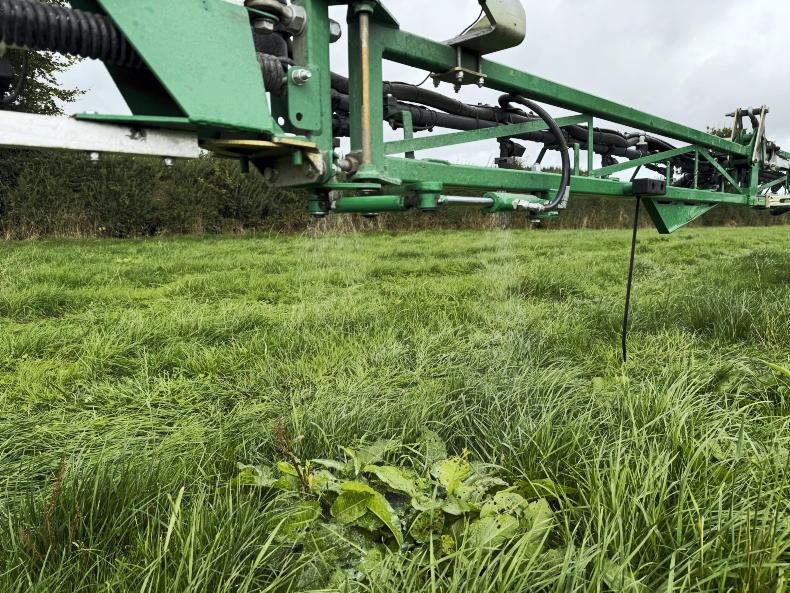
Using cameras and AI, the system identifies weeds and sprays only where the weeds are present, in real time.
The system made its working debut in Ireland at the Irish Farmers Journal Technology event at Teagasc Oakpark in 2025. This was followed by the appointment of Grasstec Group as the Irish distributor. Today, the Grasstec Group have six machines sold and working throughout Ireland.
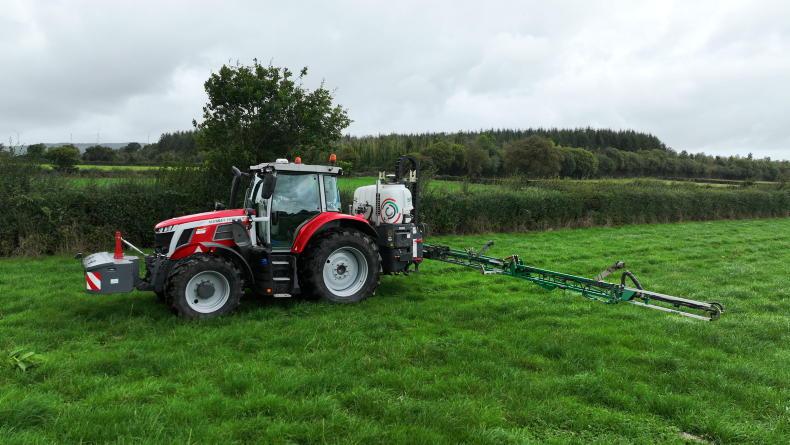
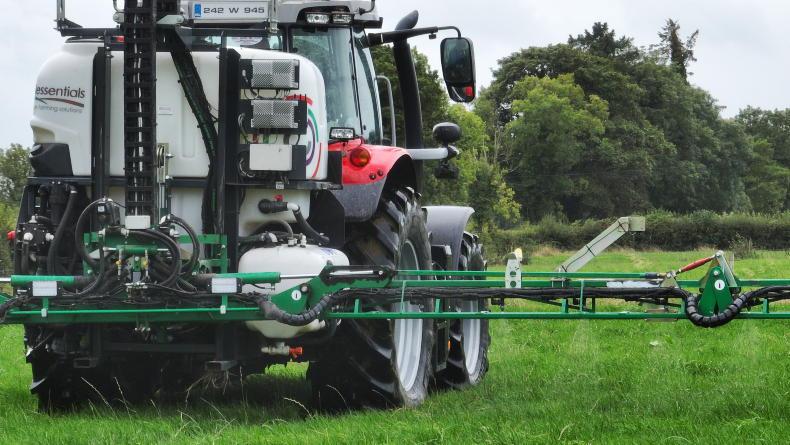
Impressed by the machine and the accuracy of the spot-spraying technology, Caileam ordered a 15m model last October. The sprayer arrived at the end of January and was paired with the farm’s Massey Ferguson 6S.165.
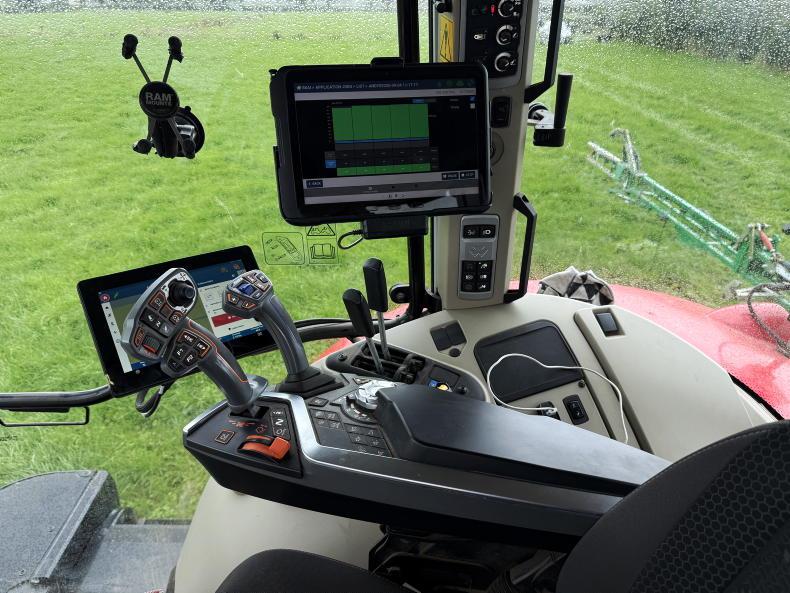
“We bought the Massey Ferguson 6S.165 last year and luckily opted for a decent spec, which came auto-steer ready,” Caileam said.
“Vantage Ireland (Grasstec Group subsidiary) fitted the Trimble GFX-1060 display, and NAV-900 receiver and guidance system. They also fitted an Isobus harness to power the sprayer. This left the tractor fully set up for guidance, autosteer and Isobus.”
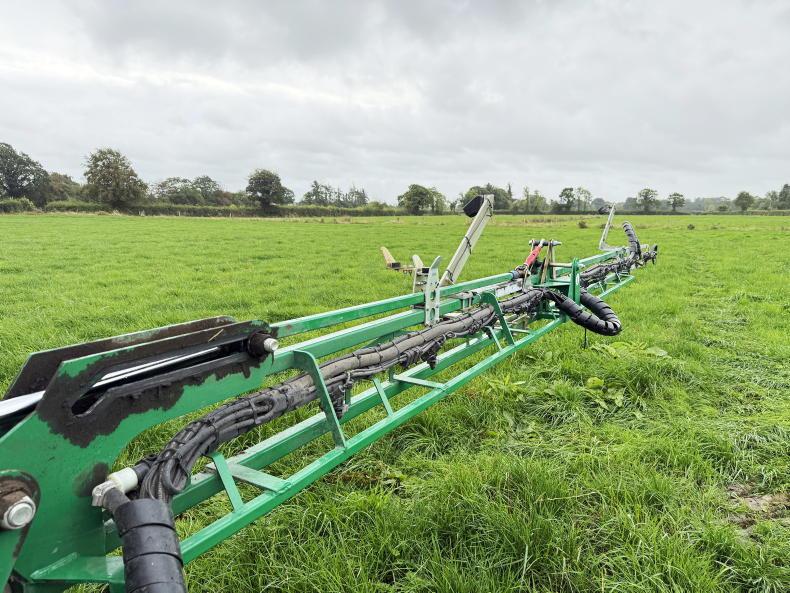
The sprayer itself is built by UK manufacturer Teams and is relatively conventional in terms of its design. It features steel booms with hydraulic height adjustment, along with the technology required for targeted spraying including boom recirculation and individual nozzle control.
SoilEssentials offer the SKAi sprayer in 9m, 12m, 15m and 24m working widths. Boom levelling is controlled via a spool valve from the tractor cab while on the fly. However, Caileam noted that he would have liked the option of automatic boom contour following.
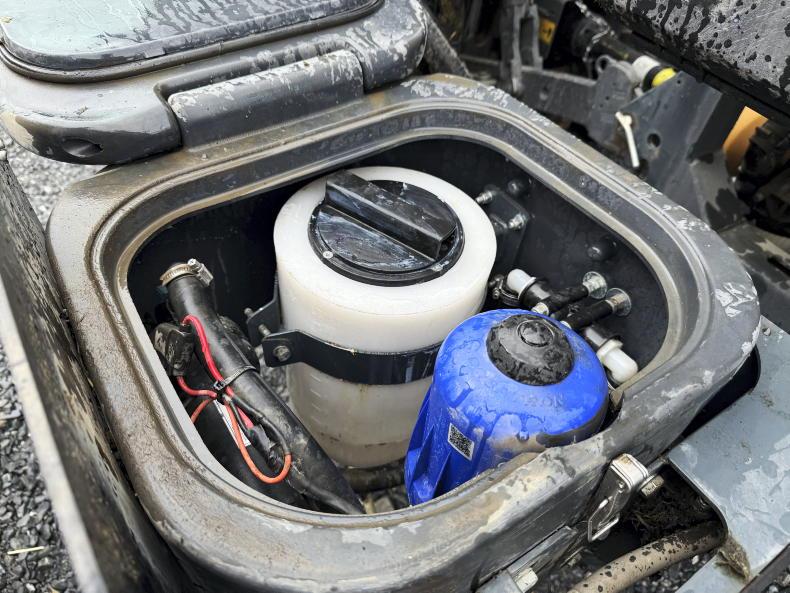
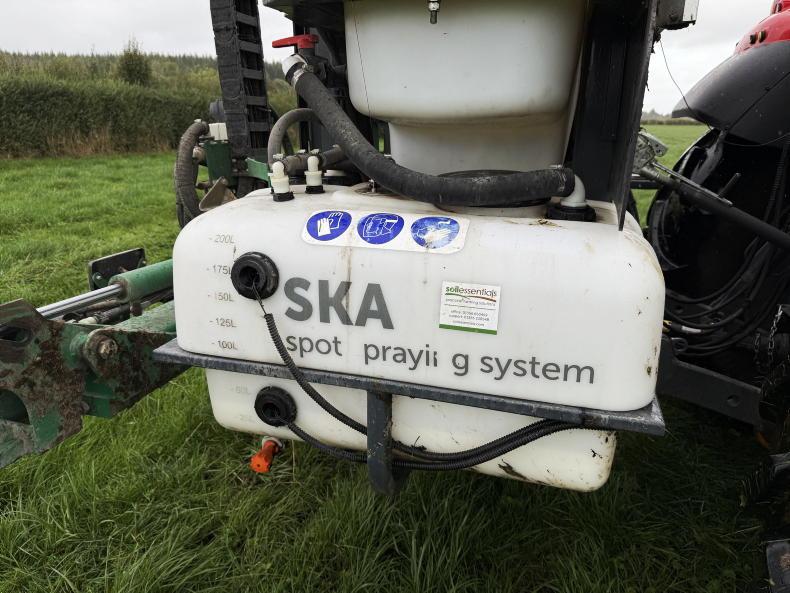
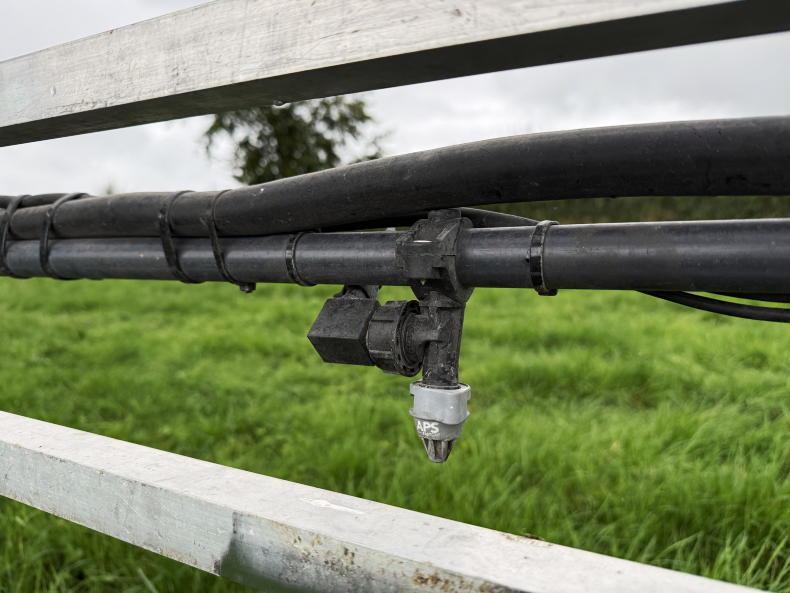
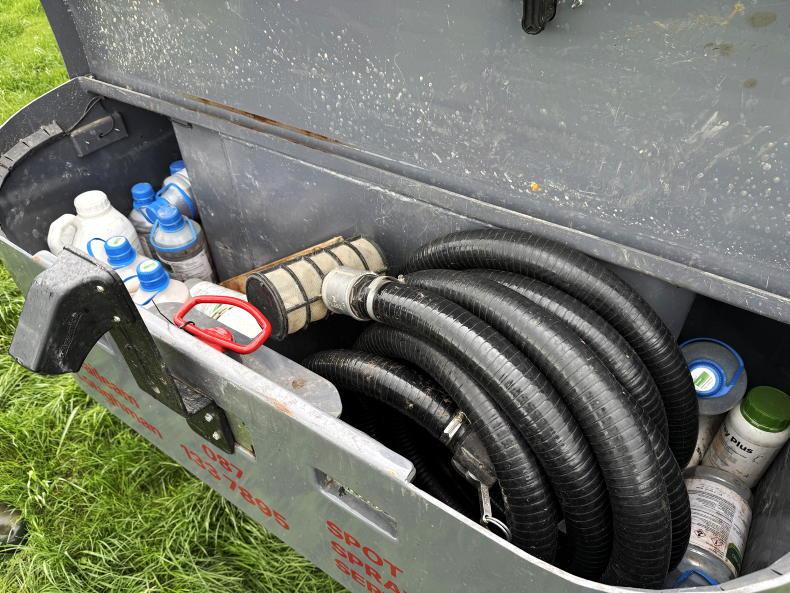
Individual nozzle shut-off is achieved using Gevasol solenoid units, which can open in just 0.1 seconds. In terms of nozzles, four low-drift nozzles are used, taking a low-pressure, high-volume approach when targeting weeds. The 15m unit has a 1,000l main tank for fresh water and a 200l spray tank for the mixed chemical solution. Alongside a small hand-wash tank, concentrated chemical is stored in a 10l tank positioned within what would typically be the induction hopper.
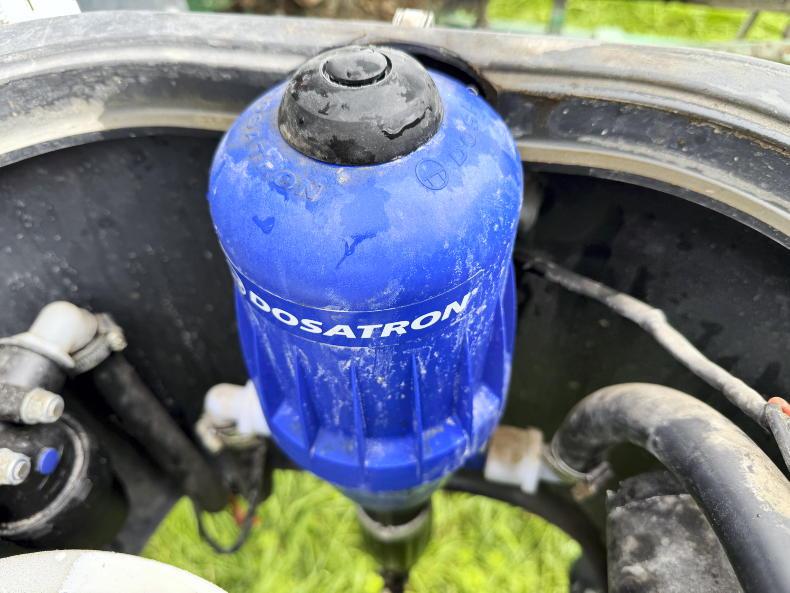
Chemical is dosed into the clean water using a Dosatron proportional dosing pump, also mounted in induction hopper. Changes to mixing ratio are done by manually adjusting the Dosatron.
At the flick of a switch, Caileam can have either 50l or 175l of mixed chemical in the spray tank at a given time, depending on the job. Any leftover spray solution can be easily drained at the end of the job.
Weed detection
While the sprayer itself may appear relatively straightforward, the clever part happens behind the scenes, where SoilEssentials’ expertise in AI comes into play.
The company’s engineers develop and embed the AI models within the software that allow the system to identify weeds. This involves feeding the system thousands of images until it can reliably identify the target weed.
As a result, accuracy improves with each software update.
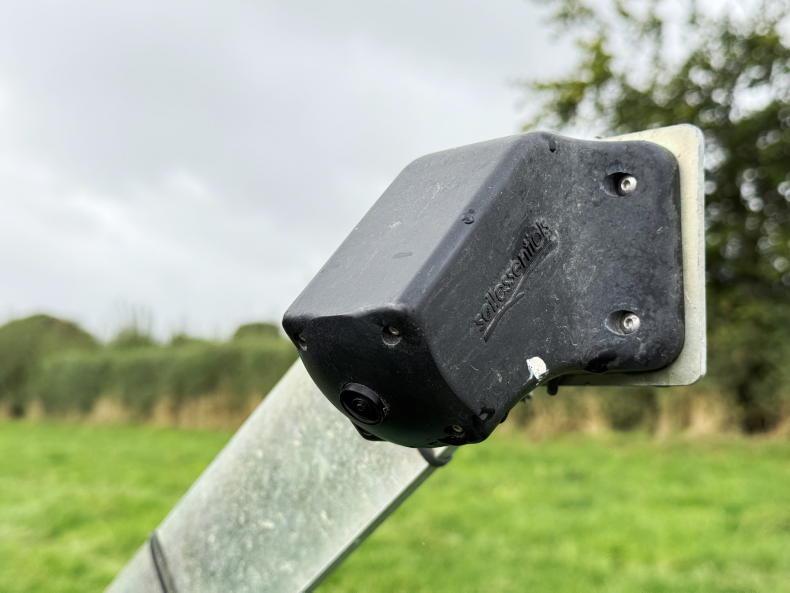
The SKAi sprayer uses five cameras positioned across the 15m working width, each with a 3m-wide resolution – four on the boom and one on the front of the tractor.
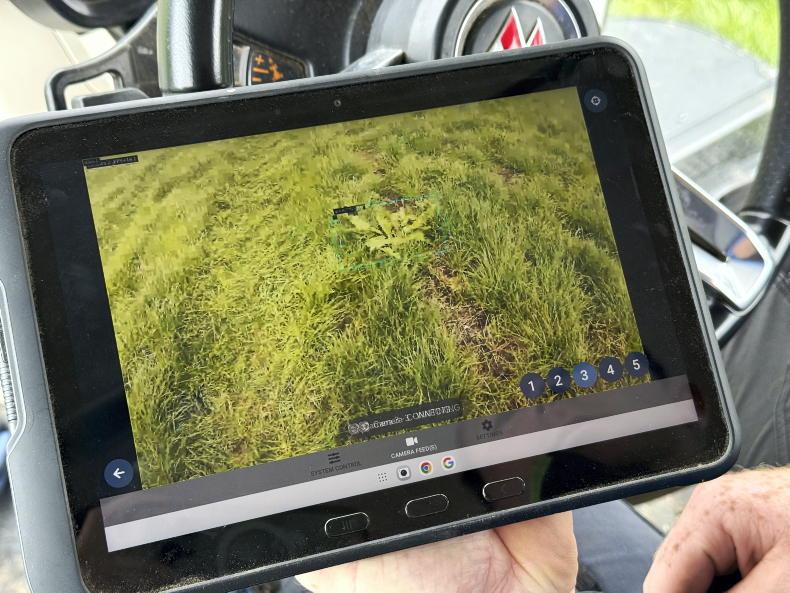
Once spraying begins, weeds are identified in a fraction of a second, with the system placing a box around the weed and assigning it a GPS reference.
Using the GPS position signal on the Skai hardware, the relevant nozzles are then switched on at the correct time, depending on the user’s settings.
Typically, Caileam sets the nozzles to engage 25cm before the weed and shut off 25cm after it to ensure the best possible accuracy. However, this can be easily adjusted through the terminal.
Inside the cab
The sprayer is controlled wirelessly via an Android tablet in the cab. Alongside live views from each camera, the tablet displays detailed bar charts. Each column can represent either a bank of nozzles or an individual nozzle, depending on the operator’s preference.
The display also shows whether an identified plant meets the spray threshold set by the operator. For example, if the threshold is set at 60%, the system will activate the relevant nozzle once the system is at least 60% confident that the identified area is a weed.
As the tablet connects to the sprayer wirelessly, it can be removed from its RAM mount and taken outside. This allows one person to individually engage and check each nozzle.
The platform also allows users to save field and farm details and select the target weed species. Application maps can then be uploaded to SoilEssentials’ Kore cloud-based precision farming platform.
According to Caileam, the sprayer is capable of targeting docks, nettles, ragwort, thistles and rushes.
“It’s probably most accurate at determining docks, but recent software updates have greatly improved the accuracy of determining nettles. Rushes can be selected as a target weed but I’ve yet to use it for spraying rushes,” he said.
Verdict
Now approaching the end of his first season with the SKAi sprayer, and with well in excess of 1,000 acres sprayed, Caileam is pleased with the venture, and particularly how the machine has performed.
“Aside from one or two teething issues, the sprayer has worked perfect and the results have been great. The support from Grasstec and the SoilEssentials team has been excellent,” Caileam said.
“What I have noticed is that if a field has a high-weed population, there comes a point when it makes better sense to blanket spray. There have been a few jobs where blanket spraying was what was needed.
“Given that the spray tank is just 200l and 175l is the maximum amount of mixed chemical that can be stored at one time, the Dosatron unit can’t keep the spray mixed as quickly as it’s being sprayed when applying a blanket application. In these situations, I had to wait at the headland for the spray tank to fill a few times,” he added.
“Although it’s not a major issue and given that the machine was built primarily to spot spray, it would be good to have the flexibility to bypass the smaller spray tank, or whatever is required, and be able to blanket spray too.
“Other than that, a level sensor in the smaller 10l chemical tank would be a good addition, so that from the cab I could see how much chemical is left or when it needs to be topped up.
“As part of the annual subscription, all software updates are free, which is great. That means that accuracy will always be improving without the need to upgrade or change the hardware.
“Although 2026 has turned out to be a tricky and challenging growing season, I don’t think I could have asked for a better first season.
“There’s no doubt that the use of agro chemicals are going to come under pressure in the future, so if we can use them more sparingly and only where they are needed, then there is both a benefit for the environment and less chance of herbicide resistance in plants too,” Caileam said.
Specs
Likes
Dislikes



SHARING OPTIONS