



Teagle is using the 2026 National Ploughing Championships for the Irish launch of its latest 6200P ‘Power Drive’ staw blower, previously debuted at Lamma show earlier in the year.
The new mounted model combines PTO fan drive with the firm’s latest hydraulic drive and control system for processing straw and hay bales. Weighing in at 1,577kg, Teagle says the 6200P is suitable for tractors from 90hp.
The 6200P will be showcased alongside the 6200H, 6100H, 8200 and the 8555 Dual Chop models. The 6200H is reasonably new to the market, following its launch at the Ploughing Championships last year.
It is a hydraulically driven machine, designed for use with smaller telehandlers and skid steer loaders for smaller enterprises, where there has been no alternative to bedding by hand due to access limitations.
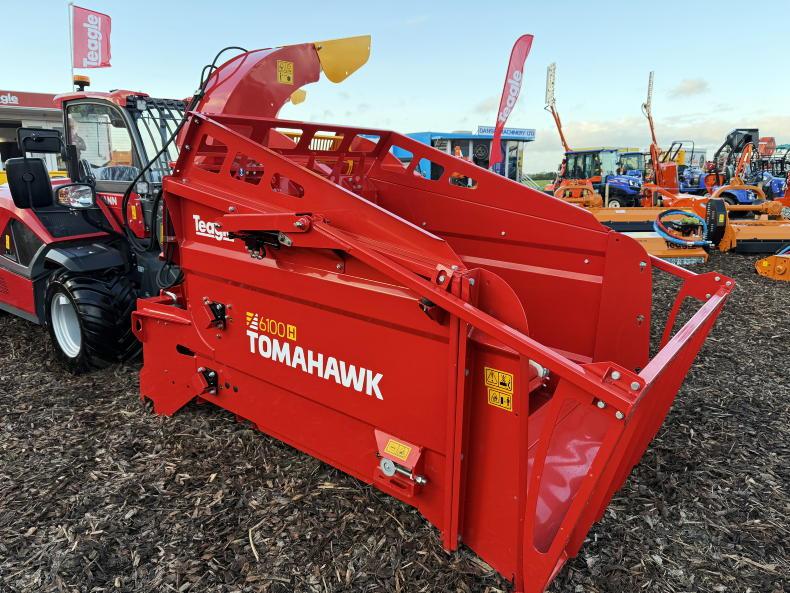
The Tomahawk 6100H has been designed for loaders with a lift capacity of 1.2-1.3t, and minimum hydraulic flow from 40-50 l/min.
It has capacity for one 1.5m (5ft) round bale, or half a rectangular bale, and will blow straw up to 12m.
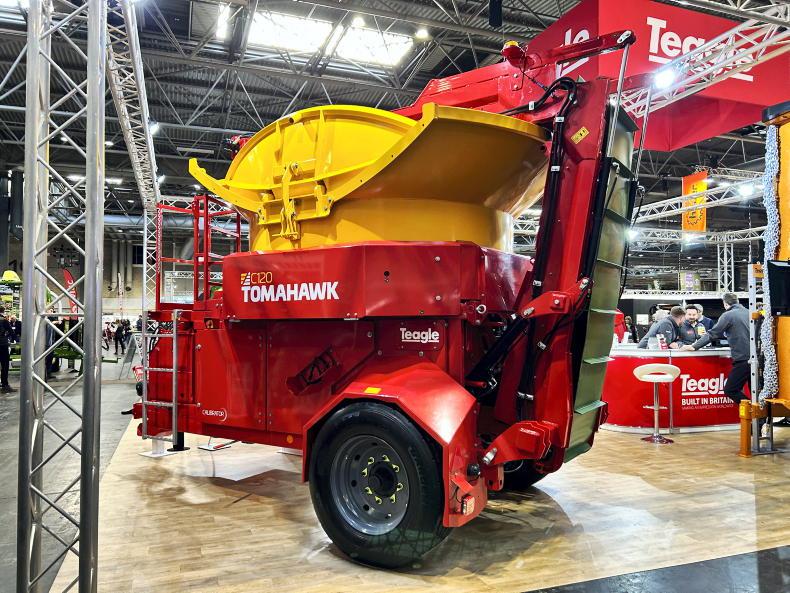
Elsewhere on the stand, Teagle will present a range of bale processors, including the C120 Mill and 505FSM models. The C120 is a trailed machine designed for high outputs of up to 15t/hour and is capable of processing round or square bales to a consistent length from 5mm to 150mm.
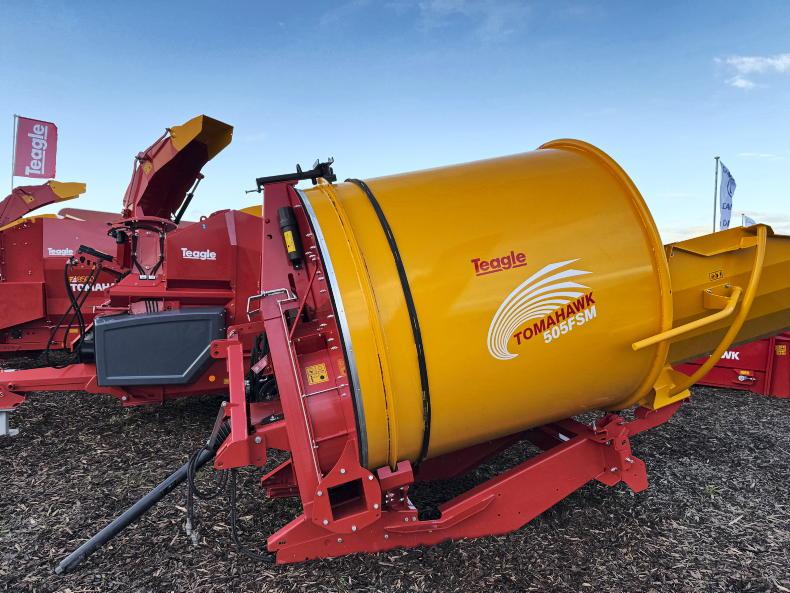
Meanwhile, the 505FSM is a smaller capacity mounted machine designed for three-point linkage use. With outputs of up to 4t/hour, it is designed for both square and round bales too, producing chop lengths from 8mm to 120mm.
Other machines
Alongside straw blowers and bale processors, Teagle will exhibit its XT range of fertiliser spreaders alongside the Berti tractor flail mulchers and its largest display yet of Berti excavator mulchers.
Keen not to give too much away, Teagle will also unveil a special machine to acknowledge its history with bale processing, which now spans over 40 years.




SHARING OPTIONS