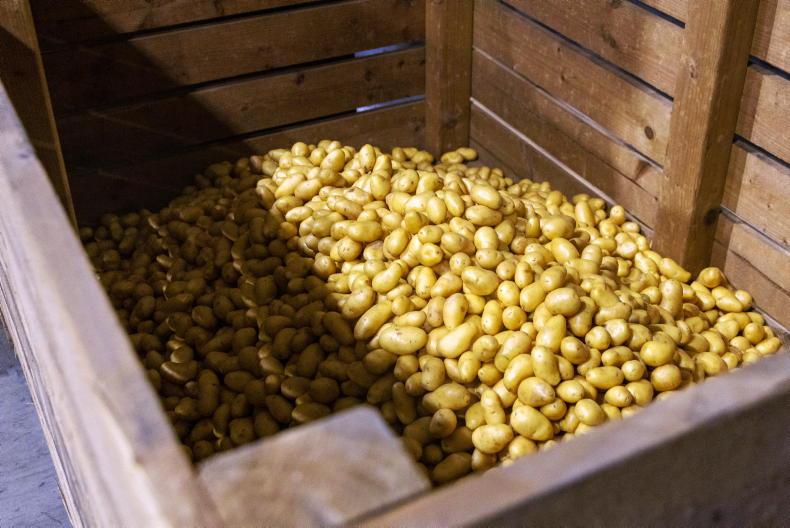
Macra has raised serious concerns over a High Court ruling that has made potato and onion storage buildings liable for commercial rates, warning that the decision could have significant implications for farmers and horticultural producers across Ireland.
The ruling in the case involving Castlecor Potato Company and Tailte Éireann has raised questions about whether other essential agricultural storage facilities could also be subject to commercial rates, potentially adding to the financial pressures facing producers already dealing with high input and operating costs.
Potato and onion stores play an important role in the horticultural sector, allowing produce to be stored safely, maintain quality and reach the market throughout the year.
Macra has warned that imposing additional charges on such infrastructure could have wider consequences for farm viability and Ireland’s food security.
Integral
Macra president Josephine O’Neill said agricultural buildings that are integral to the day-to-day running of a farm should not be treated as commercial premises for rates purposes.
“Whether a farm building is used to house a bulk tank to cool milk, store potatoes or onions, or keep hay and straw, these facilities are essential to the day-to-day operation of a farm and have traditionally been exempt from rates under the Valuation Act,” she stated.
O’Neill also questioned the basis for treating the storage of potatoes and onions as a form of processing, as well as the significance attached to the produce not being grown on land adjoining the storage buildings.
“It is madness to me that the storage of potatoes and onions could be described as an act of processing. The issue of the potatoes and onions not being produced on lands attached to the buildings is also a bizarre conclusion to come to.”
Implications
Macra believes the implications of the ruling extend beyond potato and onion producers, with the potential to create uncertainty around the rates treatment of other buildings essential to agricultural and horticultural production.
The organisation warned that additional costs for storage infrastructure could discourage investment and place further pressure on farm businesses. This comes at a time when generational renewal, farm profitability and the long-term sustainability of family farms remain significant challenges for the sector.
Macra is calling for urgent action to address the implications of the ruling and for the decision to be overturned on appeal, should the case proceed to the Supreme Court.
The organisation maintains that essential agricultural and horticultural storage buildings must be protected from commercial rates, arguing that infrastructure required to preserve farm produce and maintain a secure food supply should not become an additional financial burden for producers.