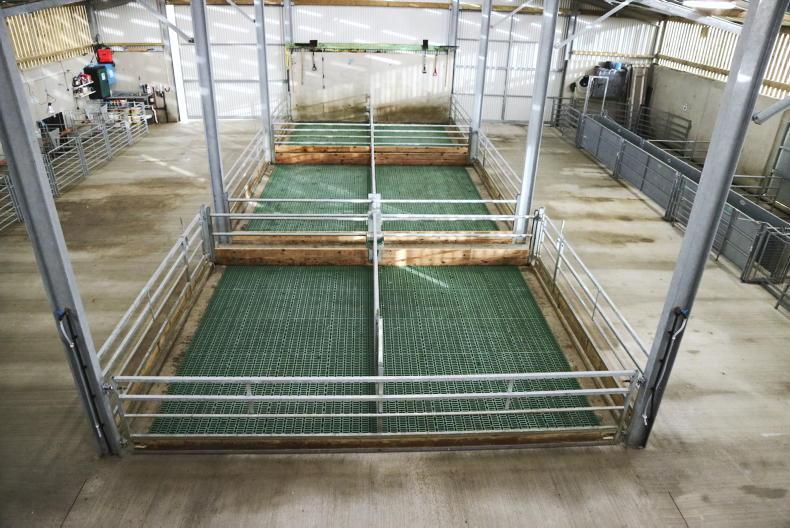
Very few new-build sheep sheds are going up without at least part of the floor area being covered in slats of some form. Any farmer who uses them usually sings their benefit, with reduced labour, a slashing of straw usage and a major reduction in lameness being some of the key benefits.
Possibly their one downfall is their tendency to block if forage is pulled on to to them by sheep, but the use of chopped silage or barriers that reduce sheep’s access to silage aid greatly with this.
It is hopefully going to be ratified that sheds below 300m² of floor space (other factors taken into account) will be granted an exemption in regard to planning permission.
The planned exemption of 1,000m³ for slurry storage is way beyond the needs of sheep farmers, but still useful for those looking to build sheds with tanks.
Tanks
All tanks under slatted floors should be constructed in accordance with S123 (Bovine livestock units and reinforced tanks).
Where it is proposed to remove manure in slurry form, tanks should always be extended outside the sheep house (so as to create an external agitation point).
As tanks are normally shallow, not more than 1.2m deep, a sump about 1.2m x 1.2m and 1.8m to 2.0m deep should be provided in the tank extension to facilitate agitation of slurry with added water. Where the length of the tank exceeds 16m, sumps should be provided at both ends for ease of agitation.
Where it is proposed to remove manure in solid form, tank depth must not be less than 450mm.
Provision must be made to facilitate entry for machinery to empty the tank. The tank may be constructed overground with a ramp access to raised feeding passage.
In cases where it is planned to use a ramp to access into the tank for TAMS aided sheep sheds, then a full set of design drawings (including details of reinforcing) and full structural calculations for the ramp and first 3 linear metres of the tank shall be prepared by a chartered engineer, and given to the Department for prior approval before the start of construction.
Slats
Slats can be made of various materials including:
Concrete.Timber.Expanded metal.Plastic.For those looking to use plastic or concrete slats, then the ‘Accepted Slat list’ by the Department will show eligible slats and their manufacturers.
For plastic sheep slats, where concrete pillars and beams are required, then the rulings in form S.123 should be adhered to. Where a spine wall is to be installed to support runners/ two rows of slats, then this can be reduced down to 200mm in thickness.
Timber and expanded metal slats can be manufactured in the farm workshop, provided the regulations in form S.148s are followed around spacing and timber sizes.
Pen spacing and tanks
Pen depth will largely be dictated by the feed space. As mentioned here before, feeding on one side will result in a shallow pen, while feeding on both sides with/without walk-through troughs will greatly increase feed space and therefore increase the depth of a pen you can create.
Let’s take the following as examples, using 450mm of spacing required per ewe with a standard bay length of 4.8m and a lying space of 1.2m² per ewe;
Feeding on one side only:
4.8m/ 0.45m = 10 ewes.Required pen area = 12m².12m²/ 4.8m = 2.5m deep pen*.*If we increase feeding to both sides, then we can install a 5m deep pen with sufficient lying and feeding capacity for 20 ewes.
The above shows that for a standard bay length, for every 250mm of pen depth, we need to have 450mm of feeding space to sustain a ewe. This works out as a ratio of 1:1.8 as regards pen depth: feeding space.
Example
3.5m deep pen x 4.8m in length
3.5m deep x 1.8 = 6.3m of a required feed space
Lying space available: 3.5m x 4.8m= 16.8m² /1.2m² per ewe = 14 ewes
The example pen depth will not sustain 14 ewes to freely access feed if we are only feeding from one side, so we will have to use a walk-through trough: 4.8m wide + (3.5m deep -0.6m for one ewe space) = 6.5m of feed space.
With a requirement of 6.3m, we have sufficient capacity with one walk-through trough.
You will notice in the above equation that 0.6m was subtracted from the pen depth.
This is due to a ewe feeding along the front of the pen will block off 0.6m of the walk-through trough, therefore we can not calculate this in.
It is not usually necessary to take the spacing that a walk-through trough will take up out of lying space where it is being shared between two pens.

Very few new-build sheep sheds are going up without at least part of the floor area being covered in slats of some form. Any farmer who uses them usually sings their benefit, with reduced labour, a slashing of straw usage and a major reduction in lameness being some of the key benefits.
Possibly their one downfall is their tendency to block if forage is pulled on to to them by sheep, but the use of chopped silage or barriers that reduce sheep’s access to silage aid greatly with this.
It is hopefully going to be ratified that sheds below 300m² of floor space (other factors taken into account) will be granted an exemption in regard to planning permission.
The planned exemption of 1,000m³ for slurry storage is way beyond the needs of sheep farmers, but still useful for those looking to build sheds with tanks.
Tanks
All tanks under slatted floors should be constructed in accordance with S123 (Bovine livestock units and reinforced tanks).
Where it is proposed to remove manure in slurry form, tanks should always be extended outside the sheep house (so as to create an external agitation point).
As tanks are normally shallow, not more than 1.2m deep, a sump about 1.2m x 1.2m and 1.8m to 2.0m deep should be provided in the tank extension to facilitate agitation of slurry with added water. Where the length of the tank exceeds 16m, sumps should be provided at both ends for ease of agitation.
Where it is proposed to remove manure in solid form, tank depth must not be less than 450mm.
Provision must be made to facilitate entry for machinery to empty the tank. The tank may be constructed overground with a ramp access to raised feeding passage.
In cases where it is planned to use a ramp to access into the tank for TAMS aided sheep sheds, then a full set of design drawings (including details of reinforcing) and full structural calculations for the ramp and first 3 linear metres of the tank shall be prepared by a chartered engineer, and given to the Department for prior approval before the start of construction.
Slats
Slats can be made of various materials including:
Concrete.Timber.Expanded metal.Plastic.For those looking to use plastic or concrete slats, then the ‘Accepted Slat list’ by the Department will show eligible slats and their manufacturers.
For plastic sheep slats, where concrete pillars and beams are required, then the rulings in form S.123 should be adhered to. Where a spine wall is to be installed to support runners/ two rows of slats, then this can be reduced down to 200mm in thickness.
Timber and expanded metal slats can be manufactured in the farm workshop, provided the regulations in form S.148s are followed around spacing and timber sizes.
Pen spacing and tanks
Pen depth will largely be dictated by the feed space. As mentioned here before, feeding on one side will result in a shallow pen, while feeding on both sides with/without walk-through troughs will greatly increase feed space and therefore increase the depth of a pen you can create.
Let’s take the following as examples, using 450mm of spacing required per ewe with a standard bay length of 4.8m and a lying space of 1.2m² per ewe;
Feeding on one side only:
4.8m/ 0.45m = 10 ewes.Required pen area = 12m².12m²/ 4.8m = 2.5m deep pen*.*If we increase feeding to both sides, then we can install a 5m deep pen with sufficient lying and feeding capacity for 20 ewes.
The above shows that for a standard bay length, for every 250mm of pen depth, we need to have 450mm of feeding space to sustain a ewe. This works out as a ratio of 1:1.8 as regards pen depth: feeding space.
Example
3.5m deep pen x 4.8m in length
3.5m deep x 1.8 = 6.3m of a required feed space
Lying space available: 3.5m x 4.8m= 16.8m² /1.2m² per ewe = 14 ewes
The example pen depth will not sustain 14 ewes to freely access feed if we are only feeding from one side, so we will have to use a walk-through trough: 4.8m wide + (3.5m deep -0.6m for one ewe space) = 6.5m of feed space.
With a requirement of 6.3m, we have sufficient capacity with one walk-through trough.
You will notice in the above equation that 0.6m was subtracted from the pen depth.
This is due to a ewe feeding along the front of the pen will block off 0.6m of the walk-through trough, therefore we can not calculate this in.
It is not usually necessary to take the spacing that a walk-through trough will take up out of lying space where it is being shared between two pens.
SHARING OPTIONS