


International environmental policy and evolving consumer preferences are placing additional demands on livestock systems. The principal challenges include reducing gaseous emissions and nutrient loss to the environment, minimising dependency on human-edible feeds, promoting biodiversity and enhancing animal health and welfare.
These sustainability challenges must be met against a backdrop of often low and variable economic margins, generated by primary agricultural production. Efficient pasture-based systems, augmented by new and emerging technologies, have the capacity to provide solutions.
Livestock systems research
The research farm at Johnstown Castle hosts a wide range of pasture-based experimental systems, from autumn- and spring-calving dairy herds operating different feed systems, to a range of calf-to-beef models operating at different levels of intensity.
Across all systems, however, increasing pasture utilised – expressed as tonnes dry matter (DM) per hectare – is a key performance indicator.
Numerous analyses have shown that this is the physical performance metric most closely aligned with net farm margins.
Maximising your grass
Sward productivity, animal performance and imported feed affect the levels of pasture utilisation achieved on farms. Pasture utilised increases where high animal performance is achieved for lower supplementary feed input, at a stocking rate that is appropriate for annual pasture growth rates.
The target is to utilise 10t-12t DM per ha for beef and dairy systems, while achieving a high level of self-sufficiency for feed energy and protein. The objective of increasing pasture utilisation must be balanced with achieving improved N use efficiency and reduced N surpluses within each system.
Central to this objective is to limit N imports (as inorganic N fertiliser and feed crude protein), while maintaining or increasing productive N offtakes (milk and carcase protein).
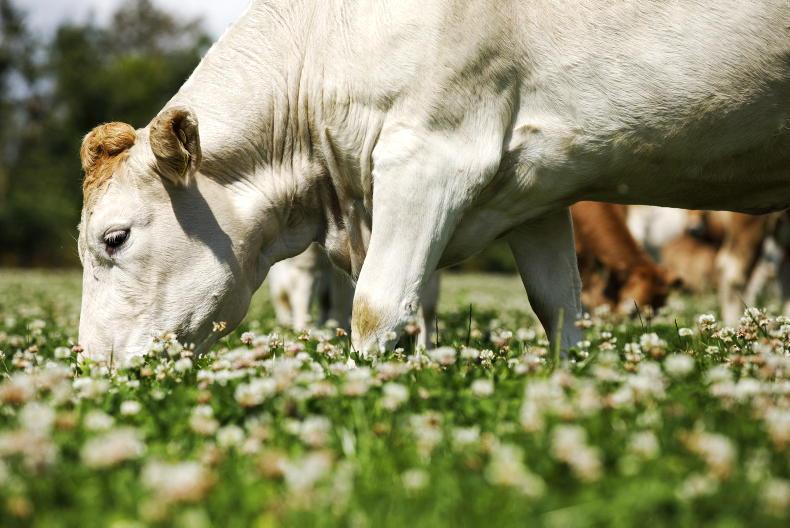
Clover incorporation into grassland swards and reduced chemical N, low-emission slurry spreading, lower crude protein feeds and optimising stocking rates are key management practices. Clover incorporation to grassland swards will be on show in the Irish Farmers Journal’s demonstration area on the day.
Low carbon emissions Addressing carbon emissions from dairy and beef systems is a key priority for the Teagasc research and knowledge transfer programmes, both in terms of improving efficiency per unit of product and mitigating sectoral totals.
Management options that are compatible with efficient pasture-based systems include the use of NBPT-protected urea instead of CAN fertiliser, earlier age at slaughter, altering sward composition and selection for robust animal genotypes (EBI).
Work on the methane abatement potential of specific dietary additives has shown promise, but a significant consideration will be the method of supplement delivery in a pasture-feeding context.




SHARING OPTIONS