



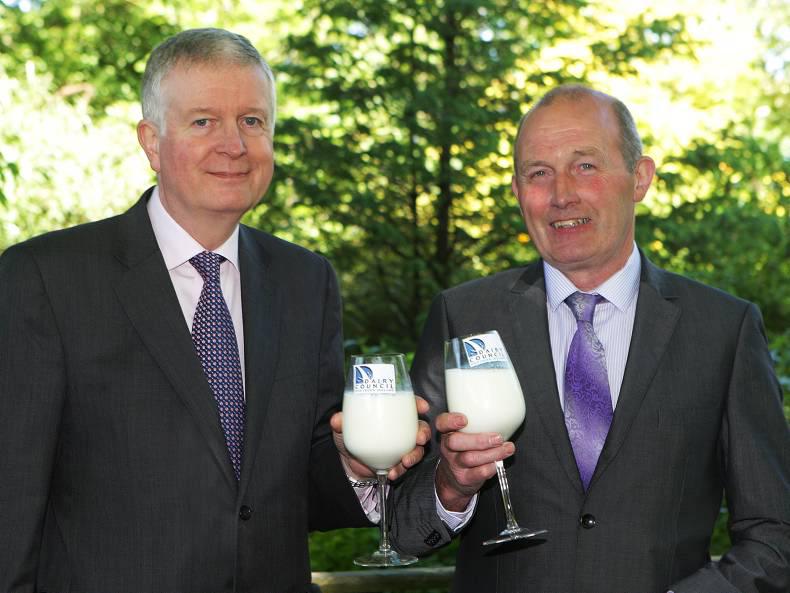
Last week, we published the views of David Dobbin, group chief executive at United Dairy Farmers, the producer co-operative that was set up to replace the statutory Milk Marketing Board for Northern Ireland (MMBNI) in 1995.
Producer co-operatives are the predominant corporate structure across the global dairy sector.
Until 20 years ago, the MMBNI was the statutory monopoly buyer of ex-farm milk for onward sale to processors, with a small proportion of the milk processed by the board’s own factories. The first 20 years of the United Dairy Farmers co-operative have seen it evolve into a dairy processing company that trades relatively little of the ‘‘raw’’ ex-farm milk produced by its members.
“A co-operative has to be run as a business – otherwise, it will hit the wall,” says Dobbin. His view is that there is a need to continually take out cost and to grow throughput, creating a more competitive business.
Dobbin points out that Dale Farm is a significant business within the UK dairy industry. When Muller-Wiseman Dairies (MWD) completes the acquisition of Dairy Crest’s liquid milk operations in Britain (currently subject to scrutiny by the competition authorities), Dairy Crest will be smaller than Dale Farm (on the basis of milk pool and turnover). That means only Arla UK, MWD and First Milk will be bigger than Dale Farm in dairy processing in the whole of the UK.
Dobbin says that United has been a ‘‘consolidator’’ within the NI dairy industry. The group has completed 16 acquisitions since he took up the position of chief executive 15 years ago. The biggest acquisition was Dale Farm, formerly part of Northern Foods plc, which was mainly in liquid milk for retail and doorstep delivery.
Subsequently, Dobbin led the group restructuring. Dromona Quality Foods was merged into Dale Farm and its sites at Bangor Dairies and Tassagh Creamery were shut down. Tough decisions were taken and people were made redundant.
The old MMBNI headquarters building in Belfast was sold. United group later acquired Rowan Glen in southwest Scotland (mostly yoghurt manufacture) and the former Parmalat operation at Kendal in Cumbria (yoghurts, dairy desserts) – both being part of the strategy to grow Dale Farm’s presence in the market in Britain.
The acquisition of the Ash Manor cheese business for adding value and retail packing was a major step at the beginning of 2014. Smaller but significant buy-outs have been the May 2014 purchase of the Fivemiletown cheese brands and the earlier acquisition of Fane Valley’s liquid milk operation and packet butter businesses.
In the ice-cream sector, the group bought out Dale Farm ice-cream and Superchill ice-cream (a distribution business in the Republic of Ireland). Around a year ago, it added Mullins ice cream to extend into the luxury scooped ice-cream market. Dobbin says that this has contributed profit to bolster the milk price in the past year.
The deal whereby United bought a 50% share of Andrews’ animal feed company to form United Feeds was already agreed when Dobbin arrived. Subsequently, he completed the buyout of the other shareholders, making it 100% owned by United. That feed business has delivered profits consistently for the group.
But profits from animal feed manufacture and from ice-cream have not been sufficient to lift United’s milk price off the bottom in 2014-15.
It’s clear that David Dobbin’s focus has been on the processing business as a means to secure and grow the wealth of the co-op members who own that business. That strategy still has to deliver.
The primary focus for most members is on the milk price paid. Expansion of the business is fine but there is a saying that ‘‘turnover is vanity, profit is sanity’’.
Profit in the business of a dairy co-operative is best expressed in the milk price. That is where United Dairy Farmers/Dale Farm group has to perform.
Strategy
It’s also clear that the strategy of the group is towards more sales of consumer products and less as dairy commodities.
The latter have been seen to be more volatile in prices over the years, but some processors maintain that taking the ups with the downs there is a better profit in the production of milk powders and butter. It is easier than trying to squeeze a margin on consumer product sales to the dominant British retailers.
Adding value is only a winner if the added costs are more than covered by the selling prices. That will determine the future competitiveness of the United/Dale Farm milk prices.
Solids content of milk (butterfat, protein and lactose) determines the yield of most of the products that are manufactured by dairy processors in Ireland.
The industry in the Republic has moved to pay for milk on a basis that emphasises solids content and penalises volume of water that have to be carted from farms and removed during processing. It’s a system similar to New Zealand’s and it provides incentives to producers to supply the milk that makes the industry more efficient.
Northern Ireland has not yet made any move to implement that type of milk pricing – and the current competition to sign up suppliers is holding back any such move.
I asked David Dobbin – what about paying for milk on the basis of solids content (fat and protein)?
Dobbin replied: “Parts of our business would be better with milk priced on the basis of solids (A plus B minus C) with a deduction for the volume of liquid. Protein content is vital for cheese yield but irrelevant for product being sold as liquid milk.
‘‘So, ideally, we should have different contracts with different pricing mechanisms depending on the end market, to give clear incentives to our members of the milk that we want to maximise income.
‘‘A possible way forward would be to put ‘shadow pricing’ on to pay sheets to show producers what the milk is worth on a different pricing formula. But we would be nervous of jumping alone to that type of pricing at a time when there is so much uncertainty around,’’ he said.





SHARING OPTIONS