Tree species selection has changed dramatically in Ireland since the middle of the last century when it was a mix of 50% European conifers, 42% exotics and 8% broadleaves.
Over the past 10 years, broadleaves have averaged 30% of afforestation programmes, with conifers – mainly Sitka spruce – forming 70% of planting. Since the demise of ash as a result of Hymenoscyphus fraxineus or ash dieback, average planting of broadleaves has decreased to 20% of the annual programme as foresters seek a viable alternative broadleaf substitute.
Disease threats, land suitability, yield and markets are all factors that influence tree species suitability. In this regard, farmers who establish forests understand the similarities of forestry and agriculture, especially in relation to cereal crop selection, which also fluctuates.
For example, oilseed rape increased from 4,500ha in 2008 to 14,500ha in 2012, while sugar beet grown by 50,100 farmers at its peak disappeared from the tillage mix 17 years ago.
Economics and markets dictate crop choice in agriculture just as they do in forestry. But forestry has to contend with other factors which were addressed in last week’s conference “Minor conifers – an appraisal of the silvicultural and marketing potential of coniferous alternatives to Sitka spruce”.
Organised by the Society of Irish Foresters and the Wood Marketing Federation, the conference examined minor conifers from the perspective of the grower and the end user. Unlike agricultural crops which are seasonal and where the raison d’être is economics, forestry is a long-term land use and has to satisfy a range of commercial, environmental and social objectives.
Like the 2015 national conference on broadleaves, species diversity and biodiversity are also key components of multipurpose forestry. However, the central objective is “to grow the right trees in the right places”, maintained Marina Conway, chief executive, Western Forestry Co-operative.
She maintained that most of the afforestation programme will continue to be carried out in western counties where species diversification is limited. However, she said that diversification to broadleaves and minor conifers is achievable on a realistic scale, providing the underlying objective is to grow quality crops.
“In my experience, foresters would like to plant more diverse conifers, but we need to avoid forced diversification,” she said. “Increased incentives are required for growing diverse conifers which produce lower yields than Sitka spruce but need better quality land and more intensive management.” she said.
She made a number of other proposals including:
Target specific areas for minor conifers. Promote niche sawmilling.Increase links with future agri-environment schemes.An encouraging aspect of growing minor conifers is the evidence available from research trials and past planting programmes as outlined by Niall Farrelly, Teagasc and Paul McClean, Forestry Commission.
“We are not starting from zero as there is both operational and experimental evidence from trials in Britain and Ireland during the last century which can inform provenance choice, nursery production regime, establishment methods and other aspects of the silviculture of alternative conifers,” said Paul McClean.
In a wide-ranging examination of trials in Ireland, Niall Farrelly explored a number of alternative conifers including species that could replace Japanese larch which is no longer planted due to its vulnerability to the disease Phytophthora ramorum.
“Apart from Sitka spruce, five species show increased productivity over larch, comprising grand fir, Douglas fir, Norway spruce, western hemlock and western red cedar,” he said. “Sitka spruce has proven to be one of the most productive conifers in Ireland and as such has become the mainstay in roundwood processing,” said John Redmond, Forest Service.
However, he outlined the risk of high dependency on Sitka, especially against the backdrop of potential threats such as the eight-toothed bark beetle and the great spruce bark beetle which has been in Britain since 1982.
Richard Lattimer, Glennon Brothers, outlined a number of sawmilling challenges facing the processing of minor softwoods. “To build a viable industry around a specific species, you need a guaranteed annual supply of at least 25,000m3,” he maintained.
Gordon Knaggs provided the wood scientist perspective. “We need to manage forests to produce quality material,” he said. “Further research is required to assign minor species to ‘strength classes’ for structural use as only Sitka spruce currently conforms with the European standard.”
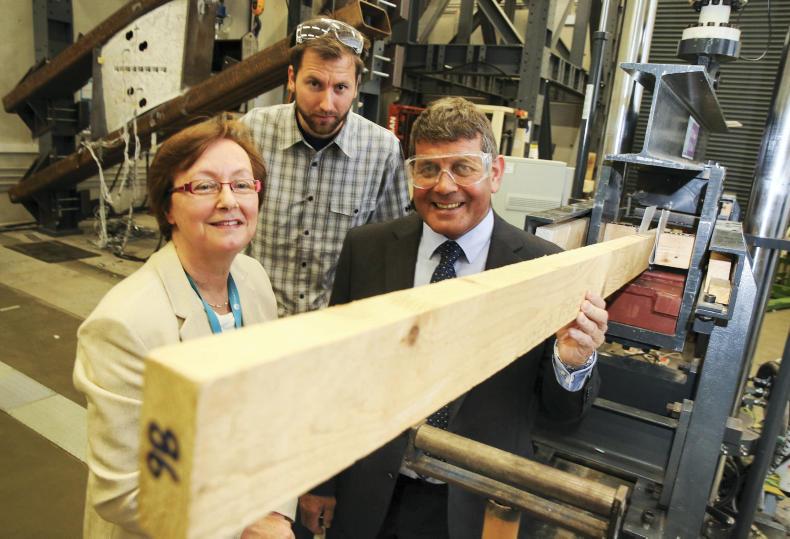
Dan Ridley-Ellis, Edinburgh Napier University, outlined some of the work being carried out by his Centre for Wood Science & Technology and NUI Galway in a new joint project announced by Minister Doyle. This project should address some of Gordon Knaggs proposals as “it will work at national and European level in standardisation for structural timber quality and production.”
Each speaker was asked to name two alternative conifer species to Sitka spruce given that we also aim to plant 20-30% broadleaves. Six speakers (two foresters, a wood scientist, a sawmiller and two forestry researchers) opted for Douglas fir as the first choice based on its growth and market potential, providing suitable sites can be sourced. Scots pine and Norway spruce were in joint second place; Scots pine because it is native and has good site adaptability while Norway is a proven species in Irish forestry, especially in frost-prone sites. Lodgepole pine was in third place providing greater research into provenance is carried out to achieve better stem form. Some speakers said that they would also favour increased planting of western red cedar and western hemlock.
Andrew Doyle, Minister of State with responsibility for forestry, addressed the duality of minor conifers as viable forest and market species. “An objective of the current Forestry Programme is to encourage tree species diversity by offering increased grants and premiums and other supports for diverse conifers and broadleaves,” he said. “The incentives for broadleaves are significant as are the increases for diverse conifers outlined in the current Afforestation Grant and Premium Scheme. The recent provision of substantial grant aid to NUI Galway to carry out work on timber standards and innovation in the built environment will support research to characterise the strength properties of a number of species, including Douglas fir and Norway spruce so they can be traded as structural timber.”
Tree species selection has changed dramatically in Ireland since the middle of the last century when it was a mix of 50% European conifers, 42% exotics and 8% broadleaves.
Over the past 10 years, broadleaves have averaged 30% of afforestation programmes, with conifers – mainly Sitka spruce – forming 70% of planting. Since the demise of ash as a result of Hymenoscyphus fraxineus or ash dieback, average planting of broadleaves has decreased to 20% of the annual programme as foresters seek a viable alternative broadleaf substitute.
Disease threats, land suitability, yield and markets are all factors that influence tree species suitability. In this regard, farmers who establish forests understand the similarities of forestry and agriculture, especially in relation to cereal crop selection, which also fluctuates.
For example, oilseed rape increased from 4,500ha in 2008 to 14,500ha in 2012, while sugar beet grown by 50,100 farmers at its peak disappeared from the tillage mix 17 years ago.
Economics and markets dictate crop choice in agriculture just as they do in forestry. But forestry has to contend with other factors which were addressed in last week’s conference “Minor conifers – an appraisal of the silvicultural and marketing potential of coniferous alternatives to Sitka spruce”.
Organised by the Society of Irish Foresters and the Wood Marketing Federation, the conference examined minor conifers from the perspective of the grower and the end user. Unlike agricultural crops which are seasonal and where the raison d’être is economics, forestry is a long-term land use and has to satisfy a range of commercial, environmental and social objectives.
Like the 2015 national conference on broadleaves, species diversity and biodiversity are also key components of multipurpose forestry. However, the central objective is “to grow the right trees in the right places”, maintained Marina Conway, chief executive, Western Forestry Co-operative.
She maintained that most of the afforestation programme will continue to be carried out in western counties where species diversification is limited. However, she said that diversification to broadleaves and minor conifers is achievable on a realistic scale, providing the underlying objective is to grow quality crops.
“In my experience, foresters would like to plant more diverse conifers, but we need to avoid forced diversification,” she said. “Increased incentives are required for growing diverse conifers which produce lower yields than Sitka spruce but need better quality land and more intensive management.” she said.
She made a number of other proposals including:
Target specific areas for minor conifers. Promote niche sawmilling.Increase links with future agri-environment schemes.An encouraging aspect of growing minor conifers is the evidence available from research trials and past planting programmes as outlined by Niall Farrelly, Teagasc and Paul McClean, Forestry Commission.
“We are not starting from zero as there is both operational and experimental evidence from trials in Britain and Ireland during the last century which can inform provenance choice, nursery production regime, establishment methods and other aspects of the silviculture of alternative conifers,” said Paul McClean.
In a wide-ranging examination of trials in Ireland, Niall Farrelly explored a number of alternative conifers including species that could replace Japanese larch which is no longer planted due to its vulnerability to the disease Phytophthora ramorum.
“Apart from Sitka spruce, five species show increased productivity over larch, comprising grand fir, Douglas fir, Norway spruce, western hemlock and western red cedar,” he said. “Sitka spruce has proven to be one of the most productive conifers in Ireland and as such has become the mainstay in roundwood processing,” said John Redmond, Forest Service.
However, he outlined the risk of high dependency on Sitka, especially against the backdrop of potential threats such as the eight-toothed bark beetle and the great spruce bark beetle which has been in Britain since 1982.
Richard Lattimer, Glennon Brothers, outlined a number of sawmilling challenges facing the processing of minor softwoods. “To build a viable industry around a specific species, you need a guaranteed annual supply of at least 25,000m3,” he maintained.
Gordon Knaggs provided the wood scientist perspective. “We need to manage forests to produce quality material,” he said. “Further research is required to assign minor species to ‘strength classes’ for structural use as only Sitka spruce currently conforms with the European standard.”
Dan Ridley-Ellis, Edinburgh Napier University, outlined some of the work being carried out by his Centre for Wood Science & Technology and NUI Galway in a new joint project announced by Minister Doyle. This project should address some of Gordon Knaggs proposals as “it will work at national and European level in standardisation for structural timber quality and production.”
Each speaker was asked to name two alternative conifer species to Sitka spruce given that we also aim to plant 20-30% broadleaves. Six speakers (two foresters, a wood scientist, a sawmiller and two forestry researchers) opted for Douglas fir as the first choice based on its growth and market potential, providing suitable sites can be sourced. Scots pine and Norway spruce were in joint second place; Scots pine because it is native and has good site adaptability while Norway is a proven species in Irish forestry, especially in frost-prone sites. Lodgepole pine was in third place providing greater research into provenance is carried out to achieve better stem form. Some speakers said that they would also favour increased planting of western red cedar and western hemlock.
Andrew Doyle, Minister of State with responsibility for forestry, addressed the duality of minor conifers as viable forest and market species. “An objective of the current Forestry Programme is to encourage tree species diversity by offering increased grants and premiums and other supports for diverse conifers and broadleaves,” he said. “The incentives for broadleaves are significant as are the increases for diverse conifers outlined in the current Afforestation Grant and Premium Scheme. The recent provision of substantial grant aid to NUI Galway to carry out work on timber standards and innovation in the built environment will support research to characterise the strength properties of a number of species, including Douglas fir and Norway spruce so they can be traded as structural timber.”





SHARING OPTIONS