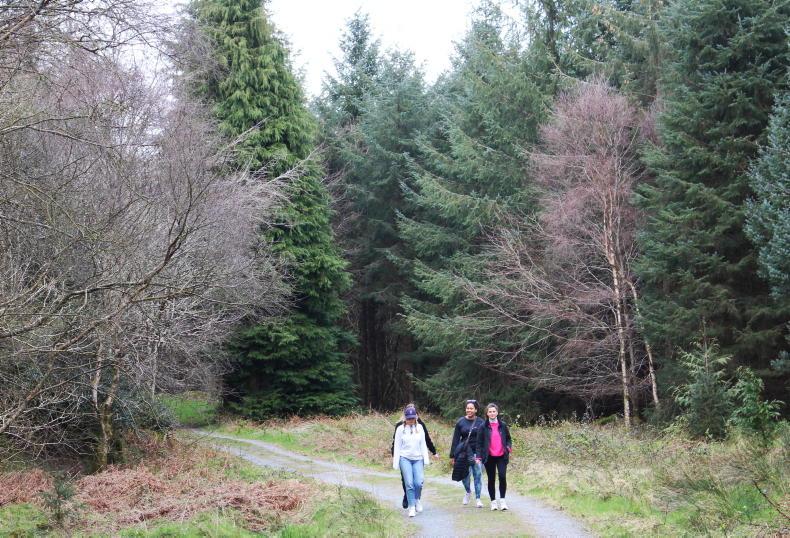
While Irish forest cover is low compared with other European countries, we are fortunate in having the highest number of recreation forests per capita in Europe. Approximately 420 forests and forest parks are open to the public throughout the island of Ireland – almost all free of charge – with additional woodland trails that people discover for themselves.
The importance of recreation forests was demonstrated in 2012 and 2013 when there was large-scale public opposition to the proposed privatisation of State forestry. The proposal was eventually abandoned, but the experience provided Government and public alike with an opportunity to reappraise the public good of the forest resource.
The importance of Irish forestry can be judged by the number of people who visit our forests as places of recreation, respite and renewal. The open forest policy adopted by the State – north and south – in the 1970s has resulted in 38 million visits to Irish forests annually.
This policy is enshrined by Coillte and is continued by the Forest Service, Northern Ireland while the National Parks and Wildlife Service woodlands along with forests managed by local authorities are widely used. In recent years, community forests have been added to the list. The RDS forestry awards highlight their importance, which are supported by the Forest Service, NeighbourWood scheme.
Forests are acknowledged not only for their physical health benefits but also as environments that enhance mental wellbeing. This was demonstrated during the Covid-19 pandemic years when visits to forests significantly increased. Research has shown that exposure to the natural environment reduces stress and anxiety, and among natural areas, forests are considered one of the more attractive.
A Woodlands for Health programme established in 2012 explored the health benefits that “woodland activities can provide to participants and to demonstrate [their] value to health professionals”. Various reports have tried to estimate the economic value of recreation forestry.
In Finland, Metsahallitus, the state-owned Finnish forestry company, receives direct Government funding for managing outdoor recreation. It is difficult to assess recreation on economic grounds but a 2015 Teagasc study – “Valuing the Ecosystem Services of Irish Forests” – estimated an annual value of €179m for forest recreation based on 29m annual forest visits.
Carried out in collaboration with UCD, UCC and UL, the study went beyond economic analysis to explore the physical and mental benefits of forest recreation.
A review of a pilot programme which involved people suffering from depression spending time in Irish forests was undertaken. “It showed that organised ‘forest walks’ were considered by medical professionals as effective adjunctive interventions for those suffering from depression,” the report claimed. “This could provide significant economic benefits for the Health Service, which would include reduced medical drug dosage, reduced clinical appointments and reduced residential care in hospitals.”
Apart from forests owned by the Irish Forestry Unit Trust (IForUT), virtually all forest recreation sites are State-owned. IForUT, which manages Irish pension fund and charity investment in forestry, has opened a number of forests to the public in recent years but there is a major benefit in opening more private forests. This will require State funding for what is a major public good but non-revenue-generating activity.
Attenborough on a balanced forestry programme
As David Attenborough celebrated his 100th birthday last week, richly deserved tributes were paid to the world’s most famous wildlife expert and climate campaigner. Attenborough had some interesting views on forestry, which are summarised in a 2019 seven-minute Netflix video Our Planet: How to Save our Forests.
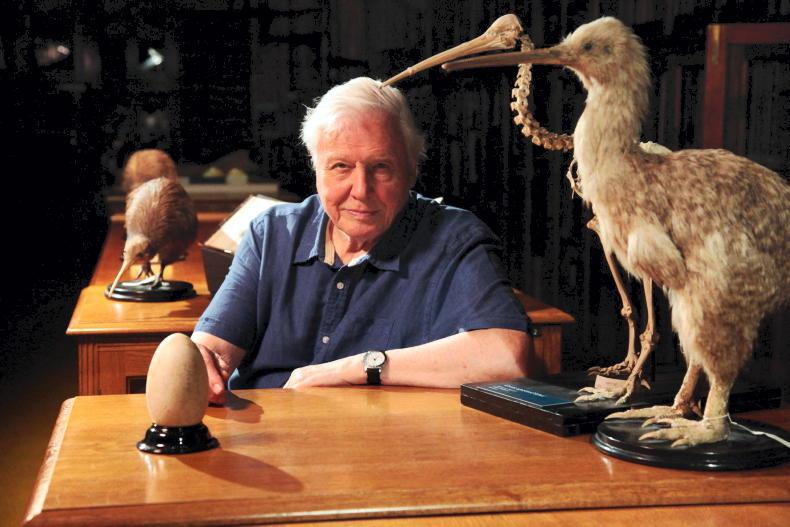
David Attenborough. \ BBC / Album
The film outlines how overcutting has destroyed large tracts of global forest, but Attenborough is hopeful that they can be restored.
“Luckily for us, the solution to how we restore the planet’s forests is simple,” he says. “We just need to give trees the opportunity to draw on their natural resilience.”
Essentially, the film is a call for a balanced forestry programme which acknowledges the need to protect and enhance our natural forest but also recognised the role of commercial forests. “But on their own natural forests can’t provide all the wood that we need,” he says. “So we also have to farm trees, just like we do other crops and create a new generation of plantations – plantations that allow wildlife to pass through natural forest corridors, that benefit local communities and economies and that are planted on existing cleared land so they don’t replace natural forests.”
The Attenborough message is simple, yet powerful: “We need trees.”
Forestry receives €5.6m to support research
Forestry and related sectors recently received €5.6m to support research out of an overall €37.5m investment in research for agri-food, forestry and bioeconomy. Along with Teagasc, nine universities are involved in four projects covering tree improvement, forests and carbon and bio-based forestry innovations (Table 1).
Almost half of the funding goes towards a project to research “Integrated bio-based innovations for sustainable manufacturing, construction, and pharmaceutical applications from Irish forest biomass”. University of Galway, the lead institution in this project will partner with Teagasc and four universities: ATU, DCU, TUD, TCD.
Storms
Led by Teagasc, the project “Advancing tree improvement research for climate-resilient, diverse, and productive forests for Ireland” is timely after two major storms in December 2024 and January 2025 caused serious damage in Irish forests within the southwest, west and border counties.
The remaining projects focus on forestry and carbon. SETU is the lead institution of a study on 3-D laser scanning for detecting change in carbon stocks and biodiversity across native and commercial forests, while UL will steer a project which is researching “disturbance-resilient forest carbon”.
While Irish forest cover is low compared with other European countries, we are fortunate in having the highest number of recreation forests per capita in Europe. Approximately 420 forests and forest parks are open to the public throughout the island of Ireland – almost all free of charge – with additional woodland trails that people discover for themselves.
The importance of recreation forests was demonstrated in 2012 and 2013 when there was large-scale public opposition to the proposed privatisation of State forestry. The proposal was eventually abandoned, but the experience provided Government and public alike with an opportunity to reappraise the public good of the forest resource.
The importance of Irish forestry can be judged by the number of people who visit our forests as places of recreation, respite and renewal. The open forest policy adopted by the State – north and south – in the 1970s has resulted in 38 million visits to Irish forests annually.
This policy is enshrined by Coillte and is continued by the Forest Service, Northern Ireland while the National Parks and Wildlife Service woodlands along with forests managed by local authorities are widely used. In recent years, community forests have been added to the list. The RDS forestry awards highlight their importance, which are supported by the Forest Service, NeighbourWood scheme.
Forests are acknowledged not only for their physical health benefits but also as environments that enhance mental wellbeing. This was demonstrated during the Covid-19 pandemic years when visits to forests significantly increased. Research has shown that exposure to the natural environment reduces stress and anxiety, and among natural areas, forests are considered one of the more attractive.
A Woodlands for Health programme established in 2012 explored the health benefits that “woodland activities can provide to participants and to demonstrate [their] value to health professionals”. Various reports have tried to estimate the economic value of recreation forestry.
In Finland, Metsahallitus, the state-owned Finnish forestry company, receives direct Government funding for managing outdoor recreation. It is difficult to assess recreation on economic grounds but a 2015 Teagasc study – “Valuing the Ecosystem Services of Irish Forests” – estimated an annual value of €179m for forest recreation based on 29m annual forest visits.
Carried out in collaboration with UCD, UCC and UL, the study went beyond economic analysis to explore the physical and mental benefits of forest recreation.
A review of a pilot programme which involved people suffering from depression spending time in Irish forests was undertaken. “It showed that organised ‘forest walks’ were considered by medical professionals as effective adjunctive interventions for those suffering from depression,” the report claimed. “This could provide significant economic benefits for the Health Service, which would include reduced medical drug dosage, reduced clinical appointments and reduced residential care in hospitals.”
Apart from forests owned by the Irish Forestry Unit Trust (IForUT), virtually all forest recreation sites are State-owned. IForUT, which manages Irish pension fund and charity investment in forestry, has opened a number of forests to the public in recent years but there is a major benefit in opening more private forests. This will require State funding for what is a major public good but non-revenue-generating activity.
Attenborough on a balanced forestry programme
As David Attenborough celebrated his 100th birthday last week, richly deserved tributes were paid to the world’s most famous wildlife expert and climate campaigner. Attenborough had some interesting views on forestry, which are summarised in a 2019 seven-minute Netflix video Our Planet: How to Save our Forests.

David Attenborough. \ BBC / Album
The film outlines how overcutting has destroyed large tracts of global forest, but Attenborough is hopeful that they can be restored.
“Luckily for us, the solution to how we restore the planet’s forests is simple,” he says. “We just need to give trees the opportunity to draw on their natural resilience.”
Essentially, the film is a call for a balanced forestry programme which acknowledges the need to protect and enhance our natural forest but also recognised the role of commercial forests. “But on their own natural forests can’t provide all the wood that we need,” he says. “So we also have to farm trees, just like we do other crops and create a new generation of plantations – plantations that allow wildlife to pass through natural forest corridors, that benefit local communities and economies and that are planted on existing cleared land so they don’t replace natural forests.”
The Attenborough message is simple, yet powerful: “We need trees.”
Forestry receives €5.6m to support research
Forestry and related sectors recently received €5.6m to support research out of an overall €37.5m investment in research for agri-food, forestry and bioeconomy. Along with Teagasc, nine universities are involved in four projects covering tree improvement, forests and carbon and bio-based forestry innovations (Table 1).
Almost half of the funding goes towards a project to research “Integrated bio-based innovations for sustainable manufacturing, construction, and pharmaceutical applications from Irish forest biomass”. University of Galway, the lead institution in this project will partner with Teagasc and four universities: ATU, DCU, TUD, TCD.
Storms
Led by Teagasc, the project “Advancing tree improvement research for climate-resilient, diverse, and productive forests for Ireland” is timely after two major storms in December 2024 and January 2025 caused serious damage in Irish forests within the southwest, west and border counties.
The remaining projects focus on forestry and carbon. SETU is the lead institution of a study on 3-D laser scanning for detecting change in carbon stocks and biodiversity across native and commercial forests, while UL will steer a project which is researching “disturbance-resilient forest carbon”.
SHARING OPTIONS