Forest certification verifies that forests and woodlands are managed according to principles of sustainable forest management (SFM). It proves that certified forests have been independently inspected and evaluated according to strict environmental, social and economic principles and criteria as agreed by an internationally recognised accredited certification body.
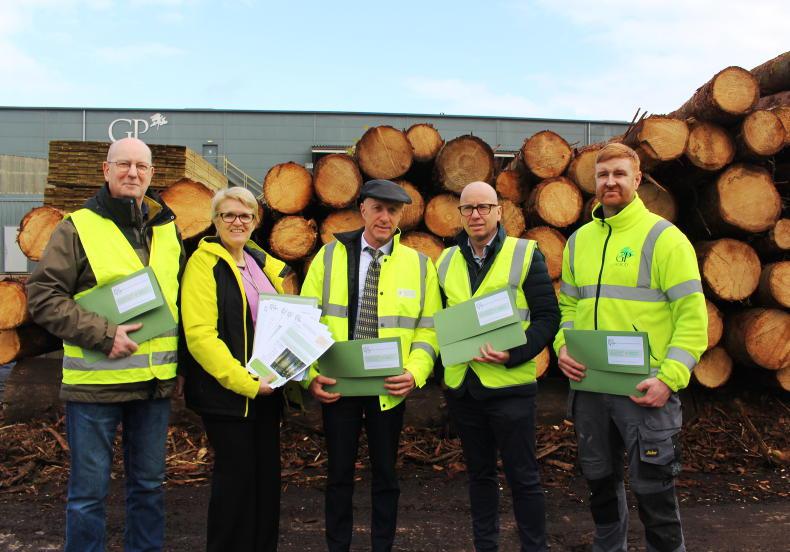
All of Ireland’s exporting timber processors achieved chain of custody (CoC) certification as long as they purchase no more than 70% of their timber from certified forests as William Merrivale, National Secretary, PEFC explained in GP Wood’s sawmill in Lissarda, Co. Cork last Friday.
He outlined the importance of achieving increased forest certification, especially for private growers as “currently 470,070ha or 58% of the forest estate is certified under FSC and PEFC” the two accredited certification bodies operating in Ireland.
As timber from private forests increases, there is now pressure on private growers to achieve certification if they wish to sell timber to sawmills and other processing mills with CoC certification.
Niall Grainger, MD, GP Wood stressed the importance of certification which is essential in maximising market share for Irish timber. “Over 50% of what we sell, goes off the island to markets that insist on purchasing only certified timber products,” he said.
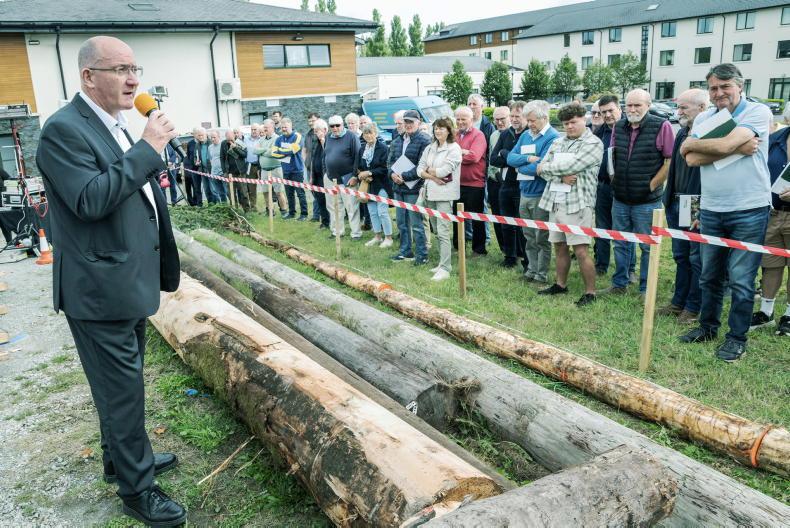
The Lissarda event, jointly organised by GP Wood and the Irish Timber Growers Association (ITGA) was an opportunity not only to stress the importance of certification for private growers but also to outline the steps being taken to achieve certification.
“With private forests projected to supply the majority of Ireland’s timber in the coming decades, progressing group certification is now a critical enabler for the sector,” said Donal Whelan, technical director ITGA.
As certification is new to most private forest owners, Mechteld Schuller, has produced 10 factsheets to explain the process. “The aim of these factsheets is to provide clear, practical guidance for forest owners on the processes, benefits, and general requirements of forest certification,” she told the attendance at Lissarda.
“These factsheets are a practical step in helping forest owners understand and engage with certification, ensuring our forestry sector remains competitive, credible, and aligned with national and EU objectives,” said Minister Healy-Rae, who launched the publications. He outlined the steps that have been taken so far to achieve his stated aim that every privately owned forest in Ireland “will be certified”.
These include:
Establishment of a Group Certification Board, which will be instrumental in advancing a coordinated national approach, supporting alignment between policy, industry, and forest owners, ensuring that certification infrastructure keeps pace with forecasted timber supply growth.An iPLAN scheme, to promote more active forest management, resulting in forests that have greater capacity to deliver ecosystem services, climate resilience, roundwood value and forest health vitality and the greater mobilisation of timber. Private forest owners receive a grant of €1,200 when submitting a Forest Management Plan (FMP) through an iPlan.While achieving certification for private growers is essential in maximising marketing options, it is costly unless forest owners combine their resources in group schemes.
“Group certification, in particular, is designed to reduce administrative and cost barriers for individual forest owners by allowing them to certify collectively under a shared framework,” said Mechteld Schuller.
The information sheets, which are funded by the Department of Agriculture, Food and the Marine under its Forestry Promotion Projects, can be downloaded (www.groupcertification.ie) alongside the Certification Resource Library. Contact Mechteld Schuller (info@groupcertification.ie) for further information.
Timber transport and Irish roads
The recently launched “Good Practice Guide for Managing Sustainable Timber Transport” provides interesting information on Ireland’s road infrastructure as well as challenges for Irish timber harvesters, hauliers and ultimately timber growers in the use of public and forest roads.
“Motorways and National Roads are suitable for all vehicles up to the legal weight limit, as will the majority of Regional Roads, however, some local restrictions may apply on certain Regional Roads,” the guide states. “Over the past three decades, there have been significant developments in the dimensions and weights of vehicles,” it adds.
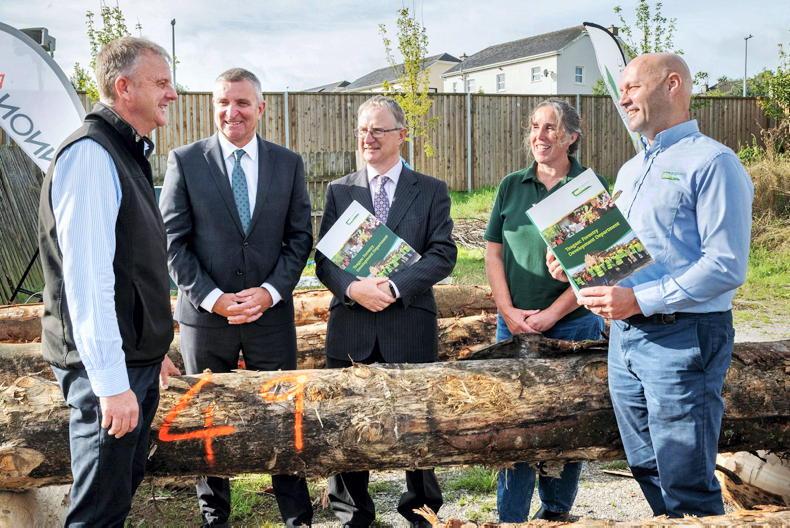
Minister of State, Michael Healy-Rae, who launched 10 information sheets last Friday at GP Wood, Lissarda, Co Cork, with William Merivale, PEFC; Mechteld Schuller, author of the information sheets; Niall Grainger, MD, GP Wood and Shane O’Callaghan, director. \ Donal Magner
“In Ireland, before the early 1980s, the maximum gross vehicle weight stood at 32.5 tonnes for a four-axle articulated combination. Today, this limit has expanded to 46 tonnes”
These increased weights are vital in moving a commodity such as timber but the guide outlines how we lag behind Scandinavia where “Finland and Sweden, permit even more substantial weight limits, reaching up to 60 tonnes for seven-axle road trains, encompassing both rigid and trailer units.”
The report draws attention to weights in Northern Ireland where “the maximum gross vehicle weight is 44 tonnes, so any timber HGVs transporting stock between the two jurisdictions should be aware of the variance”.
The guide outlines the enormous network of public roads in Ireland (102,100km), virtually all of which are used by timber hauliers. Add this to forest roads (estimated at 14,000km) and the total road network reaches 116,000km (Table 1), almost three laps of the equator.
“To minimise damage on all roads, the guide places strong emphasis on route planning to optimise operations, ensure safety and compliance, reduce environmental impact, and minimise costs,” the guide states. “It’s a critical component of a well-organised and successful timber transport operation, particularly as it can reduce the impact on vulnerable roads.”
Ireland needs more commercial forests, maintains Mike Glennon
Mike Glennon, joint MD, Glennon Brothers stressed “the need for more commercial forests in Ireland to meet future demand for construction-grade timber, alongside wider action to address bottlenecks in housing delivery across planning, infrastructure and skills” when Minister of State with responsible for Housing, Local Government and Planning, John Cummins visited the company’s Alexanders Timber Design (ATD) mill in Irvine, North Ayrshire, recently.
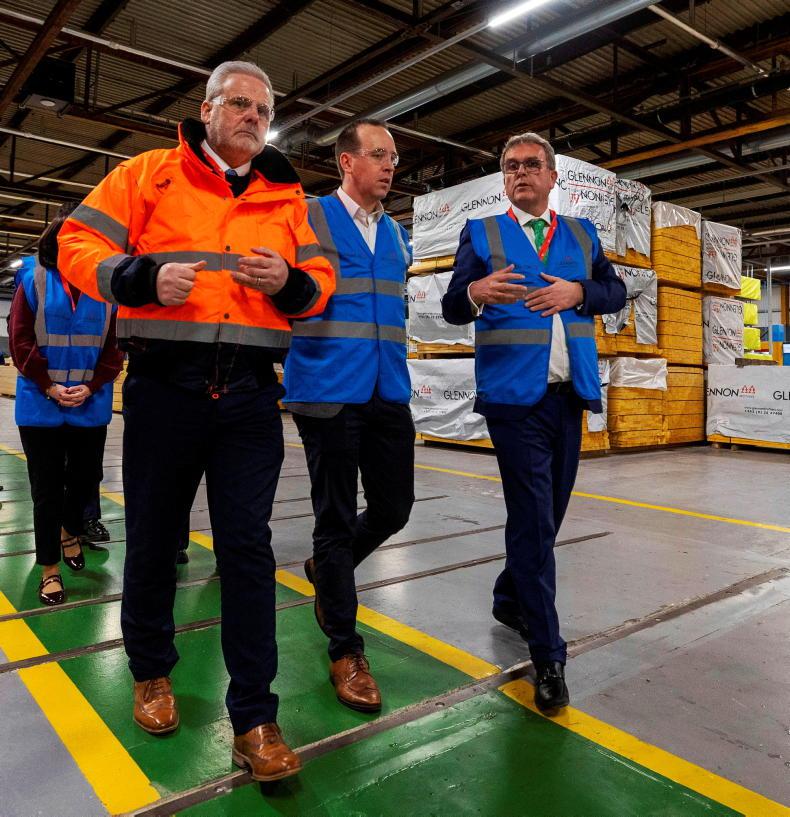
Minister of State John Cummins (centre) with Jim Patterson, Head of Timber Frame, ATD and Mike Glennon, Joint MD, Glennon Brothers. \ Jeff Holmes
“Forestry has a key role to play in helping Ireland meet its housing needs and climate change targets,” he said. “With just 2,500ha planted in 2025, against a Government annual target of 8,000ha and climate change targets of 16,000ha, Ireland must increase forest cover to avoid significant EU penalties”.
Forest certification verifies that forests and woodlands are managed according to principles of sustainable forest management (SFM). It proves that certified forests have been independently inspected and evaluated according to strict environmental, social and economic principles and criteria as agreed by an internationally recognised accredited certification body.
All of Ireland’s exporting timber processors achieved chain of custody (CoC) certification as long as they purchase no more than 70% of their timber from certified forests as William Merrivale, National Secretary, PEFC explained in GP Wood’s sawmill in Lissarda, Co. Cork last Friday.
He outlined the importance of achieving increased forest certification, especially for private growers as “currently 470,070ha or 58% of the forest estate is certified under FSC and PEFC” the two accredited certification bodies operating in Ireland.
As timber from private forests increases, there is now pressure on private growers to achieve certification if they wish to sell timber to sawmills and other processing mills with CoC certification.
Niall Grainger, MD, GP Wood stressed the importance of certification which is essential in maximising market share for Irish timber. “Over 50% of what we sell, goes off the island to markets that insist on purchasing only certified timber products,” he said.
The Lissarda event, jointly organised by GP Wood and the Irish Timber Growers Association (ITGA) was an opportunity not only to stress the importance of certification for private growers but also to outline the steps being taken to achieve certification.
“With private forests projected to supply the majority of Ireland’s timber in the coming decades, progressing group certification is now a critical enabler for the sector,” said Donal Whelan, technical director ITGA.
As certification is new to most private forest owners, Mechteld Schuller, has produced 10 factsheets to explain the process. “The aim of these factsheets is to provide clear, practical guidance for forest owners on the processes, benefits, and general requirements of forest certification,” she told the attendance at Lissarda.
“These factsheets are a practical step in helping forest owners understand and engage with certification, ensuring our forestry sector remains competitive, credible, and aligned with national and EU objectives,” said Minister Healy-Rae, who launched the publications. He outlined the steps that have been taken so far to achieve his stated aim that every privately owned forest in Ireland “will be certified”.
These include:
Establishment of a Group Certification Board, which will be instrumental in advancing a coordinated national approach, supporting alignment between policy, industry, and forest owners, ensuring that certification infrastructure keeps pace with forecasted timber supply growth.An iPLAN scheme, to promote more active forest management, resulting in forests that have greater capacity to deliver ecosystem services, climate resilience, roundwood value and forest health vitality and the greater mobilisation of timber. Private forest owners receive a grant of €1,200 when submitting a Forest Management Plan (FMP) through an iPlan.While achieving certification for private growers is essential in maximising marketing options, it is costly unless forest owners combine their resources in group schemes.
“Group certification, in particular, is designed to reduce administrative and cost barriers for individual forest owners by allowing them to certify collectively under a shared framework,” said Mechteld Schuller.
The information sheets, which are funded by the Department of Agriculture, Food and the Marine under its Forestry Promotion Projects, can be downloaded (www.groupcertification.ie) alongside the Certification Resource Library. Contact Mechteld Schuller (info@groupcertification.ie) for further information.
Timber transport and Irish roads
The recently launched “Good Practice Guide for Managing Sustainable Timber Transport” provides interesting information on Ireland’s road infrastructure as well as challenges for Irish timber harvesters, hauliers and ultimately timber growers in the use of public and forest roads.
“Motorways and National Roads are suitable for all vehicles up to the legal weight limit, as will the majority of Regional Roads, however, some local restrictions may apply on certain Regional Roads,” the guide states. “Over the past three decades, there have been significant developments in the dimensions and weights of vehicles,” it adds.

Minister of State, Michael Healy-Rae, who launched 10 information sheets last Friday at GP Wood, Lissarda, Co Cork, with William Merivale, PEFC; Mechteld Schuller, author of the information sheets; Niall Grainger, MD, GP Wood and Shane O’Callaghan, director. \ Donal Magner
“In Ireland, before the early 1980s, the maximum gross vehicle weight stood at 32.5 tonnes for a four-axle articulated combination. Today, this limit has expanded to 46 tonnes”
These increased weights are vital in moving a commodity such as timber but the guide outlines how we lag behind Scandinavia where “Finland and Sweden, permit even more substantial weight limits, reaching up to 60 tonnes for seven-axle road trains, encompassing both rigid and trailer units.”
The report draws attention to weights in Northern Ireland where “the maximum gross vehicle weight is 44 tonnes, so any timber HGVs transporting stock between the two jurisdictions should be aware of the variance”.
The guide outlines the enormous network of public roads in Ireland (102,100km), virtually all of which are used by timber hauliers. Add this to forest roads (estimated at 14,000km) and the total road network reaches 116,000km (Table 1), almost three laps of the equator.
“To minimise damage on all roads, the guide places strong emphasis on route planning to optimise operations, ensure safety and compliance, reduce environmental impact, and minimise costs,” the guide states. “It’s a critical component of a well-organised and successful timber transport operation, particularly as it can reduce the impact on vulnerable roads.”
Ireland needs more commercial forests, maintains Mike Glennon
Mike Glennon, joint MD, Glennon Brothers stressed “the need for more commercial forests in Ireland to meet future demand for construction-grade timber, alongside wider action to address bottlenecks in housing delivery across planning, infrastructure and skills” when Minister of State with responsible for Housing, Local Government and Planning, John Cummins visited the company’s Alexanders Timber Design (ATD) mill in Irvine, North Ayrshire, recently.

Minister of State John Cummins (centre) with Jim Patterson, Head of Timber Frame, ATD and Mike Glennon, Joint MD, Glennon Brothers. \ Jeff Holmes
“Forestry has a key role to play in helping Ireland meet its housing needs and climate change targets,” he said. “With just 2,500ha planted in 2025, against a Government annual target of 8,000ha and climate change targets of 16,000ha, Ireland must increase forest cover to avoid significant EU penalties”.
SHARING OPTIONS