



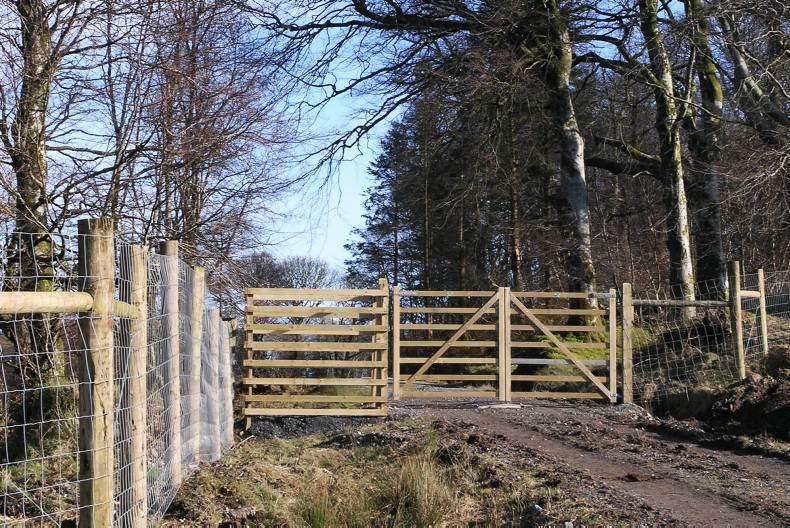
Fencing and fence maintenance are key operations in forestry as they are in most farming activities. While some plantations in Ireland incorporate hedgerows and walls to protect their crops, it is likely that most will require part or total fencing.
Trees, like other crops, need to be protected against damage by livestock and other animals, especially during the early years of growth. It is vital therefore to ensure that you use quality fencing stakes and strainers.
The Forest Service acknowledges the importance of good fencing and allocates 9% to 19% of the total afforestation grant to cover the cost of erecting the fence and the purchase of fencing material, including stakes, strainers, stays and fencing wire.
A criticism of fencing posts has been directed towards their service life, which in some instances has been as low as four years. After that, they may decay, which places the forest at high risk from stock damage unless costly maintenance is carried out.
Standards
Round-fencing posts, if dried to at least 28% moisture content and pressure treated with the correct preservative, will far outlast insufficiently treated posts, which have not been properly dried. On the surface, both products look the same, so how can the purchaser identify the quality product?
In 2007, a standard (IS 436) was put in place, which ensures that stakes are dried and treated with suitable preservatives to provide a service life of at least 15 years. The IS 436 label, along with producer’s name, should be clearly identifiable in batches of stakes.
The Forest Service encourages those applying for the afforestation grant to choose IS 436 certified fencing stakes and strainers. Growers who opt for 1S 436 will receive €150/ha more for a number of Grant Premium Categories (GPCs) (Table 1).
To qualify for the higher IS 436 grant rates, all fencing posts must be certified to IS 436 standard. In addition, the Forest Service insists: “All applications for grant aid must be clearly identified, outlining the location of each fence type and length erected in metres on a biodiversity map or a separate ‘Fencing Map’ as described in the revised mapping standards.”
To receive the higher grant, an IS 436 Fencing Post Certificate must be completed in full and attached to Form 2 when making an afforestation grant application. Samples of the required fencing certificates for IS 436 are available from the Forest Service, Johnstown Castle, Co Wexford.
Only companies that are certified by the NSAI to produce IS 436 are entitled to reproduce this certificate. The standard ensures both quality and full traceability.
The €150 differential per hectare for IS 436 fencing should prove attractive to forestry companies and forest owners. However, many afforestation sites are still fenced with non-IS 436 posts.
Forest owners should be aware that stakes and strainers that do not conform to the standard are likely to have a much shorter service life, resulting in high maintenance costs, which are not covered by grants. Also, the owner has no recourse to compensation, as there is neither traceability nor a guarantee supplied with non-IS 436.
In addition to IS 436, farmers and landowners with forests will be interested in other aspects of timber in ground contact, including timber in forest entrances (gate posts, styles, roadside fencing, etc) and two other fencing standards: IS 435 for timber post and rail, mostly roadside fencing; and IS 437 for stud fencing. Again, both standards provide traceability back to the producer.
Seminar
Standards and related issues will be addressed by a panel of experts at a half-day seminar – ‘‘Timber in Ground Contact’’ – on Thursday 3 September in Farmleigh House, Phoenix Park, Dublin (registration at 8.45am). Speakers will examine issues on enhancing the life of timber in ground contact as well as addressing the challenges and opportunities for home-grown timber in replacing imported timber stakes and non-renewable fencing posts.
Tom Hayes, Minister of State with responsibility for forestry, will launch the seminar. The opening address will be supplied by Ed Suttie, research director of Building Research Establishment in the UK. He will examine international developments in timber treatment, while Andrew Kidney, production director, Balcas Timber Ltd, will provide a sawmiller’s practical approach to timber in ground contact.
Janet Sycamore, operations director, Timber Decking and Cladding Association in the UK, will discuss improving the quality of timber in ground contact.
A paper outlining the user’s point of view will be provided by Donal Slattery, purchasing manager, Farm Relief Services Fencing Systems.
Barry Matthews, certification officer with the National Standards Association of Ireland, will provide an in-depth analysis of two standards (IS 435 and IS 436) and suggestions on their updating and review.
The seminar is important for the Irish forestry and forest products industry, as the fencing market is an important outlet for thinnings produced by farmers and other landowners with forests.
The event is aimed at forest owners, end users and specifiers such as contractors, architects and engineers.
It will also have special interest for timber preservation companies, sawmillers, stake treatment plants, State companies and agencies, forestry companies, forestry consultants and agricultural advisers.
Entry to the seminar is free but attendees must register by 29 August by email (info@wood.ie) or by phoning the Wood Marketing Federation on 086-2607883.



SHARING OPTIONS