



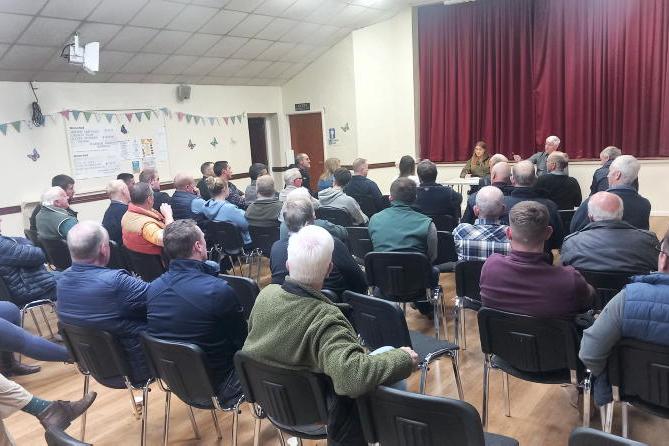
There was a mixture of anger and despair among local farmers in Seaforde, Co Down on Tuesday evening as they shared their experiences of bovine TB.
The meeting was organised by local farmer Ronnie Murphy who said farmers were being trapped in a constant cycle of TB testing and movement restrictions with no sign of improvement.
“How much longer can we stick this? I am fed up reading reports and consultations.
"It’s time we had action,” he said.
The latest statistics from DAERA show that the Newtownards divisional veterinary office (DVO), which includes the Seaforde area, has the highest TB rates in NI.
We went from 330 cattle to over 500 cattle within a few months because we were closed up
Annual herd incidence in Newtownards DVO to July 2025 was 15.95% and compares to a rate of 12.23% a year earlier. Across all of NI, annual herd incidence in July 2025 was 10.84%, up from 10.09% in July 2024.
The meeting on Tuesday evening heard from many farmers impacted by TB breakdowns in recent years.
“We went from 330 cattle to over 500 cattle within a few months because we were closed up.
"We were down for 13 months in total. It was horrendous. We were run off our feet,” said one dairy farmer.
Another farmer told the story of how her family’s entire herd was depopulated after a long running TB breakdown.
“My 10-year-old son reared some of those cows from they were calves, but he says he doesn’t want to keep cows anymore in case it happens again. That’s the effect this has on our future farmers,” she said.
Smaller herds
The level of stress that TB restrictions put on farmers with smaller herds was evident at the meeting too.
Several suckler farmers pointed out that TB breakdowns in the autumn have created huge problems as their calves could not be sold and they had no shed space to winter them.
“I tried out wintering cattle, but it only works if you get mild weather. The fear of going down again at this time of year was a big reason why I got out of sucklers,” said one beef farmer.
Another issue raised was that the recent jump in cattle prices means that TB compensation paid a few months ago no longer helps replace reactor animals.
“In the last 18 months, I lost 72 cattle. I can only buy in again now, but I need to put £1,500 a head on top of what I got last year to replace them. The only thing I can do is bring my heifers on through and hope they don’t go down in the test,” a local farmer said.
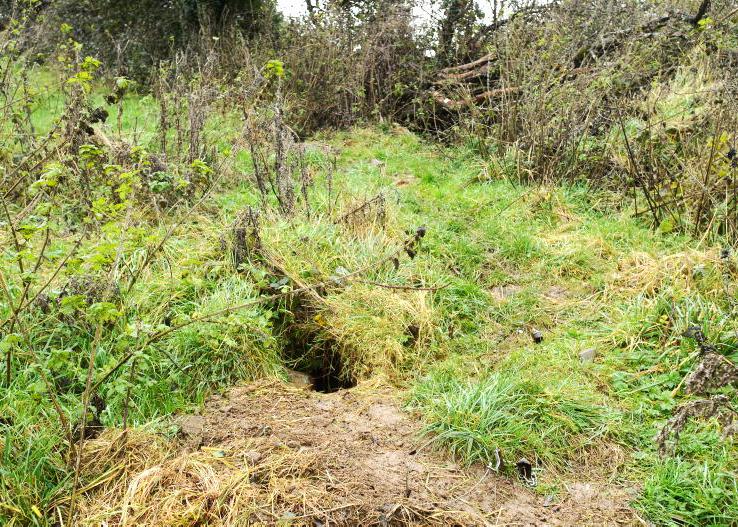
The overwhelming consensus was that, whilst badgers are not the only cause of TB outbreaks in cattle, the disease reservoir in wildlife needs to be addressed.
Several farmers pointed out that badger populations in the area have grown exponentially and, asides from harbouring TB, it has had a detrimental impact on other wildlife.
“When was the last time you saw a hedgehog, or a bee’s nest, or anything that nests on the ground?” one farmer asked.
Whilst the DUP and UUP were represented by local councillors, the most high-profile politician in Seaforde on Tuesday evening was Sinn Féin MP Chris Hazzard.
With farmers arguing that there has been a long running failure to deal with TB, does that mean part of the blame lays with Sinn Féin who held the NI agriculture portfolio from 2007 to 2016?
“I don’t think we are in the same place that we were 10 years ago when it comes to the need for a [badger] cull. We have been at a point for a number of years now where we need to move on this,” Hazzard responded.
The South Down MP said a key factor is the ballooning cost of the TB programme, which is now costing taxpayers over £60m a year in NI.
He also argued that the Test and Vaccinate or Remove (TVR) research project which his party colleague Michelle O’Neill started in 2014 has “helped inform a consensus” on the need for wildlife intervention.
With the next Assembly election due in 2027, would Sinn Féin be prepared to take on the agriculture portfolio again and address the bovine TB issue?
“Yes, if we get enough ministers around the table next time round, we will happily go back and take agriculture,” Hazzard said.
The misconception that badgers cannot be culled because they are protected under an international treaty was addressed by William Taylor from Farmers For Action on Tuesday evening.
He explained that there are exceptions under the Bern Convention which legally allow wildlife intervention measures to be carried out on badgers.
He pointed out that badgers are clearly listed under appendix three of the treaty, which means they can be culled under certain conditions.
However, Taylor argued that badgers are instead being wrongly treated as appendix two animals, so they have strict protections from culling.
“It is probably going to take a legal case to change why badgers are treated as appendix two even though they are appendix three,” he said.




SHARING OPTIONS