One of the outstanding features of the Ulster Grassland Society (UGS) spring visit to the dairy farm run by Gordon, Lynda and Christopher Mitchell outside Banbridge was the attention to detail around calf rearing.
“You can meet full genetic potential of the animal if you get it right. It is money well spent,” Gordon told visitors last Tuesday.
Replacement heifers in the herd currently calve down at two years, with the aim to achieve upwards of 1kg of daily weight gain during rearing, meaning heifers are at least 370kg at 13 months.
Calves on the farm are kept in individual cribs for the first two weeks, before moving onto an automatic feeder.
Calf coats and heat lamps are used in cold weather, which also helps to ensure there is no need to compensate for low temperatures by higher rates of feeding.

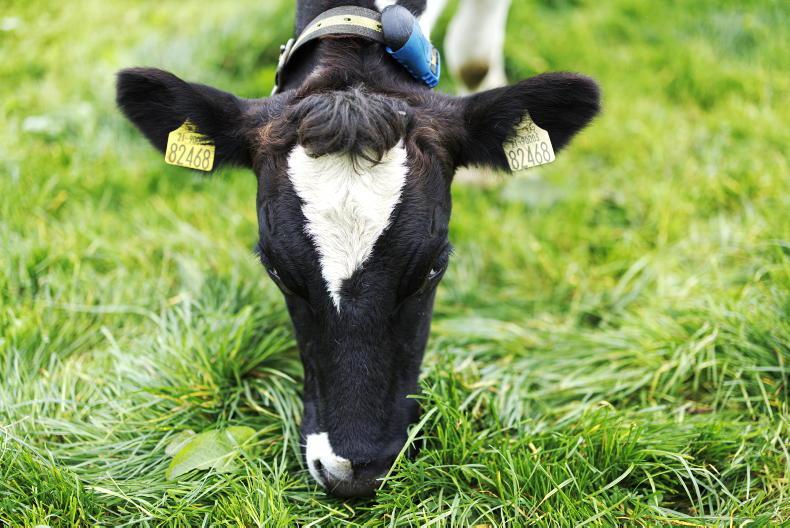
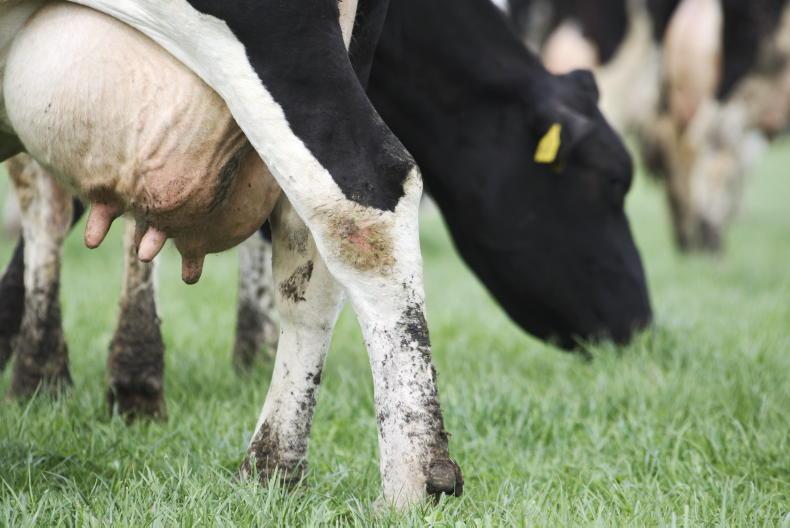
Cows at grass on the Mitchell farm outside Banbridge.
Newborn animals are kept on cow colostrum for three days, before moving onto 700g per day of milk replacer (Calf Defender from Britmilk) to day seven. From day eight to 15 they are gradually built up to 900g per day and this feeding rate is maintained until day 42. Over the next 30 days, calves are gradually weaned. Total powder usage is around 46kg per calf.
By following a set feeding programme and ensuring a clean environment, the Mitchells have had no issues with calf scour or pneumonia this past winter.
“I now have stronger animals than what I had in the past. That’s why I put the effort into the calves the way I do,” said Gordon.
Beef calves on the farm are kept on the same feeding regime as dairy heifers, before being moved on at around 10 to 14 days of age.
Closed
The Mitchells operate a closed herd, other than a beef bull being used on cows not suited for breeding or to sweep up after AI.
Most of the herd (70%) calves from September to December, with calving finished by March. In total, there are 90 Holstein Friesian milking cows and 25 replacements per year, kept on the 140-acre farm.
The herd is currently averaging just over 9,300l at 4.55% butterfat and 3.43% protein, giving total milk solids of 749kg per cow.
With animals remaining in the herd for an average of four lactations, lifetime yield is an excellent 37,500l per cow.
Total meal fed is 3.12t per cow, leaving a milk from forage figure at around 2,300l.
Breeding
Going forward, the main aim when breeding is to continue to increase milk solids, improve fertility and longevity.
Current conception rates to AI are around 47%, with calving interval averaging 375 days
In recent years, the Mitchells have focused on Profitable Lifetime Index (PLI) when selecting bulls and that is shown in their figures, with the 2021 calf crop having an average PLI of £179, compared to a PLI of £311 for 2025-born calves. Sexed semen is used in replacement heifers, with all semen bought from AI Services.
Current conception rates to AI are around 47%, with calving interval averaging 375 days.
Split
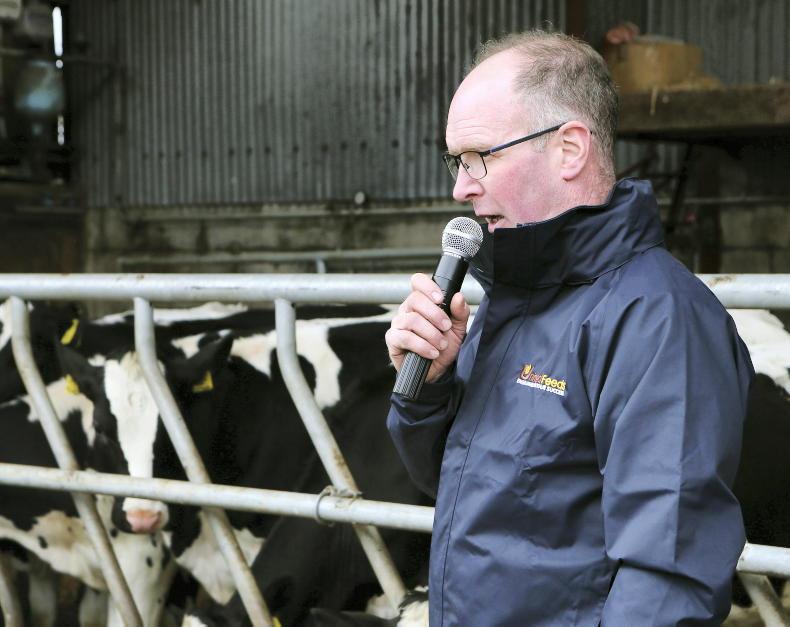
The Mitchells run two groups of cows at this time of year. High yielders and those not-in-calf stay inside until after first cut silage. The Total Mixed Ration (TMR) is set at maintenance plus 18l for cows and maintenance plus 16l for heifers, with animals then fed to yield in the parlour. Currently the high group is averaging 43l per cow. Diets are formulated by United Feeds.
Once yields drop to 33l or lower and if the cow is confirmed back in calf, then they join the grazing group.
High standards extend to grass on Mitchell farm
The Mitchells won the UGS Grassland Farmer of the Year competition in 2022, so it is no surprise that a lot of effort goes into managing grass.
Cows normally are turned out before the end of March, with paddocks on a 21-day rotation and strip wire used to allocate fresh grass every 12 hours. The aim is to go into swards at covers of 3,200kg dry matter per hectare (DM/ha) and graze down to 1,800kg.
No fertiliser is applied to swards ahead of the first grazing, with 30 units of Nitrogen (N) plus Sulphur (around one bag/acre) normally spread thereafter.
To help ensure good quality in the sward, pre-mowing is done and could begin as early as the second grazing. If a paddock gets ahead of cows, it will be taken out as bales.
The Mitchells have been measuring grass weekly during the growing season for 7 years and in 2025 the farm grew an impressive 13.5t DM/ha.
The aim is to reseed 20% of the farm each year, with 80 acres on the farm currently under five years old. Gordon explained to UGS members he realised the value of reseeding when TB hit a few years ago – with fewer cows, he took the opportunity to rejuvenate swards.
That was the difference. It told us we need to do things differently
In one particular field, half of it was reseeded and the following year it grew 12.2t compared to 7.8t on the remaining area.
“That was the difference. It told us we need to do things differently. We need younger swards about here,” he said.
His preference is to use Aber varieties, with 70% diploids and 30% tetraploids in the mix.
Gordon also works closely with Pogue Soil Solutions, with the farm split into four zones and each zone tested every four years. Some fields need potassium, but the farm is high in phosphorus (P), so no P fertiliser is applied.
Various products are utilised, including the slurry additive, Slurry-Mór and Marigro, a seaweed extract.
One of the outstanding features of the Ulster Grassland Society (UGS) spring visit to the dairy farm run by Gordon, Lynda and Christopher Mitchell outside Banbridge was the attention to detail around calf rearing.
“You can meet full genetic potential of the animal if you get it right. It is money well spent,” Gordon told visitors last Tuesday.
Replacement heifers in the herd currently calve down at two years, with the aim to achieve upwards of 1kg of daily weight gain during rearing, meaning heifers are at least 370kg at 13 months.
Calves on the farm are kept in individual cribs for the first two weeks, before moving onto an automatic feeder.
Calf coats and heat lamps are used in cold weather, which also helps to ensure there is no need to compensate for low temperatures by higher rates of feeding.

Cows at grass on the Mitchell farm outside Banbridge.
Newborn animals are kept on cow colostrum for three days, before moving onto 700g per day of milk replacer (Calf Defender from Britmilk) to day seven. From day eight to 15 they are gradually built up to 900g per day and this feeding rate is maintained until day 42. Over the next 30 days, calves are gradually weaned. Total powder usage is around 46kg per calf.
By following a set feeding programme and ensuring a clean environment, the Mitchells have had no issues with calf scour or pneumonia this past winter.
“I now have stronger animals than what I had in the past. That’s why I put the effort into the calves the way I do,” said Gordon.
Beef calves on the farm are kept on the same feeding regime as dairy heifers, before being moved on at around 10 to 14 days of age.
Closed
The Mitchells operate a closed herd, other than a beef bull being used on cows not suited for breeding or to sweep up after AI.
Most of the herd (70%) calves from September to December, with calving finished by March. In total, there are 90 Holstein Friesian milking cows and 25 replacements per year, kept on the 140-acre farm.
The herd is currently averaging just over 9,300l at 4.55% butterfat and 3.43% protein, giving total milk solids of 749kg per cow.
With animals remaining in the herd for an average of four lactations, lifetime yield is an excellent 37,500l per cow.
Total meal fed is 3.12t per cow, leaving a milk from forage figure at around 2,300l.
Breeding
Going forward, the main aim when breeding is to continue to increase milk solids, improve fertility and longevity.
Current conception rates to AI are around 47%, with calving interval averaging 375 days
In recent years, the Mitchells have focused on Profitable Lifetime Index (PLI) when selecting bulls and that is shown in their figures, with the 2021 calf crop having an average PLI of £179, compared to a PLI of £311 for 2025-born calves. Sexed semen is used in replacement heifers, with all semen bought from AI Services.
Current conception rates to AI are around 47%, with calving interval averaging 375 days.
Split
The Mitchells run two groups of cows at this time of year. High yielders and those not-in-calf stay inside until after first cut silage. The Total Mixed Ration (TMR) is set at maintenance plus 18l for cows and maintenance plus 16l for heifers, with animals then fed to yield in the parlour. Currently the high group is averaging 43l per cow. Diets are formulated by United Feeds.
Once yields drop to 33l or lower and if the cow is confirmed back in calf, then they join the grazing group.
High standards extend to grass on Mitchell farm
The Mitchells won the UGS Grassland Farmer of the Year competition in 2022, so it is no surprise that a lot of effort goes into managing grass.
Cows normally are turned out before the end of March, with paddocks on a 21-day rotation and strip wire used to allocate fresh grass every 12 hours. The aim is to go into swards at covers of 3,200kg dry matter per hectare (DM/ha) and graze down to 1,800kg.
No fertiliser is applied to swards ahead of the first grazing, with 30 units of Nitrogen (N) plus Sulphur (around one bag/acre) normally spread thereafter.
To help ensure good quality in the sward, pre-mowing is done and could begin as early as the second grazing. If a paddock gets ahead of cows, it will be taken out as bales.
The Mitchells have been measuring grass weekly during the growing season for 7 years and in 2025 the farm grew an impressive 13.5t DM/ha.
The aim is to reseed 20% of the farm each year, with 80 acres on the farm currently under five years old. Gordon explained to UGS members he realised the value of reseeding when TB hit a few years ago – with fewer cows, he took the opportunity to rejuvenate swards.
That was the difference. It told us we need to do things differently
In one particular field, half of it was reseeded and the following year it grew 12.2t compared to 7.8t on the remaining area.
“That was the difference. It told us we need to do things differently. We need younger swards about here,” he said.
His preference is to use Aber varieties, with 70% diploids and 30% tetraploids in the mix.
Gordon also works closely with Pogue Soil Solutions, with the farm split into four zones and each zone tested every four years. Some fields need potassium, but the farm is high in phosphorus (P), so no P fertiliser is applied.
Various products are utilised, including the slurry additive, Slurry-Mór and Marigro, a seaweed extract.
SHARING OPTIONS