



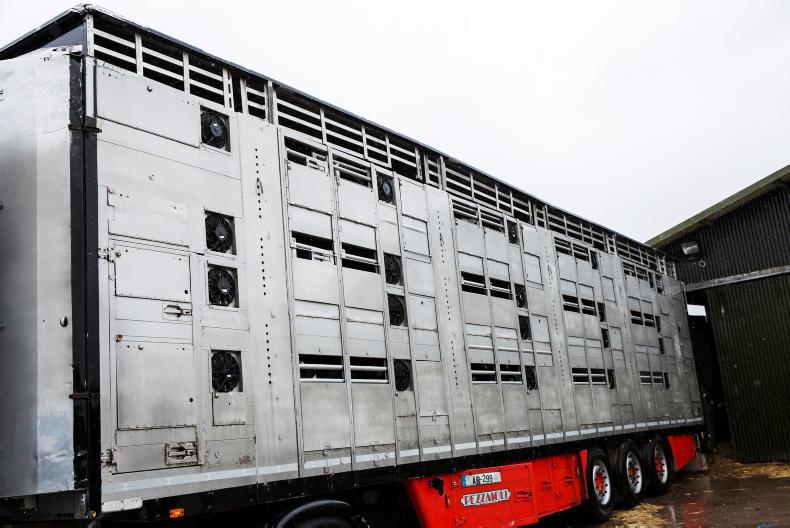
The suspected case of Bluetongue Virus (BTV) on a farm holding near Bangor, Co Down are extremely worrying for farmers not only in Northern Ireland but also on the island of Ireland.
The possible trade implications for farmers in Northern Ireland are huge if BTV is confirmed with the Department of Agriculture, Environment and Rural Affairs (DAERA) already moving to suspend the live export of livestock under a number of headings.
These suspensions apply to cattle, sheep, goats, alpacas and deer. Sheep are by far the most exposed category of animal with cattle affected to a much lesser extent. This is highlighted by the fact that there is more sheep exported out of Northern Ireland than processed there. Over 390,000 sheep have been exported live to-date in 2025, while over 354,000 sheep have been slaughtered in factories in Northern Ireland.
Current situation
Exports of cattle and sheep out of Northern Ireland to farms for breeding or further finishing have been suspended to all destinations.
Exports of cattle and sheep to Britain for direct slaughter have also been suspended with DAERA stating: “Currently direct slaughter moves to [Britain] are not permitted. Guidance for export certification will be updated as soon as possible”.
Exports to Ireland for direct slaughter are permitted with 48 hours advance notice. “Moves to direct slaughter only from NI to the EU require pre-notification 48 hours in advance to the recipient member state,” DAERA said.
The implications on the live export trade are expanded upon below for the main jurisdictions with export figures summarised in Table 1.
Exports to Ireland
The number of sheep exported to Ireland for direct slaughter up to the week ending 22 November is running at 210,666 head. This compares to 287,933 head for the corresponding period in 2024. Exports to Ireland were lower earlier in the year due to tighter supplies and exporters diverting sheep to Britain.
Exports for slaughter had increased to about 5,500 head in the last two weeks compared to an average of 3,700 head for the previous five weeks. The number of cattle exported for direct slaughter is 2,143 head. As mentioned above exports to Ireland can continue under 48-hour pre-movement notification.
Export figures to farms in Ireland have been published by DAERA up to the end of October and stand at 27,451 sheep and 893 cattle. This compares to 37,033 sheep for the first 10 months of 2024. Exports of sheep during October 2025 of 1,393 head were much lower than the 5,626 head exported in October 2024.
Exports to Britain
As outlined above exports to Britain for direct slaughter are not permitted with DAERA outlining that guidance for exports will be updated as soon as possible. The number of sheep exported up to week ending 22 November was 39,006 head. This compares to 17,738 for the corresponding period in 2024.
Exports to Britain have strengthened in the last three weeks following a re-emergence of a significant price differential between lamb prices in Northern Ireland and Britain. Exports averaged 1,281 head for the last three weeks when exports for the month of October averaged at 286 head. Exports of cattle are not affected with no exports since April for direct slaughter.
The export of sheep to Britain under the ‘breeding and production’ category has become an important outlet for sheep with 97,256 head exported up to the end of October. This is down on the figure of 139,625 head exported in 2024 but is still an important source of competition. Exports of cattle under the same heading is just 2,602 head.
Exports to other destinations
There was a steady trade of exports from Northern Ireland to other countries earlier in 2025 with 9,474 sheep exported for direct slaughter and 6,910 sheep exported to farms under the breeding and production health certificate. This trade for direct slaughter has slowed in recent months with just two loads of sheep totalling 740 sheep exported for direct slaughter since-mid June. While there were 1,395 sheep exported to farms in October.
Import figures
While sheep exports are of major importance there was only tiny numbers of sheep recorded as being imported in Northern Ireland. This includes just 133 sheep imported from Ireland to farms with imports from Britain not permitted.
The import of cattle however is significant with DAERA figures showing 14,319 cattle imported for direct slaughter from Ireland up to 22 November and 29,618 cattle imported on to farms. The trade of such animals is not subject at present to any trading restrictions.


SHARING OPTIONS