



The department has proposed an amendment to existing legislation which, if approved by MLAs, would apply penalties to direct payments where farmers don’t participate in a new carbon footprinting project.
The updated regulation requires farm businesses to have registered for the project and completed associated training by 15 May 2029. Those who don’t comply by that date would have a 10% penalty applied to their Farm Sustainability Payment that year, rising to 15% thereafter. Similar conditions will apply to participation in the Soil Nutrient Health Scheme from 2027 and the Bovine Genetics Project from 2028.
In a letter sent to the Stormont committee, DAERA said the carbon footprint project will provide a “whole farm carbon footprint free of charge” to farmers. It will use one carbon calculator to ensure standardised and consistent results, with associated training provided by CAFRE. The letter added that the project was co-designed alongside the Carbon Farming Partnership, which included representatives from the Ulster Farmers’ Union (UFU), the NI Agricultural Producers Association (NIAPA), processors and environmental organisations.
However, the UFU has made clear it is firmly opposed to making carbon auditing a mandatory condition linked to farm payments and that position is shared by some MLAs at Stormont, particularly from unionist parties. There was similar opposition to a DAERA plan to require farmers to tissue tag their breeding animals as part of the Bovine Genetics Project and in the end, the department had to back down.
Even if carbon audits are not linked to farm payments, it looks increasingly likely that there could be other financial incentives put in place.
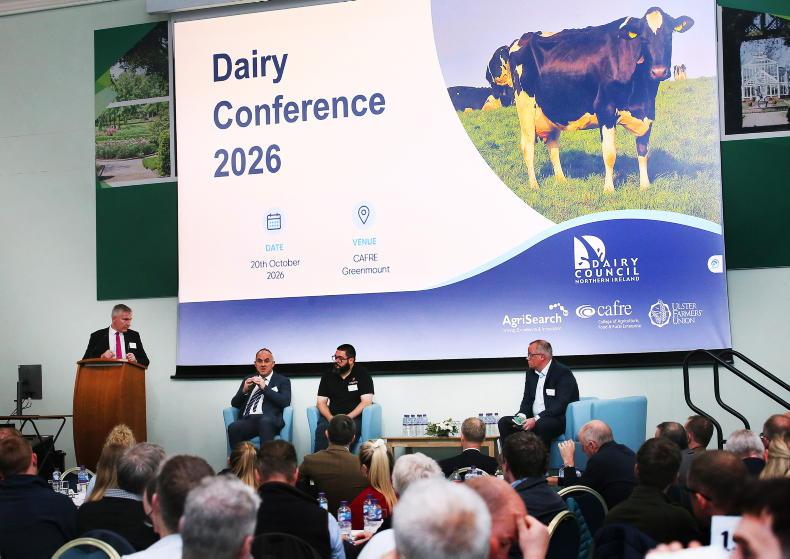
At a dairy conference held at Greenmount on Tuesday, a number of representatives from milk processors outlined a desire to get carbon auditing done and the potential it is included as a mandatory condition to receive future sustainability bonuses.
Ed Wright from Dale Farm said he had he has highlighted to customers the work done on sustainability improvements in NI and cited initiatives including the soil scheme, the Bovine Genetics Project and the plans for carbon audits.
However, he expressed frustration at the length of time it is taking to get a carbon project off the ground.
“We will have one calculator – that is brilliant in theory – our issue is the length of time taken to get us there. I am running out of road saying there is a carbon audit programme coming. The scale of NI should work. I am very optimistic, but we do need to put our foot down on this,” he said.
Rory Farrell from Lakeland Dairies said customers “want to understand our footprint”, and if we want to secure the best paying outlets, it is necessary to have baseline data in place.
Ben Williams from Leprino Foods noted that farmers in Britain, the US and New Zealand are already doing carbon audits and showing reductions in carbon intensity per litre. In NI, he said the likes of improvements in genetics can reduce our footprint, but there is still a lot of scope on some farms to drive down emissions by better management. “We have 10,000l cows in 8,000l facilities. We need knowledge exchange,” he said.
Calculator
Back in June, DAERA confirmed it had awarded a £2.5m contract for a carbon calculator to Sans Souci Consulting Ltd., who will work alongside based Ricardo-AEA to deliver the service.



SHARING OPTIONS