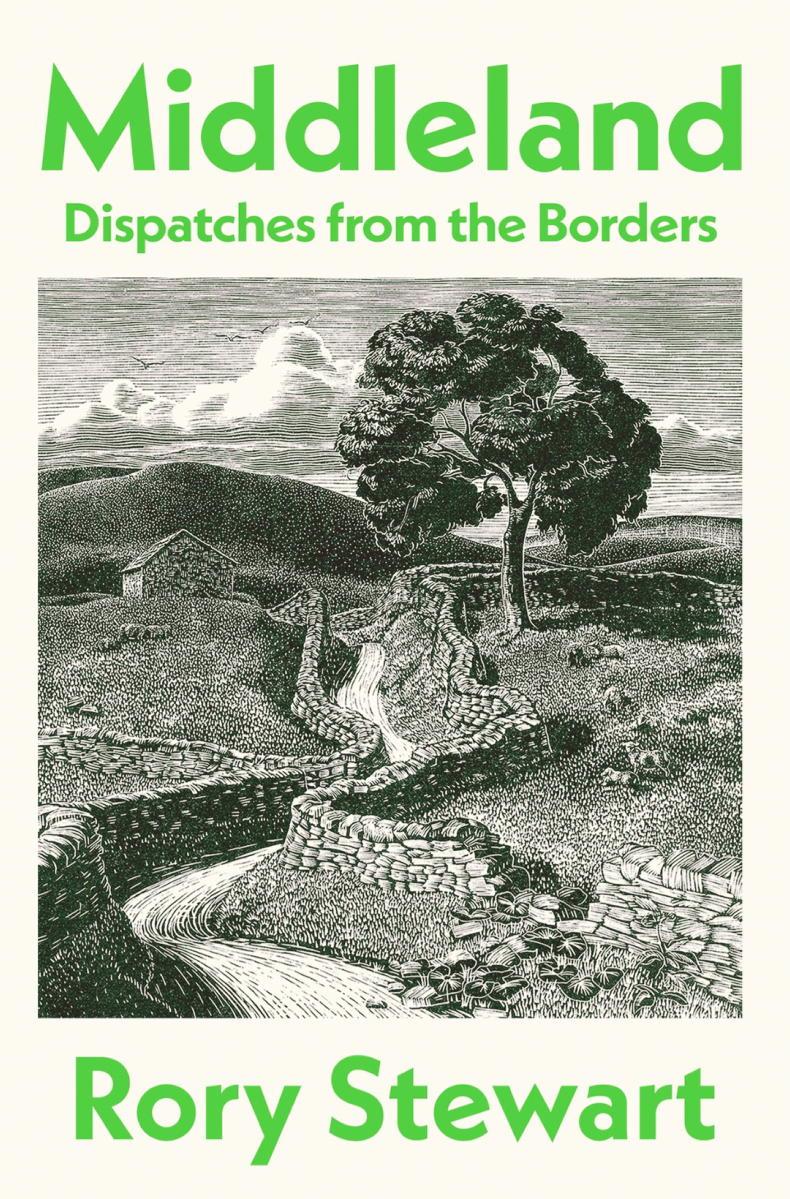
It is clear from Rory Stewart’s new book, Middleland, that the former MP spent a lot of time talking and listening to ordinary farmers.
For almost a decade, Stewart was Conservative MP for one of the UK’s most rural constituencies in Cumbria in the northwest corner of England.
He also served as a UK government minister across various departments, including at the Department of Environment, Food and Rural Affairs (Defra).
But unlike most books by former politicians, Stewart does not spend his time defending the policies that were rolled out during his tenure.
In fact, he is brutally honest about how frustrating government policies can be, especially for the likes of farmers who are directly impacted by them.
In Middleland, Stewart writes that during a Sunday stroll in Cumbria, he thought about the impact of 12 different grant schemes and seven different government agencies.
The impacts ranged from limits on stocking rates for sheep grazing, to grants for livestock fencing, to incentives for tree planting and peatland restoration.
“I am conscious that somewhere in the middle of it all stands an infuriated farmer, trying to keep doing what his family had done for generations: producing food,” he writes.
Farming knowledge
Stewart’s knowledge of farming is impressive, although the book has a shaky start when he seems to confuse laying hens with broiler chickens by suggesting they live for “six short weeks”.
Aside from that, it is hard to find fault with much of his commentary about farming, the environment and landscape management.
He is critical of long-standing agricultural policy in England which “seems bent on copying the landscape of the United States” where land is used for either food production or the environment, but not both.
“[It is] a binary vision in which land becomes either an industrial factory for the production of the maximum food at the cheapest price, or a national park almost devoid of human cultivation,” he writes.
Interestingly, he suggests that policymakers in Northern Ireland, Scotland and Wales have “a more thoughtful understanding of farming” where agriculture and conservation are more intertwined.
Stewart occasionally cuts politicians some slack and points out that flawed decisions by government ministers are often the result of poor advice from civil servants. The former minister argues there needs to be new ways of injecting more critical thinking into the civil service, which would better serve both ministers and taxpayers.
“We need to recognise when knowledgeable people have become rigid or lost their desire or energy to fight,” he writes.
Newspaper articles
Middleland is mostly a collection of short articles that Stewart originally wrote for his local newspaper when he was an MP from 2010 to 2019.
While Cumbrian farmers struggled with everything from poor profitability to bovine TB during that period, he suggests the situation has become “far worse” for farmers in more recent years.
In particular, Stewart is critical of the phasing out of farm support payments in England, new post-Brexit trade deals, and the upcoming changes to inheritance tax relief for farmland.
Rewilding
For me, one of the most enjoyable parts of the book is when the author meticulously pulls apart the argument for abandoning upland farms for so-called “rewilding”.
Stewart points out that rewilding is not about “turning the clock back a few decades […] but turning it back millennia”.
“There have been farms on the fellside, with pasture grazed by livestock, for at least 6,000 years,” he writes.
The former MP argues that rewilding is “rarely the most cost effective, reliable way of restoring biodiversity” and instead it comes with “environmental risks”.
This includes losing the species which thrive in the current farmed landscape and encouraging an explosion in beaver and deer populations which prevent trees emerging.
Stewart says that stopping upland farming will simply offshore more food production to other countries where there is probably a worse environmental impact.
Admiration
Throughout the book, the author appears to admire the determination that farmers have to keep on farming, regardless of the hurdles that come their way. He describes family farms as “rare reservoirs of vitality”.
Looking back at history, Stewart points out it is over 200 years since the industrial revolution when people left the countryside to find employment in cities.
“And yet by a miracle, our rural areas still hold some traces of where we all began,” he writes.
Who is Rory Stewart?
The author of Middleland, Rory Stewart, is a former diplomat and politician who served as Conservative MP for Penrith and the Border from 2010 to 2019.
Since leaving politics, Stewart has pursued a career as an academic and broadcaster. He currently co-presents The Rest is Politics podcast with former Labour Party spin doctor Alastair Campbell.