The countdown is on to one of the most important renewable electricity auctions of the year, which will determine the next wave of wind and solar farm developments across Ireland.
Bids for the sixth Renewable Electricity Support Scheme (RESS 6) auction are set to open this week, with final results scheduled for 9 December.
For developers, farmers and landowners, the outcome could determine whether projects already in development proceed to construction. However, concerns are growing that the maximum prices developers can bid may be too low to make some projects financially viable.
The auction also has separate allocations for wind and solar, placing limits on the volume of renewable electricity generation that can secure support. The sixth auction comes as Ireland works towards its 2030 targets of 8GW of installed solar capacity and 9GW of onshore wind.
How the auction works
RESS is the Government’s main support scheme for large-scale renewable electricity projects. Operated by EirGrid, the competitive auction allows developers to bid for 16-year State-backed electricity support contracts. Developers submit an offer price, expressed in euro per megawatt-hour (€/MWh), representing the electricity revenue they are seeking.
Under the scheme’s two-way floating Feed-in Premium mechanism, projects receive a top-up payment when wholesale electricity prices fall below their agreed support price. Conversely, when wholesale prices rise above that price, projects return the difference for the benefit of electricity consumers.
This provides developers with greater revenue certainty, helping them secure the finance needed to build wind and solar farms. Since the first RESS auction in 2020, some 235 renewable electricity projects, representing 6,282MW of capacity, have secured support.
This includes 190 solar farms with a combined capacity of 4,648MW and 45 onshore wind projects representing 1,634MW. Solar has dominated recent auctions, securing approximately 960MW in RESS 4 and 860MW in RESS 5.
Maximum allocation per pot
Under RESS 6, onshore wind and solar have separate pots. The Government has now confirmed minimum and maximum quantities of electricity generation that can be supported under each pot. These quantities are expressed in gigawatt-hours (GWh), rather than megawatts (MW), as they relate to annual electricity generation rather than installed capacity.
The maximum allocation for solar is therefore 1,400GWh, compared with just 400GWh for onshore wind. This gives solar 3.5 times the maximum annual generation allocation available to wind projects.
To put these figures into perspective, assuming a solar capacity factor of 11%, the 1,400GWh maximum would be equivalent to approximately 1,450MW of installed solar capacity.
For onshore wind, assuming a 30% capacity factor, the 400GWh allocation would equate to approximately 150MW.
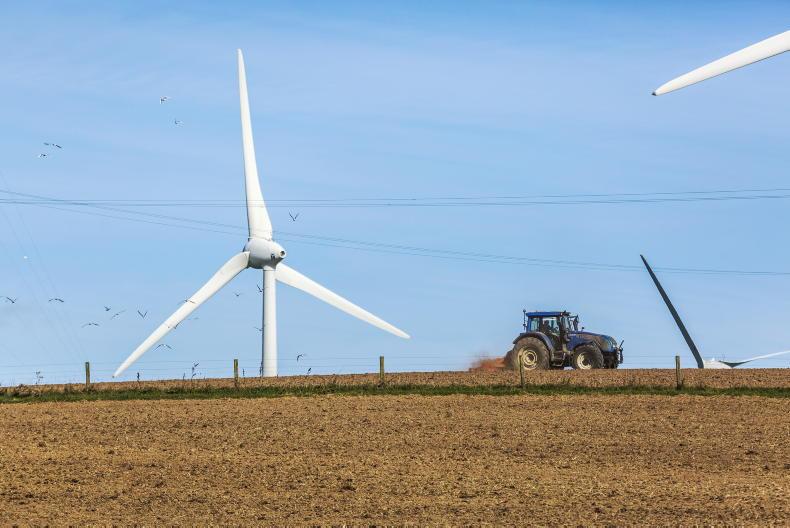
The relatively small wind allocation raises questions over how much new onshore wind capacity can secure support through this auction, particularly given Ireland’s ambitious 2030 targets.
Price caps raise concerns
Another critical factor is the maximum price developers can bid.
The Government has confirmed a ceiling of €110/MWh for solar projects and €105/MWh for onshore wind. These are maximum offer prices, not guaranteed payments. Developers must compete below these ceilings, with successful bids potentially coming in considerably lower.
However, the €110/MWh solar cap has attracted criticism from industry representative body Solar Ireland. The organisation warns that the ceiling may not adequately reflect the rising costs of developing and constructing solar farms.
The maximum solar offer price remains unchanged from RESS 4 and RESS 5.
According to Solar Ireland, maintaining the same nominal ceiling effectively represents a reduction in real terms once inflation is considered.
This comes despite rising costs across grid connections, electrical infrastructure, construction, labour and financing. There are also concerns about potential increases in solar module costs before projects awarded contracts under RESS 6 are built in 2028 and 2029. Developers bidding today must therefore estimate construction costs several years into the future, while remaining within a fixed price ceiling. For some projects, the figures may no longer stack up.
Projects withdrawn
Ahead of the final withdrawal deadline, Solar Ireland raised its concerns directly with the Department of Climate, Energy and the Environment.
The organisation said confidential feedback from members indicated that projects were likely to be withdrawn, reduced in scale or reassessed because of financial viability concerns.
The Department subsequently confirmed that several projects had withdrawn before the deadline. However, the number of projects involved, their combined capacity and the reasons for withdrawal have not been published. Solar Ireland believes smaller developments could be particularly exposed, as they have less capacity to spread substantial grid connection and infrastructure costs across their generating capacity.
This could ultimately reduce competition and favour larger developments.
New auction rules
RESS 6 also introduces changes to how projects are assessed, including new measures aimed at strengthening European renewable energy supply chains.
Projects meeting specified resilience requirements can receive a 0.05-point scoring bonus. The measures reflect EU efforts to reduce dependence on Chinese manufacturing for renewable energy equipment.
Solar developments face requirements covering modules, cells, inverters and other major components, while wind projects face conditions relating to turbines and permanent magnets. Although the scoring advantage appears small, it could prove decisive where competing projects achieve similar auction scores.
The revised framework also accommodates projects incorporating battery storage, recognising its growing role in managing an electricity system increasingly dependent on wind and solar generation.
Community benefit
Successful projects must establish a Community Benefit Fund, contributing at least €2 for every MWh of electricity generated or compensated under the scheme.
For example, a solar farm generating 20,000MWh annually would contribute at least €40,000 each year. The funding supports local environmental, social and economic initiatives, including community organisations and clubs.
However, those benefits depend on projects securing support and ultimately being built.
Countdown to results
Attention now turns to 25 November, when the provisional auction results are due to be announced. The results will reveal the level of competition, the prices developers are prepared to accept and the quantity of renewable electricity generation securing support.
For farmers and landowners with existing development agreements, the outcome could determine whether proposed wind and solar farms move towards construction or face further delays. However, winning a RESS contract does not guarantee a project will be built. Developers must still secure finance, complete grid connections and manage construction costs.
RESS 6 will provide an important test of whether the Government has struck the right balance between affordable electricity for consumers and commercially viable renewable energy projects.