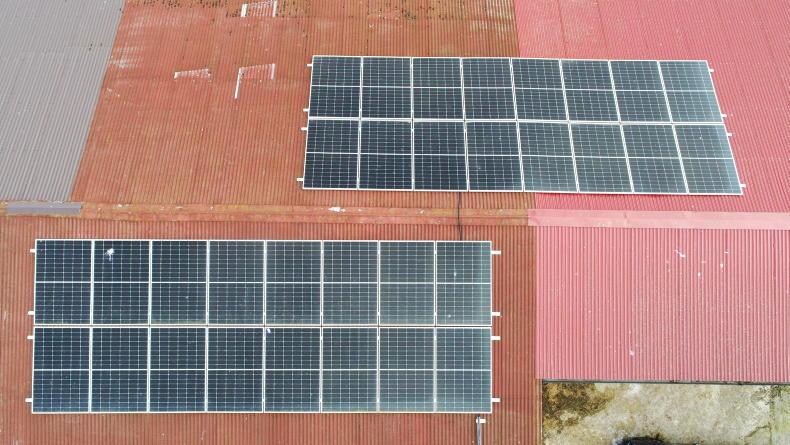
Farmers considering solar PV investment could find the enhanced SEAI grant a more accessible alternative to TAMS, with fewer agricultural-specific restrictions and grant decisions issued in as little as 15 minutes.
This follows clarification from the Sustainable Energy Authority of Ireland (SEAI) in response to 26 questions from the Irish Farmers Journal.
From 6 October 2026, support under the Non-Domestic Microgeneration Grant (NDMG) increased from approximately 23% to an effective 45%, with the higher rate available until 6 July 2027.
The increase comes as tighter TAMS selection criteria have restricted access to solar funding, previously available at rates of up to 60%. However, unlike TAMS, the SEAI scheme does not provide grant aid for battery storage.
1. All farm types are eligible
One of the most significant differences concerns eligibility. Under TAMS, farmers must satisfy agricultural eligibility requirements, while the revised solar measure has introduced further restrictions.
However, SEAI has confirmed that all farm types are eligible to apply under the NDMG. When asked whether there were specific agricultural eligibility requirements or restrictions, SEAI stated: “There are no agricultural specific requirements.”
This means farmers are assessed under the general business requirements of the scheme rather than a separate set of agricultural criteria.
2. No separate farm electricity meter required
A common issue for farmers considering solar PV is whether the farmyard and farmhouse must operate on separate electricity supplies. Many Irish farms have a single electricity meter serving both the agricultural business and the dwelling house.
SEAI has confirmed that a separate commercial meter is not required. This is important for smaller farms where installing a separate electricity connection could add significantly to project costs.
It also means that having a domestic electricity account does not automatically exclude an agricultural business from applying. However, the electricity connection must serve an eligible business premises, even where the associated MPRN is classified as domestic.
3. Electricity consumption not assessed in application
Under the previous TAMS solar arrangements, farmers were required to submit 12 months of electricity bills and undergo an on-farm assessment to establish their electricity demand.
However, SEAI confirmed that electricity consumption is not assessed as part of the NDMG application.
“The consumption of the site is not accounted for in the NDMG application,” it stated.
Instead, the farmer and their solar contractor must determine an appropriate system size. SEAI explained that this will typically depend on available roof space, on-site electricity demand and the site’s Maximum Import Capacity (MIC) and Maximum Export Capacity (MEC).
However, this does not mean electricity demand is irrelevant. Installations must serve a site with electricity demand, rather than being developed solely for export.
4. Solar panels permitted on agricultural sheds
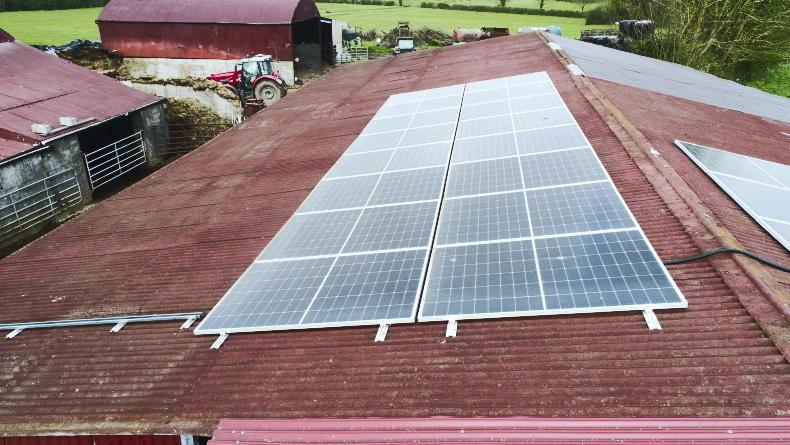
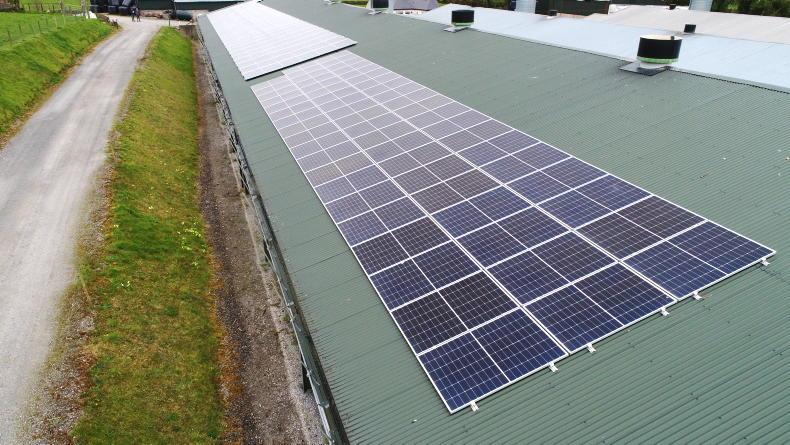
SEAI has confirmed that agricultural sheds are eligible locations for solar PV installations under the scheme.
The main requirements are that the roof is structurally suitable and the installation complies with the relevant safety and mounting requirements in the scheme’s Code of Practice. One particularly important clarification concerns slurry agitation points. Under TAMS, the presence and location of agitation points can restrict the eligibility of certain agricultural buildings for solar PV grant aid. However, SEAI confirmed that there are currently no specific restrictions relating to agitation points under the NDMG. It cautioned that agricultural businesses must still comply with any relevant Department of Agriculture or other regulatory requirements. Responsibility for meeting these requirements remains with the business.
5. No distance limit for ground-mounted solar
While ground-mounted solar PV installations were also eligible under TAMS, the SEAI scheme offers greater flexibility in where panels can be located. Under TAMS, ground-mounted arrays must be located within 500m of the farmyard. However, SEAI confirmed that there is no equivalent distance restriction under the NDMG.
The installation must be connected in parallel with the MPRN associated with the application. Farmers must still comply with relevant planning and grid connection requirements.
6. Existing TAMS recipients can apply
Farmers who previously received TAMS funding for solar PV are not automatically excluded from applying for the SEAI grant. SEAI confirmed that a farmer with an existing TAMS-funded installation can apply for NDMG support towards an additional solar PV system. However, the same installation cannot receive funding under both schemes.
“Yes, but not for the same installation (no double funding),” SEAI stated. Ideally, the additional installation should be electrically separate from the existing system.
7. Farmers can change installers
SEAI confirmed that farmers must submit their own grant applications, with installers not permitted to apply on their behalf. It also clarified that farmers can change solar PV suppliers after grant approval, despite claims by some installers that applicants are tied to their original supplier.
8. Grant decisions can take just 15 minutes
The NDMG offers a much faster grant approval process than TAMS, with SEAI confirming that decisions are issued within 15 minutes following automated checks. However, farmers must secure grant approval before starting work, while the separate ESB Networks connection process can take at least four weeks.
The enhanced 45% rate applies only to new applications submitted from 6 October 2026, with existing applications ineligible for the increase.
9. Grant payments typically take six weeks
Under the NDMG, installers upload the completion documentation to trigger grant payment, which SEAI says typically takes six weeks, provided all paperwork is complete. Farmers must either pay their installer in full or enter into an agreed payment or financing arrangement before claiming the grant. They have eight months from grant approval to complete the installation and submit the required documentation. Projects may be subject to desktop or on-site inspections before or after payment, which can delay the process. Post-payment inspections typically take place within one to two months.
10. No grant for storage
Unlike TAMS, which previously supported both solar PV panels and battery storage, the NDMG does not provide grant aid for batteries. SEAI confirmed that any decision to introduce battery storage support or extend the enhanced 45% grant beyond its nine-month period rests with the Department of Communications, Energy and the Environment.
How is the 45% grant calculated?
SEAI calculates grants using a rate card based on typical solar PV installation costs.
The amount paid is the lower of the rate-card grant or 45% of eligible invoiced costs, meaning farmers may receive less than 45% of their installation cost.
The enhanced rate is available until 6 July 2027, and farmers must secure grant approval before starting work.
Next week
In next week’s paper, we will run through a number of examples comparing the TAMS solar capital investment scheme grant to the new SEAI grant.