
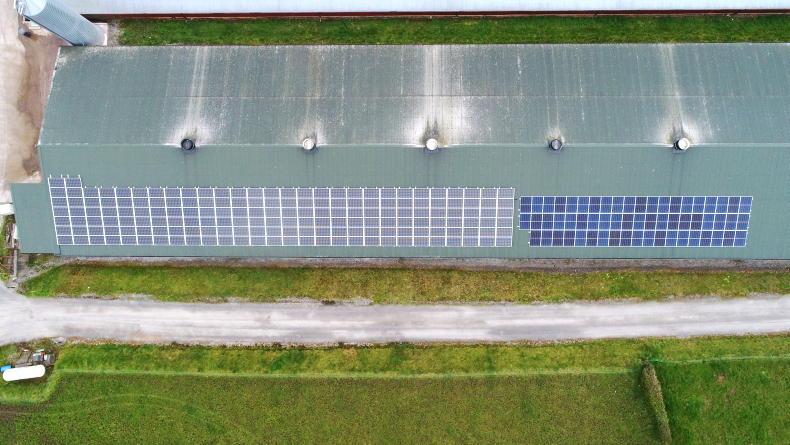
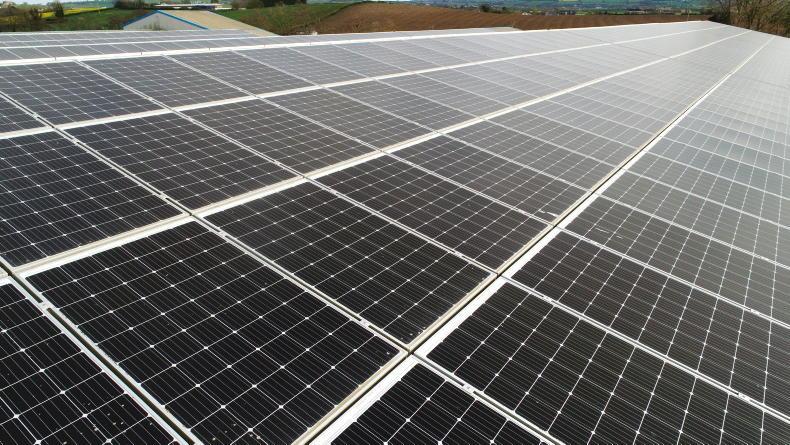
While the Department of Agriculture’s decision to cut approval rates for solar PV systems under TAMS by 90% during an energy crisis was disappointing, the SEAI’s new, enhanced solar grants could go some way towards bridging the gap.
From 6 October 2026, support under the Non-Domestic Microgeneration Grant (NDMG) increased from around 23% to an effective 45%, with the higher rate available until 6 July 2027.
Last week, we provided a full breakdown of the differences between NDMG and TAMS.
One of the main advantages of the NDMG is it’s much faster approval process, with SEAI confirming that grant decisions can be issued within 15 minutes following automated checks.
Farmers must secure grant approval before starting work, and depending on the system size, the ESB Networks connection process can take at least four weeks.
This week, we delve into the numbers to see how the two schemes compare on costs, savings and payback periods.
TAMS versus SEAI
Under TAMS, farmers could avail of a 60% capital grant towards a solar PV system and a battery system with a capacity of up to half that of the solar installation.
The scheme was exceptionally attractive, with payback periods of between one and three years common.
There was, however, quite a bit involved in securing the grant. Farmers had to supply an on-farm energy report, submit 12 months of electricity bills and factor in potentially lengthy waiting periods for grant approval and payment following the submission of a claim.
All of those considerations had to be taken into account when assessing the overall benefits of the scheme.
The NDMG is considerably more straightforward. Unlike TAMS, it is not specifically designed for farmers but is open to a much wider range of businesses.
As a result, the application process has been designed to be relatively simple, with grant decisions issued within 15 minutes of automated checks.
SEAI also states that grant payments typically take six weeks, provided all necessary paperwork is complete.
While ease of access is important, the success of any grant scheme ultimately depends on its impact on the bottom line. Using figures supplied by the industry, we can compare the economics of a typical farm solar PV installation under both schemes.
Farm
For this example, we look at a dairy farmer milking 120 cows in a spring-calving system, using a 10-unit herringbone parlour and a 6,000l bulk tank.
Energy consumption varies considerably from farm to farm, depending on herd size, milking facilities, equipment efficiency and management practices. With this in mind, we have used a typical dairy farm as the basis for calculations.
The solar panels, electricity generation and potential savings remain the same regardless of the grant scheme used. What changes is the level of grant support available and, consequently, the upfront investment and payback period.
Other factors, including the farm’s business structure, the price received for electricity exported to the grid and the energy efficiency of existing equipment, can also have a significant impact on the overall return.
The system
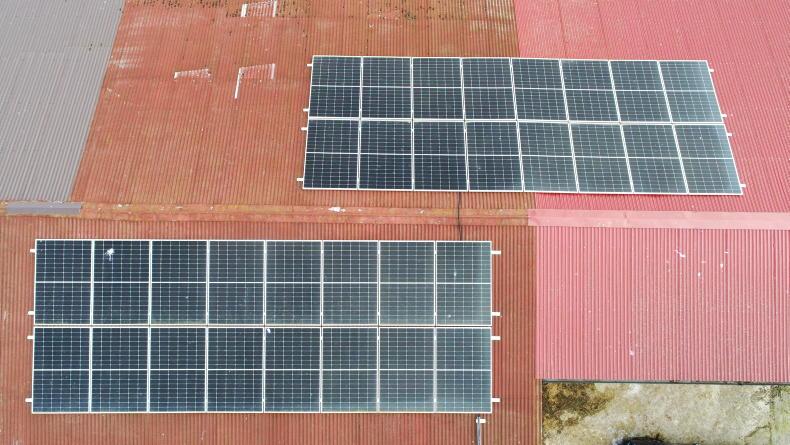
The farm consumes around 40,000kWh of electricity annually, with around half of that used for milk cooling and water heating. In this example, the farmer is installing a 30kWp (kilowatt peak) solar PV system alongside a 17.2kWh battery.
As with any solar PV installation, the system should ideally be sized to maximise the amount of electricity generated and consumed on the farm.
However, some electricity will inevitably be exported to the grid, especially during periods of strong sunshine when on-farm demand is relatively low. That is where battery storage can play a role, allowing surplus electricity generated during the day to be stored and used later, rather than exported.
In this example, the 30kWp solar PV system costs €39,300 excluding VAT, while the 17.2kWh battery adds another €7,500, bringing the total investment to €46,800 excluding VAT.
Up to this point, the costs and potential savings are identical under both schemes. The difference emerges when grant support is factored in. Under TAMS, the farmer could receive €19,080 towards the solar PV installation and a further €4,500 towards the battery, bringing total grant support to €23,580.
Revised SEAI scheme
Under the revised SEAI scheme, the farmer would receive €17,200 towards the solar PV installation. However, there is no grant support available for the battery, leaving a difference of €6,380 in total grant aid between the two schemes.
The Accelerated Capital Allowance (ACA) scheme is a tax incentive that allows qualifying businesses to deduct 100% of the eligible capital cost of solar PV equipment from taxable profits in the first year.
Where applicable, this tax relief should be factored into the calculations as it can reduce the effective cost of an installation. However, the actual benefit will depend on the farm’s tax position, business structure and the equipment eligible for relief.
With ACA factored in, the net cost of the system after grants ranges from €7,860 to €19,338, depending on the farm’s business structure and the grant scheme used (see Table 1). For sole traders, the difference in net investment between the TAMS and SEAI options is €3,190. For limited companies, the difference increases to €5,583, which is a considerable sum.
Payback
One benefit of the current period of high electricity prices is that it significantly strengthens the business case for investing in solar PV. For our calculations, electricity imported from the grid costs 30c/kWh, while electricity exported to the grid earns 15c/kWh. The system is expected to generate 26,250kWh annually, of which approximately 17,062kWh will be used on the farm, with the remaining 9,188kWh exported to the grid.
The system is estimated to deliver €6,497 in annual electricity benefits through reduced grid electricity purchases, including savings achieved by storing excess solar generation in the battery for later use, and revenue from exporting surplus electricity to the grid. Under the Department of Agriculture’s TAMS grant, the estimated payback period is just 1.2 years for a sole trader and 2.1 years for a limited company.
Under the enhanced SEAI grant, the payback period remains attractive, increasing to 1.7 years for a sole trader and three years for a limited company. While TAMS remains the more financially attractive option where approval can be secured, the enhanced SEAI grant still offers a compelling return on investment.
For farmers considering solar PV, particularly those unable to secure TAMS approval, the new grant rate could provide a worthwhile alternative. Ultimately, the figures show that, even with lower grant support, a well-sized solar PV system can still deliver a relatively short payback period, particularly on farms with substantial daytime electricity demand.