The fact that the average Irish beef heifer calves at 31.5 months tells us two things. Firstly, that beef farmers as a group do not buy in to the principle of two-year-old calving and secondly, that the Irish beef calving spread is far too broad. Think about it – over 75% of Irish suckler cows are classified as spring-calving. How can a heifer calving at 31.5 months slot into a spring-calving spread at this age, given a target calving period of 10 weeks?
Progressive
A progressive suckler farm calves animals on their birthday, be it two or three years. Some in a split-calving pattern will argue that they allow a spring-born heifer to calve in autumn at 30 months, or vice versa, which is largely fine. However, letting older animals slip between herds like this is a bad habit to get into, often used as an excuse for sluggish fertility performance.
Last week on our beef pages, the example used to demonstrate the monetary gains from pushing grassland was a 40ha farm running 45 suckler cows. Assuming that this farmer is breeding his own replacements and calving over 12 weeks in the springtime, how much better off would he or she be to calve heifers at 24 months versus 36 months?
Talking money
In terms of the direct costs (feed, vet, breeding, cow costs) involved in bringing a heifer calf from birth to point of calving, choosing 24- versus 36-month calving represents a saving of approximately €250 per heifer. If our theoretical farmer is operating a 20% replacement rate, that keeps €2,250 in their back pocket.
Then there are the indirect costs. A breeding animal should always be working for us while we’re investing resources in her – there should be a calf at her side and/or one in the oven. The fact that 24-month calving has been shown to work long-term, both in research and commercial settings, means that there is an opportunity cost to factor in once we go older than this. We’re tying up land, labour and feed that could otherwise go towards generating more beef output on the farm, as well as passing up the chance to get an extra calf from our theoretical heifer.
At the Beef 2016 event last year, Teagasc specialists carried out a full cost analysis on the replacement strategy of a 40ha suckler beef farm operating at a stocking rate of 170kg organic N/ha (producing 24-month steer, 20-month beef heifer and carrying 53 suckler cows). Calving home-bred replacements at 24 versus 36 months increased net profit per cow (excluding labour) by almost €84 (€4,480 total) in this instance.
How to calve at two
We have established that calving heifers later than 24 months of age is like hiring a plumber for two days to fix a leaky boiler, and spending the first talking beef prices together at the kitchen table. So what’s the problem? The main turn-offs that we at the Irish Farmers Journal hear concern calving difficulty, hitting weight targets, stunting growth and negative knock-on effects.
The important thing to remember when calving heifers at two is that they do need some extra attention. Unless he is excessively easy-calving, the sire used on your mature cows probably won’t be suitable for use on your heifers. Target a bull with a calving difficulty of less than 5% with an accompanying reliability figure of >90%. The fact that most stock bulls won’t achieve a reliability figure this high means that those calving heifers at 24 months should consider AI. It will also allow the option of synchronising using prostaglandin, which will be cheap at around €7/head and condense the heifer calving pattern.
Weight for it
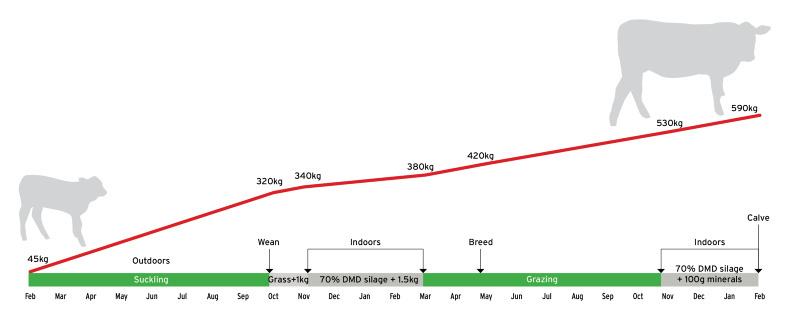
In terms of successful 24-month calving, age itself really is irrelevant. In terms of the puberty onset and the development of the reproductive system, weight is the barometer. The target for a beef heifer is to be 60% of her mature weight at breeding, at which point 90% of animals will be cycling, and 85% of mature weight at calving.
The important thing to remember is that mature weight in a suckler cow is not reached until around five years of age. Yes, she has calved smaller than your older cows. Yes, she will appear to be smaller than your older cows in her second season. This is normal – you have not stunted her growth. In weight terms, we want to be breeding a continental animal at a minimum of 420kg. The graphic above outlines the optimum nutritional regime for a two-year-old calving heifer.
Knock-on
The final prevailing issue with calving at two concerns the knock-on effect on our animal’s fertility. Will she slip back after the combined shock to her system of calving and suddenly having to rear a calf?
All going well (easy calving/proper condition management/mineral nutrition) she shouldn’t slip. But, just in case, best practice is to calve heifers at the beginning of the season to give them some leeway to slip back slightly.
A well-bred, fertile animal will reclaim these lost days later on in her production life. Calving early on also means that our potentially difficult calvings will be coming at the beginning of the season, when we’re most switched on and our enthusiasm and energy levels are at their peak. Once calved, these heifers should recieve 1-2kg of a simple energy concentrate until turnout to grass to prevent condition loss and help the resumption of reproductive cyclicity.
Genetic gain
There are some benefits you can’t put a figure on. Think about how long it takes for positive breeding decisions to come to fruition.
I want to put milk back into my herd. I choose a suitable sire with a big daughter milk figure in the catalogue this week. In May 2017, I breed my best cow with this bull, hoping for a heifer. Next spring 2018, low and behold, she has a heifer calf. In May 2019, I put this high milk-index heifer in-calf to pop at 24 months and she calves the following spring (2020). The first benefit I see of my original breeding decision back in January 2017 will be when she weans her calf in late 2020. Calving at 36 months and that pushes back to 2021 – almost five years waiting.
Average beef heifer calves at 31.5 months.€250 extra to calve at 36 versus 24 months.In a 53-cow herd amounts to an €84/cow saving all-in.Consider AI usage and synchronisation with heifers.Be aware of weight targets (420kg at breeding).Calve early in season and supplement post-calving.Almost five years to wait for selection benefits in 36-month system.
The fact that the average Irish beef heifer calves at 31.5 months tells us two things. Firstly, that beef farmers as a group do not buy in to the principle of two-year-old calving and secondly, that the Irish beef calving spread is far too broad. Think about it – over 75% of Irish suckler cows are classified as spring-calving. How can a heifer calving at 31.5 months slot into a spring-calving spread at this age, given a target calving period of 10 weeks?
Progressive
A progressive suckler farm calves animals on their birthday, be it two or three years. Some in a split-calving pattern will argue that they allow a spring-born heifer to calve in autumn at 30 months, or vice versa, which is largely fine. However, letting older animals slip between herds like this is a bad habit to get into, often used as an excuse for sluggish fertility performance.
Last week on our beef pages, the example used to demonstrate the monetary gains from pushing grassland was a 40ha farm running 45 suckler cows. Assuming that this farmer is breeding his own replacements and calving over 12 weeks in the springtime, how much better off would he or she be to calve heifers at 24 months versus 36 months?
Talking money
In terms of the direct costs (feed, vet, breeding, cow costs) involved in bringing a heifer calf from birth to point of calving, choosing 24- versus 36-month calving represents a saving of approximately €250 per heifer. If our theoretical farmer is operating a 20% replacement rate, that keeps €2,250 in their back pocket.
Then there are the indirect costs. A breeding animal should always be working for us while we’re investing resources in her – there should be a calf at her side and/or one in the oven. The fact that 24-month calving has been shown to work long-term, both in research and commercial settings, means that there is an opportunity cost to factor in once we go older than this. We’re tying up land, labour and feed that could otherwise go towards generating more beef output on the farm, as well as passing up the chance to get an extra calf from our theoretical heifer.
At the Beef 2016 event last year, Teagasc specialists carried out a full cost analysis on the replacement strategy of a 40ha suckler beef farm operating at a stocking rate of 170kg organic N/ha (producing 24-month steer, 20-month beef heifer and carrying 53 suckler cows). Calving home-bred replacements at 24 versus 36 months increased net profit per cow (excluding labour) by almost €84 (€4,480 total) in this instance.
How to calve at two
We have established that calving heifers later than 24 months of age is like hiring a plumber for two days to fix a leaky boiler, and spending the first talking beef prices together at the kitchen table. So what’s the problem? The main turn-offs that we at the Irish Farmers Journal hear concern calving difficulty, hitting weight targets, stunting growth and negative knock-on effects.
The important thing to remember when calving heifers at two is that they do need some extra attention. Unless he is excessively easy-calving, the sire used on your mature cows probably won’t be suitable for use on your heifers. Target a bull with a calving difficulty of less than 5% with an accompanying reliability figure of >90%. The fact that most stock bulls won’t achieve a reliability figure this high means that those calving heifers at 24 months should consider AI. It will also allow the option of synchronising using prostaglandin, which will be cheap at around €7/head and condense the heifer calving pattern.
Weight for it
In terms of successful 24-month calving, age itself really is irrelevant. In terms of the puberty onset and the development of the reproductive system, weight is the barometer. The target for a beef heifer is to be 60% of her mature weight at breeding, at which point 90% of animals will be cycling, and 85% of mature weight at calving.
The important thing to remember is that mature weight in a suckler cow is not reached until around five years of age. Yes, she has calved smaller than your older cows. Yes, she will appear to be smaller than your older cows in her second season. This is normal – you have not stunted her growth. In weight terms, we want to be breeding a continental animal at a minimum of 420kg. The graphic above outlines the optimum nutritional regime for a two-year-old calving heifer.
Knock-on
The final prevailing issue with calving at two concerns the knock-on effect on our animal’s fertility. Will she slip back after the combined shock to her system of calving and suddenly having to rear a calf?
All going well (easy calving/proper condition management/mineral nutrition) she shouldn’t slip. But, just in case, best practice is to calve heifers at the beginning of the season to give them some leeway to slip back slightly.
A well-bred, fertile animal will reclaim these lost days later on in her production life. Calving early on also means that our potentially difficult calvings will be coming at the beginning of the season, when we’re most switched on and our enthusiasm and energy levels are at their peak. Once calved, these heifers should recieve 1-2kg of a simple energy concentrate until turnout to grass to prevent condition loss and help the resumption of reproductive cyclicity.
Genetic gain
There are some benefits you can’t put a figure on. Think about how long it takes for positive breeding decisions to come to fruition.
I want to put milk back into my herd. I choose a suitable sire with a big daughter milk figure in the catalogue this week. In May 2017, I breed my best cow with this bull, hoping for a heifer. Next spring 2018, low and behold, she has a heifer calf. In May 2019, I put this high milk-index heifer in-calf to pop at 24 months and she calves the following spring (2020). The first benefit I see of my original breeding decision back in January 2017 will be when she weans her calf in late 2020. Calving at 36 months and that pushes back to 2021 – almost five years waiting.
Average beef heifer calves at 31.5 months.€250 extra to calve at 36 versus 24 months.In a 53-cow herd amounts to an €84/cow saving all-in.Consider AI usage and synchronisation with heifers.Be aware of weight targets (420kg at breeding).Calve early in season and supplement post-calving.Almost five years to wait for selection benefits in 36-month system. 





SHARING OPTIONS