'Antibiotic resistance is not one-way traffic from animals to humans'
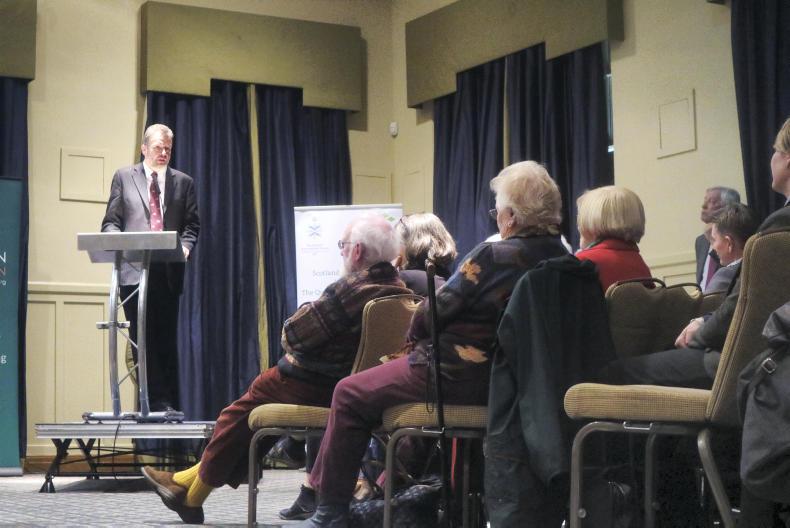
The Crichton Foundation hosted the first of their 2018 Crichton Conversations as Dominic Mellor spoke at Easterbrooke Hall in Dumfries at an event sponsored by the SRUC.
Dominic Mellor addresses the crowd gathered for the SRUC sponsored Crichton Conversation
ADVERTISEMENT
Despite public perception, anti-microbial resistance is not solely caused by overuse on farms, according to a study in the Royal Society Journal.
The study states that “animal population is unlikely to be the major source of resistance diversity for humans.”
Professor of Epidemiology and Veterinary Public Health at the University of Glasgow, Dominic Mellor was speaking at the Crichton Conversation event in Dumfries on Tuesday.
ADVERTISEMENT
He stated that while it was important that agriculture continued to play its part in protecting the efficacy of available antibiotics, it was not solely responsible for their increasing prevalence in human medicine.
Instead, there is a far greater likelihood of resistance transmission occurring from human to human and animal to animal rather than between the two.
Antibiotic resistance is not one-way traffic from animals to humans. Of all the resistant samples looked at in the study, the majority were unique to humans.
Register for free to read this story and our free stories.
This content is available to digital subscribers and loyalty code users only. Sign in to your account, use the code or subscribe to get unlimited access.
The reader loyalty code gives you full access to the site from when you enter it until the following Wednesday at 9pm. Find your unique code on the back page of Irish Country Living every week.
CODE ACCEPTED
You have full access to the site until next Wednesday at 9pm.
CODE NOT VALID
Please try again or contact support.
Despite public perception, anti-microbial resistance is not solely caused by overuse on farms, according to a study in the Royal Society Journal.
The study states that “animal population is unlikely to be the major source of resistance diversity for humans.”
Professor of Epidemiology and Veterinary Public Health at the University of Glasgow, Dominic Mellor was speaking at the Crichton Conversation event in Dumfries on Tuesday.
He stated that while it was important that agriculture continued to play its part in protecting the efficacy of available antibiotics, it was not solely responsible for their increasing prevalence in human medicine.
Instead, there is a far greater likelihood of resistance transmission occurring from human to human and animal to animal rather than between the two.
Antibiotic resistance is not one-way traffic from animals to humans. Of all the resistant samples looked at in the study, the majority were unique to humans.
If you would like to speak to a member of our team, please call us on 01-4199525.
Link sent to your email address
We have sent an email to your address. Please click on the link in this email to reset your password. If you can't find it in your inbox, please check your spam folder. If you can't find the email, please call us on 01-4199525.
ENTER YOUR LOYALTY CODE:
The reader loyalty code gives you full access to the site from when you enter it until the following Wednesday at 9pm. Find your unique code on the back page of Irish Country Living every week.






SHARING OPTIONS