



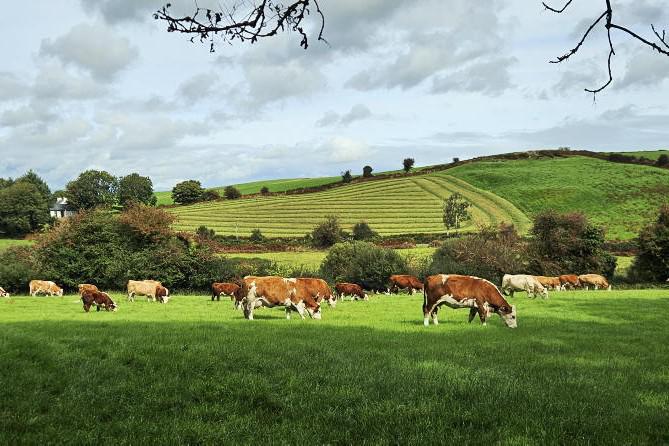
I don’t know whether it’s best to describe the weather of the last week as showers with sunny spells, or vice versa.
Fortunately, the last of the silage was wrapped up a few weeks ago. The yard went from dry to soaked and back to dry again within a short space of time, and this happened numerous times, daily, over the last week. Strong winds were a feature too, as they swirled September into gear.
While yards and roads dried out pretty quickly, the same can’t be said of land.
The cull cows and heifers returned from the out-farm the weekend before last and the intention was to leave the cows and calves there until early October. The weather didn’t care much for those intentions.
Last week’s rain changed that plan and over half of them are likely to be back home before this weekend is passed.
Scanning won’t take place on the cows for another few weeks, but the heifers were scanned a few weeks ago.
It was the first time in a long time trying out a synchronisation programme on them and I was happy with how it went, with a 74% in-calf rate.
Only one repeat held and one younger heifer who I chanced with the group was also in-calf.
The heavier of the empty heifers have gone on feed now and I’ll monitor their progress.
A decision on whether I’ll go that route for breeding them that way again will be reserved until they are calved.
If I was to do it next spring, based on this year, I’d be slower to serve repeats in the heifers, but that’s only because any cows with issues have largely been weeded out of the system by now so I can afford to be tougher on the heifers.
Getting them into the yard for AI proved easier than expected, so that negated that concern I had. The fact there was no bull with them was a positive in a number of ways.
There wasn’t the awkwardness of trying to take him from the group and decide where to put him.
An associated bonus is knowing when the heifers will be finished calving too.
Even accounting for the one that did repeat, all heifers should have calved by St Patrick’s Day, so they can stay together as a group.
To round out the benefits, it was another mouth less to feed and tied with that, it gave a bit of room for another animal when it came to the nitrates stocking rate too.
I’ll make a final call on what to do closer to next May, but it was worth trying it out anyway. Those heifers were weighed ahead of scanning and the good year showed in them.
I need to take a more in-depth look at the growth rates, as some were behind on an average daily gain basis. There could be a worm issue there, so they will be treated accordingly.
My few dairy-beef calves threw up a surprise too, with rumen fluke showing up in the faecal egg counts.
They had been grazing drier fields for the most part and I thought it was down to the dairy breeding that some were a little behind in weights compared to others.
Thinking a bit harder about it, I remembered one of the paddocks they grazed borders a drain.
Some of the ground on the field side of it is always soft and may be the root of the problem.
A targeted treatment on them has turned them around in a short space of time.



SHARING OPTIONS