



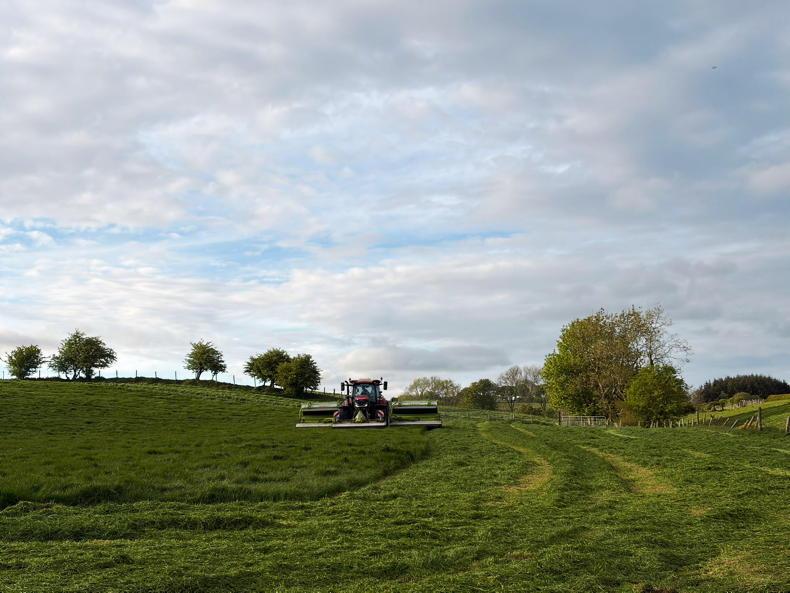
At the time of writing on Monday, first-cut silage is now mowed and we are aiming to have it all in the pit by Tuesday, with the hope of getting it covered on Wednesday.
Originally, I had planned to leave cutting until the weekend or possibly the start of next week, but with the current dry spell I decided to make the most of the weather and get the majority of the first cut harvested in dry conditions while the opportunity was there.
We still have another 25 acres of first cut to go in, although that ground will likely not be ready for at least another fortnight.
Two of the fields that were reseeded last autumn had initially been earmarked for silage, but have been grazed instead.
A significant amount of scutch grass had headed and I wanted to get that cleaned out early. Grazing will also help to thicken the sward.
The wet winter left considerable tracking damage in both reseeds, with clay washed into the corners of fields in places. Both fields need rolling, although I am unsure whether that alone will be enough to fully correct the damage caused over the winter.
Heifers
We finally managed to get our heifers turned out last week following their second bluetongue vaccination.
They are now grazing at our out farm, although it will be quite a short grazing season there this year.
Typically, we only graze that ground until early September at the latest, as it is heavier, north-facing land and grass growth tends to tail off earlier in the autumn, if ground conditions do not beat us first.
A four-month grazing period is far from ideal, but after the difficult spring it is good to finally see stock outdoors. Hopefully warmer temperatures and a dry summer will allow us to make the most of the short grazing period.
At the out farm we also sprayed off a field in mid-April that had suffered significant grub damage.
The sward had not been reseeded for as long as I can remember, so we took it as a sign to sort the field.
Once again, we opted for discing rather than ploughing, as the heavier ground there seems to suit that system well. The reseeds we have established using discs so far have performed strongly.
Yields
The autumn-calving cows are currently milking well and averaging 34 litres per cow.
We are now two weeks into breeding spring calvers and cows are cycling well, with over 45 animals already inseminated.
Last year we introduced the stock bull after three weeks, but in hindsight there were still too many cows left for him to serve effectively.
This breeding season I intend to rely much more heavily on artificial insemination (AI) in the hope of tightening the calving pattern and finishing calving by the end of March.
Once calving drifts into April, I find both cows and calves can struggle.
Calves often do not thrive to the same extent, while later-calving cows also have less time between calving and the start of the next breeding season.
We plan to scan in five weeks’ time, which should give a clearer indication of conception rates in the first three weeks of breeding.
While milk yields from the spring-calving cows initially responded well when cows went to grass, production has unfortunately slipped back again and they are not milking as strongly as would normally be expected at this stage of the year.
I suspect this may be linked to the difficult spring grazing conditions. It possibly took too long before cows got properly settled at grass, while poor graze-outs during the first rotation may also have reduced grass quality in the second rotation. We are currently taking maintenance plus 16 litres of grass.
I won’t push to take any more milk off grass for the time being as I’m worried it might negatively affect both milk yields and conception rates.


SHARING OPTIONS