



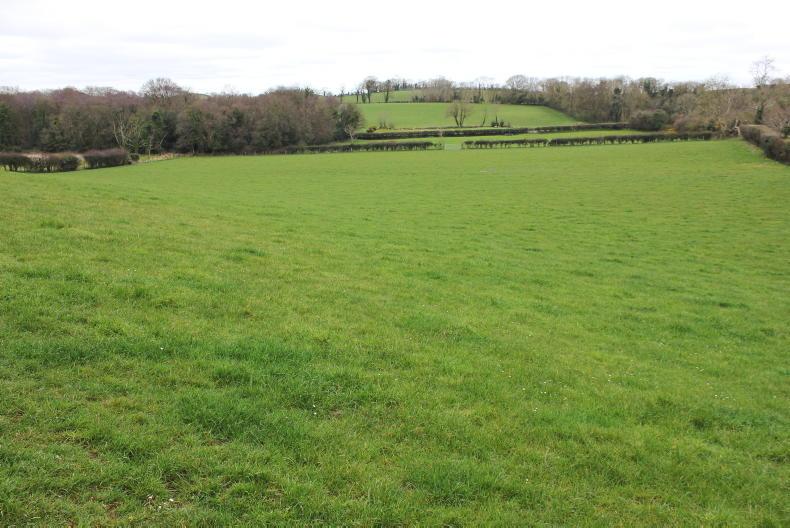
Luckily, I am not in any way cynical, bureaucratically suspicious, or tending toward taking a jaundiced view of the world: but some people are, and they might raise a sceptical eyebrow at some of my soil test results from the Soil Nutrient Health Scheme (SNHS).
Indeed, if they were wanting to create a bit of mischief, they might well wonder aloud at the convenience of wanting a reduction in applied phosphorus, and a tendency for fields to throw up results that indicate excessively high levels.
That could be the take-home message from the first batch of fields tested on my home farm.
As someone who has regularly tested land for the last 40 years, you do tend to build up an overall picture of soil health.
Back in the 1980s if a new piece of conacre was taken on, then typically it needed at the very least 2t per acre of lime (and often far more). In addition, if silage or hay had been removed then phosphorus (P) and potassium (K) indices were usually zero.
Back then (although we didn’t know or appreciate it) these products were cheap as chips and we were told that all that stuff was mined somewhere behind the Iron Curtain and shipped to us for half nothing because people there needed the money. How things have changed.
Picture
Trawling back through results, the picture that emerges on this farm is that in a grassland situation, pH drops very slowly and probably 1t per acre every 10 years would maintain the status quo.
With the application of farmyard manure, slurry, and poultry litter, P levels tend to be quite high, and this is easily retained at an index of 3. Potash is a different animal altogether, and I quickly learned that a two-cut silage system was equivalent to turning on the tap and quickly draining the field of all K reserves. Frequent applications of muriate of potash in the autumn have addressed that issue.
Home farm
So far, I only have results for 10 fields from the home farm. This area was sampled before Christmas. However, the rented farm was just done at the end of March.
When I first heard about the scheme, I thought it was an enormous undertaking, and wondered how many years it would take to complete. My guess is that some of the organisers are wondering just how much of a bigger job this has turned out to be than first anticipated?
Perhaps the rest of my farmed area will tie in with previous decades of testing, but some of the land close to the yard is throwing up far higher figures (especially for P) than ever before.
I have had the occasional index of 4 for one or two fields, but a couple on this latest list have jumped from index 3 to index 5. In over 40 years of soil sampling, I have never even seen an index 5 – I thought you only got results like that if you sampled a lump of dung.
Opposite
What I was expecting was quite the opposite: I reckoned that a stranger was more likely to include those wet corners, boggy bits, and poor looking areas which could skew the results slightly in a downward fashion.
However, pH levels are tying in broadly with what I had expected, and so far just a couple of fields have slipped below 6.0. K figures are also pleasingly high, but this may be thanks to my concerted efforts with heavy applications of bagged potash to address the problem.
Forefathers
A recurring thought that persists is what our forefathers would have made of this new system.
I come from a background where a farmer was frequently judged on how they looked after their farmed land.
If they sold off manure, didn’t apply lime, and farmed ‘poor’ land, then they were viewed in a negative manner by peers and neighbours.
Conversely, a farmer who was renowned for having ‘fat’ land was held in equally high esteem and could walk tall within the community. I can’t help wondering how they would have reacted to this soil scheme. My guess is that some of them will be turning in their graves.




SHARING OPTIONS